Mount Nittany Conservancy

  • Joy of Christmas Spirits

    Today, it is not unusual to enter a bar and find a laundry list of exotic beers on tap or to hear news of a local brew pub or microbrewery opening up. Such was not the case in 1984 (only five years after the legalization of homebrewing) when the editor of the Centre Daily Times approached local lawyer Ben Novak about writing a bi-weekly beer column for the paper. The following excerpt appears in The Birth of the Craft Brew Revolution published by Nittany Valley Press, which collects those columns, the very first of their kind in the United States, and makes them available for the first time since their original publication. They harken back to a time when only a small American subculture had discovered the endless, delicious possibilities of good beer.

    By Ben Novak

    There are some folks who say that Christmas is not what Christmas once was.

    In the ancient days, a story was once passed through England that a savior had been born to redeem this dull and work filled world. We do not know whether all who heard believed the story. But we do know that just about everyone who heard it believed the very story itself to be a sufficient cause for joy and celebration.

    Thus it is recorded that Christmas was “celebrated from early ages with feasting and hearty, boisterous merriment.” To raise up the lowest spirits to the joy of the occasion in the bleakest month of winter, special Christmas ales were brewed. The joy of the Christmas story and the warmth of a Christmas ale were welcomed at every Yule-time hearth. The poet Marmion caught the spirit in his verse:

    England was merry England then,
    Old Christmas brought his sports again
    ‘Twas Christmas broaches the mightiest ale
    ‘Twas Christmas told the merriest tale
    A Christmas gambol oft would cheer
    A poor man’s hearth through half the year.

    The Wassail Bowl is best known to be associated with Christmas cheer. In ancient times the chief ingredients of Wassail were strong beer, sugar, spices and roasted apples. The following is a recipe for Wassail served in 1732 at Jesus College, Oxford as transcribed by the venerable Bickerdyke:

    “Into the bowl is first placed half a pound of Lisbon sugar, on which is poured one pint of warm beer, a little nutmeg and ginger are then grated over the mixture, and four glasses of sherry and five pints of beer are added to it. It is then stirred, sweetened to taste and allowed to stand covered for two to three hours. Three or four slices of thin toast are then floated on the creaming mixture, and the Wassail bowl is ready.” In another recipe this mixture is made hot, but boil boiling, and is poured over roasted apples laid in the bowl.

    Such a recipe must have been the inspiration for the following old carol which celebrates our theme:

    Come help us to raise
    Loud songs to the praise
    Of good old England’s pleasures
    To the Christmas cheer
    And the foaming Beer
    And the buttery’s solid treasures.

    Merry olde England did not become merry on lagered beer nor even on the standard ales of today. Special holiday beers and Christmas ales were deep and manly draughts. So do not attempt to try the recipe above with Miller, Bud, or even Twelve Horse. To revive the Wassail and the joy of Christmas past, the ancient ales and beers must be rediscovered.

    In the 19th century and up until Prohibition most of the 1500 breweries of America annually produced special Christmas and holiday ales and beers. The 14 years of Prohibition not only wiped out half of America’s breweries, but also all but one or two of its holiday brews.

    Special Christmas Brews

    The times, however are catching up to the past. The brewing of Christmas ales and beers is once again spreading across the land. In 1974, the Anchor Brewing Company introduced the first new Christmas Ale in America since 1939. Every year since then Anchor has brewed a new and different Christmas Ale to cheer the hearts of San Franciscans. Nearer to home, the Fred Koch Brewery of Dankirk, NY brews a delighted “Holiday Beer.” It is lighter than many Christmas ales, but deeper and fuller bodied than ordinary ales. This Holiday Beer is available at some Centre County distributors and restaurants.

    Not much farther away but not yet available in Pennsylvania in Newman’s Winter Ale, specially brewed for the holidays in Albany, NY.

    Special Christmas imported beers are available in most large cities. They include Noche Buena from Mexico, and Aass Jule ol (pronounced Arse Yule Ale) from Norway. Noche Buena is brewed by Austrian immigrants who modeled it after the holiday brews of Imperial Vienna. It has been described as one of the best examples of “Teutonic nostalgia” for the colorful beers of the 19th century. It is a dark brown malty brew with a great blend of imported hops. Aass Jule ol is not really an ale’ the word “ol” means beer in Norwegian. It has a dark, rich, malty flavor which seems to have the power to redeem the darkest day in December.

    Across the country, microbrewers and regional brewers have been bringing out special Christmas brews which are not widely distributed. In Minnesota, August Schell makes an amber beer with deep taste which it calls “Xmas Beer.” In Wisconsin, the Walter Brewing Co. of Eau Claire has been making a dark “Holiday Beer” since the 1880’s. Walters also continues to market another brand called “Lithia Christmas Beer.” In Colorado, the Boulder Brewing Co. began brewing a special Christmas Ale in 1979. It is a strong, dark ale flavored with fresh ginger root. Michael Lawrence, the brewmaster at Boulder, merrily informs us that “It is modeled after the mulled ales of 17th and 18th century England.

    The West Coast, however has the largest number of Christmas Ales. In addition to Anchor of San Francisco, the award winning Yakima Brewing Co. of Washington State makes an annual holiday mulled ale of honey and spices which is described as Wassail. It is “Grant’s Christmas Ale” which has a 6 percent to 7 percent alcohol content. Farther south the Sierra Nevada brewery of Chico makes “Celebration Ale” for the holidays. It has been described as a “classic winter ale in the English tradition.”

    Thus with the rediscovery in America of Christmas ales and holiday beers there is some small reason to hope that Christmas may once again be celebrated as Christmas once was. Just as on that first Christmas night the breath of the humblest stable animals warmed the crib of the child who came to bring joy to the world, so special Christmas ales and beers have traditionally been brewed to warm us to the joy of that blessed story.

    Ein Prosit der Gemutlichkeit!

  • New Life for the Old Willow

    Although it has long been commemorated with a campus historical marker, many modern Penn Staters do not know the story of Old Willow, the University’s oldest tradition. Two recent graduates, Brenden Dooley and Jordan Harris, hope that will soon change.

    By Jordan Harris

    The duty of summarizing the history of Penn State’s Old Willow was done masterfully by Ben Novak in his book “Is Penn State a Real University.” Old Willow, as recorded by Dr. Novak and on the new plaque installed last month to honor it, was brought to the Farmers High School of Pennsylvania by Evan Pugh upon his arrival as the school’s first President. As was common association, the tree symbolized a gesture of birth and hope for the newborn institution and was thus treated with necessary reverence by its students. Freshman, as the new plaque remembers, would literally bow before it signifying their appreciation for Penn State’s oldest living tradition.

    A combination of bad fortunes destroyed Evan Pugh’s Old Willow. Equally bad fortunes subsequently doomed the original willow’s off-shoot and despite yet another, a third-generation willow, being prominently planted in the shadow of Old Main, the lore and tradition of the once beloved tree faded away. Brenden Dooley and I agreed that the time to recapture the lore and tradition of Old Willow is right now. Dr. Novak’s book brilliantly reminded us of the role that Old Willow played in Penn State’s past. The willow should play an equally central role in Penn State’s future.

    Our inaugural step to recovery was to propose that Penn State’s current Old Willow be designated status as a Heritage Tree. The designation is given to individual trees holding “exceptional historical, cultural, and/or aesthetic value” to the university. Along with this status, comes an information plaque in front of the willow and a promise by the university to take all reasonable measures to forever preserve the tree. Thanks to the efforts of many, this step is now complete. The next step, cementing Old Willow’s place in Penn State’s future, is now up to all of us.

    Legend has it, that Pugh trimmed the sapping of Old Willow from the garden of English poet Alexander Pope. In Pope’s poetic interpretation of The Odyssey of Homer, what could be confused as an ode to Old Willow‘s future is included:

    Like leaves on trees the race of man is found — Now green in youth, now withering on the ground; Another race the following spring supplies: They fall successive, and successive rise. –Alexander Pope (The Iliad of Homer)

    Pope may just as well have been talking about the ever-changing nature of our university. A university exists in a constant state of evolution and rebirth. Each fall a new generation arrives at Penn State with a fresh vision of what “Penn State” is, and what it should become. This fall will be no different in this fact while holding one unique distinction. The class of 2018 will, in possession of its own fresh vision, arrive with the university’s 18th President carrying a fresh new vision of his own. What better time for Old Willow and its meaning to reclaim center stage as an important Penn State symbol? What better time for Penn State freshman to once again bow before it, perhaps literally, but at least in spirit and ask “where will we take our great university?” There will be no better time.

    The rest of us are not exempt from these questions, especially now. It is no secret that as a university community we are emerging from the most challenging time in our history, and one of the most difficult situations in the history of higher education. A referendum lies with us to be open and encouraging to new visions and new directions and to embrace a new kind of rebirth. No Penn State tradition is better able to capture that referendum and provide us with hope than Old Willow.

    Brenden and I hope, and would certainly prefer, that no one think of us when they see the Old Willow Memorial Plaque, nor suspect that they will. We hope instead that the plaque and the status as a Heritage Tree means that countless generations will be able to look at the Willow remembering what the tree has always stood for and where it can inspire us collectively to go. Old Willow can, and will, inspire us today in our most challenging times, to continue the progression of our great university. The inspiration that stems from it places the burden squarely with us.

  • Ben Novak Receives ‘Friend of the Mountain’ Award at Mount Nittany Night

    Ben Novak Receives ‘Friend of the Mountain’ Award at Mount Nittany Night

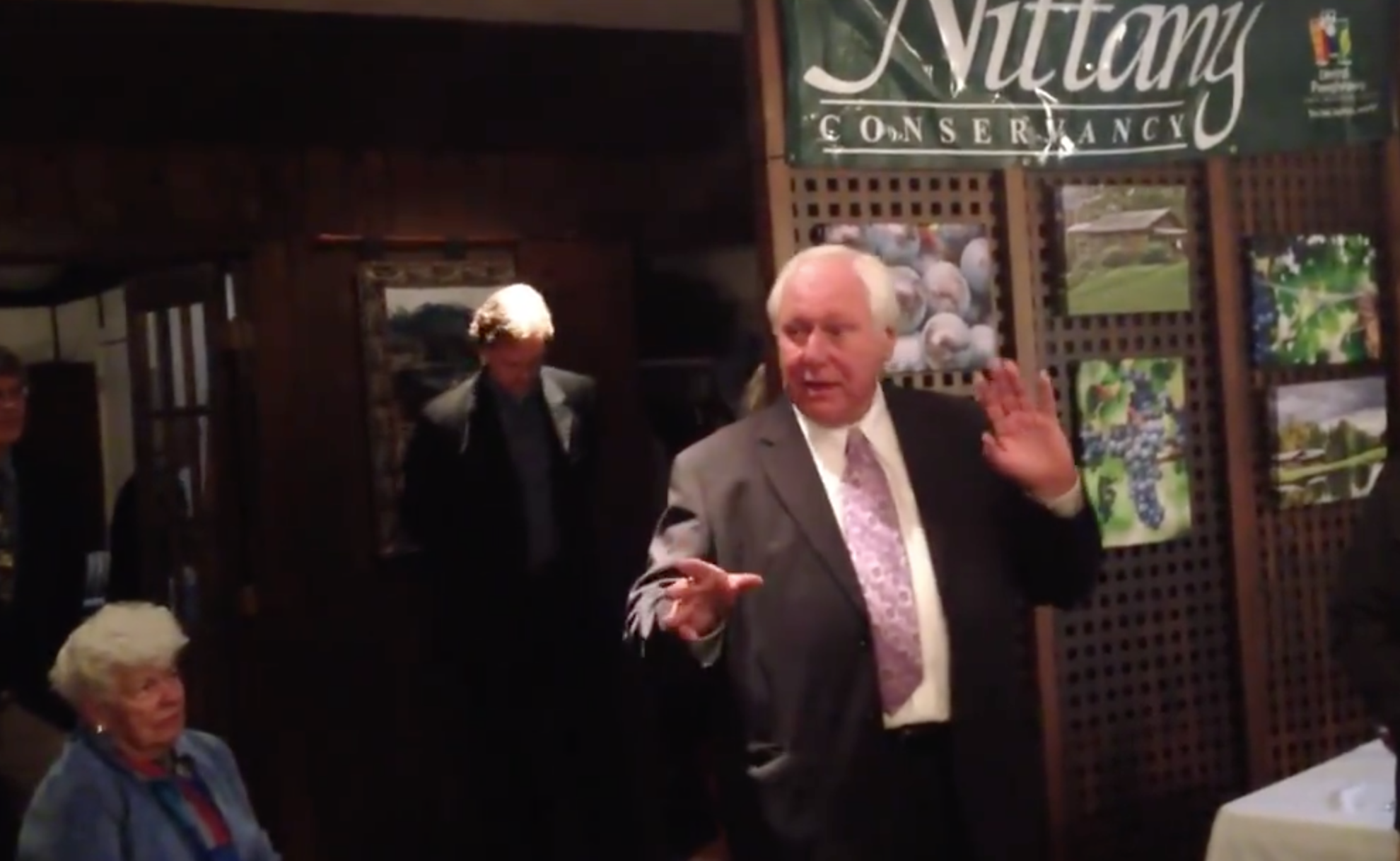
    Ben Novak, founder and first president of the Mount Nittany Conservancy, was recognized with the “Friend of the Mountain” Award at Mount Nittany Night on April 4, 2014 by MNC board member Jeff Dietrich. Tom Shakely filmed Jeff Dietrich’s remarks and Ben Novak’s short address:

    Jeff Dietrich, MNC board member:

    No one can properly recall the long tale of Mount Nittany without uttering the name of Ben Novak. Ben has lived the Penn State experience to the fullest. He was student body president, assistant dean of students, president of the Lion’s Paw Alumni Association, and a University trustee. But perhaps the most significant and lasting Happy Valley legacy of this U.S. Army Bronze Star recipient is his love and tireless dedication to Mount Nittany’s beauty, and for telling her story.

    During the 1980s, when the moment of opportunity came to purchase hundreds of acres of the Mountain’s most visible land, Ben was equipped with both a vision and the passion that led to the formation of the Mount Nittany Conservancy, and the nearly miraculous feat in the early 1980s of raising about $120,000 in little more than a year. Indeed, it was thanks to Ben’s critical negotiations with landowner and previous “Friend of the Mountain” recipient Wilhelm Koggelman, that the Mount Nittany Conservancy and its supporters were able to seize that moment. As Ben tells the story, since the Mount Nittany Conservancy was still just a dream during the negotiations, the deal was done on a handshake between Ben and Willy. During the adventure, Ben played a central role not only in organizing and directing the group’s fundraising efforts, but also appealing personally to the State College community and wider Penn State alumni groups. Having himself been enchanted by the inherent “magic of the Mountain,” Ben recognized that the path of necessity ending in donor’s pocketbooks, led through the heart and imagination. He made time to speak directly to every school classroom, civic organization, campus group, and alumni function to share the legend of the Mountain and Princess Nittany for the Mountain that bears her name.

    Ben had to be a bit of a rebel to do this. As he has said, and I quote, “I started this when nobody believed we could raise the money. I went against the leadership of my organization in Lion’s Paw, the University administration, and many people in the town who thought it was a fool’s errand. I was banking completely on the emotional attachment of alumni, students, and townspeople to preserve the sacred of the Mountain in its natural state. I bet everything on that, and it came through.”

    Ben continues to tell the story of the Mountain today, and so we are very pleased this evening to honor Ben Novak, who so richly deserved to be called “Friend of the Mountain.”

  • Old Willow and the Heritage Tree Endowment

    Onward State broke the news that the Senior Class of 2014 Gift Committee has released its three options for seniors to choose from for their class’s permanent visible symbol on Penn State’s campus.

    Of the three options, one is called the “Heritage Tree Endowment” and relates to Old Willow, one of Penn State’s earliest symbols and something that Nittany Valley Press popularizes through its book, “Is Penn State a Real University?: An Investigation of the University as a Living Ideal.” Here’s how the Senior Class Gift Committee describes the Heritage Tree Endowment:

    This gift “will preserve the beauty and unique character of the University Park campus through the creation of an endowment to protect trees that have special historical, cultural or aesthetic value and are designated as Penn State Heritage Trees. The University would recognize the gift by transplanting on to campus a fourth-generation descendant of ‘Old Willow,’ a landmark tree planted soon after Penn State admitted its first class of students in 1859, by Professor of Horticulture William G. Waring. Members of the senior class of 2014 could enjoy watching this tree grow as they return to campus again and again throughout their lives, while the endowment provides permanent funds to protect and nurture the University’s Heritage Trees.”

    In “Is Penn State a Real University,” author Ben Novak writes about the origin of Old Willow in the chapter “Old Willow, Monarch of the Campus.” It seems only appropriate to excerpt a bit of that here, to provide even more context for why the Heritage Tree Endowment is such an innovative, sustainable, and yet culturally meaningful concept:

    In the 18th and 19th centuries many new institutions were founded. One of the ways people chose to show their faith in them was by planting a tree at the time of the founding. It was a symbol of faith that the new tree, like the new institution, would outlive its founders. At the time of the American Revolution, for example, Liberty Trees were planted in town squares up and down the land to signify faith in the vigor and permanence of the new nation.

    Penn State also had a tree that symbolized the faith of her founders. When Dr. Evan Pugh was invited to become Penn State’s first president, he was still living in England conducting research. Once on a visit to the estate of the poet Alexander Pope, Dr. Pugh took a cutting from one of the willows at Pope’s villa at Twickenham. He remembered this cutting as he was packing to leave for his new post at Penn State, and decided he would bring this scion with him as his special tree to plant on the campus of the new college. It was also said that he wished to transplant “a bit of England on our pioneer campus.”

    When he brought his tree and his idea to William G. Waring, former principal of the Bellefonte Academy and Penn State’s newly-appointed first superintendent of grounds, there was instant enthusiasm. Dr. Pugh and Dr. Waring scouted the area to pick the most suitable spot for the tree. They chose to plant it at the main entrance to the college. At that time Allen Street ran through campus, and the Mall was a fenced driveway. The entrance to the college was at a point where a path veered over to Old Main. President Pugh’s willow was planted beside the gate and stile. A sidewalk still veers off from the Mall at that point.

    The Old Willow at the gate was well deserving of the faith that had been placed in it. It grew to be a magnificent tree. Dr. Runkle, the College Librarian, wrote of it, “no one who saw it and loved it in its prime will ever forget its beauty and majesty.” It became the focal point of the campus.

    The gate where it was located was the place of many fondly remembered comings and goings, and many a campus meeting was held under its branches. As a result, it became one of the best remembered symbols of early Penn State.

  • The Student Contributions to Penn State

    The Mount Nittany Conservancy’s “Ben Novak Fellowship” provides Penn Staters and Nittany Valley residents an opportunity to encounter the Nittany Valley’s legendary spirit through cultural and environmental experiences meant to enhance appreciation for our distinctive community and encourage friendships for the future. The Mount Nittany Conservancy’s Ben Novak Archives are intended to help new generations encounter the Ben Novak Fellowship’s namesake.

    Ben Novak, founder of the Mount Nittany Conservancy, delivered the following speech in his capacity as a Penn State Trustee to the Board of Trustees at its November 1989 meeting:

    Chairman Huck, President Jordan, President Althaus, President Martin, Representative Donaldson, Chairwoman Atwood, Members of the Board:

    The subject I am addressing today is students. Everybody likes stories. So sit back and relax, and let me tell one of the greatest stories of the spirit of Penn State and what it has meant to the greatness of this University. It is a story rarely told, and so for most of you will be new. It is a wonderful story of how much the students of this University have contributed to most of the things we feel are really great about Penn State over the past 130 years. For the student body, acting on its own, independently, usually without administrative or Trustee support, has played a vital role in Penn State’s growth which is without parallel by almost any other portion of the university community.

    Our story begins with a dream, the dream of our Founder and first President, Evan Pugh. When Evan Pugh arrived at the Farmer’s High School to take up his duties as President in 1859, he found little to excite the imagination. He found a building under construction, and a few students who came to learn the practical aspects of agriculture and the mechanic arts. It was a high school, and barely that; little more than a vocational trade school for farmers. But Evan Pugh had a dream that Penn State was to be more, much more than that. In his mind’s eye he saw the great University that was to be. “I would create a noble institution,” he said, “such as Yale or Harvard or Princeton.”

    But how was such a dream to be even begun, let alone realized? Evan Pugh turned to the students. Penn State would have to be more than a vocational trades school. Evan Pugh had told the students that “the only regret of his entire childhood” he later wrote, had been “those two years wasted in learning a trade.” So he inspired them to make the Farmer’s High School more than a trade school and to make themselves more than just tradesmen, but to become men of character. And in the fall of 1859, the students raised $250 and began to make the school a real College. They formed the Washington and the Cresson Literary Societies. Without faculty, budget, position or status, the students began to mold Penn State into the University it was to become. These societies created their own reading room, and built up libraries that Wayland Dunaway recounts, rivaled the College Library. In 1896 funds were made available to create chairs of language, literature, history and philosophy, and the College began to provide the Liberal Arts education our land grant charter had called for. But for 37 years, the students had done it largely on their own, creating the spirit of a real University before we were even a college.

    These student societies created the first printed publications ever published at Penn State. In 1873 and 1874 they brought out the Cresson Annual and the Photosphere. These were completely created and funded by the students themselves. Indeed, in the earliest issue the editors reported that their journal was not only “the latest thing out,” but that the editors were also “out, out of pocket.”

    The journals continued until 1887 when these two Societies formed a Joint Committee to bring out a regular college newspaper called the Free Lance. The Free Lance, as you know, was the forerunner of the Daily Collegian. Just two years ago, the Collegian celebrated its 100th Anniversary, remembering the founding by students, on their own, of what became Penn State’s award winning daily newspaper.

    But creating the forerunners of the College of Liberal Arts, and the Daily Collegian were not the only things that students created on their own.

    The 1890s are recorded in the official history books as the years of great growth for Penn State. In the late 1880s under the dynamic leadership of President George W. Atherton, funds became available for new buildings and an expansion of the campus which would enable the college to increase in size by almost one thousand per cent in the next few decades.

    But that period of growth was also a time of crisis for Penn State. The plans for the college called for growth, but there were no funds for dormitories. The town had not grown enough to provide for an influx of that many students. If the college were to grow, where were the students to be housed?

    The College once more looked to student initiative. In 1887 the ban on Fraternities and secret societies was lifted. Students were allowed to organize themselves independently. The results were spectacular. In the next 20 years, the students built 38 dormitories on the campus and downtown, in the form of Fraternities. The student body grew from 287 in 1887 to about 2,500 in that period, with about three quarters of these new students living in entirely student created housing.

    In effect, once freed of administrative oversight and intervention, students built an average of almost two dormitories a year from 1888 to 1918. They did this without administration support, without a Dean of Students to do it for them, and without government funding. They did it on their own. And they made those Fraternity houses the most beautiful buildings and architecture in the entire Borough.

    Without students providing this housing on their own, our campus could not have grown. There was no General State Authority then. There were only the local banks and local mortgage financing. But Penn State students were able to bond themselves together, in such strong bonds of loyalty, that the Penn State Alumni News reported in the 1920s that banks considered these student fraternities to be the safest investment in the United States.

    Football today we like to think of as one of the most important parts of Penn State life. It, too, was begun entirely by students, without help from faculty, administration or the Board of Trustees. Intercollegiate football games were originally organized entirely by students, beginning in about 1882, with the first “regular season” in 1887. This was set up without any administrative support, without coaches, and little but student initiative. Indeed, it is recorded in the history books that,

    “…prior to 1894 the student body frequently raised and discussed the question; why do not the Faculty and Alumni take more interest in athletics?”

    Indeed, the early athletic programs at Penn State were entirely funded by the students themselves. Dean Erwin Runkle reported:

    “Games are financed by subscription; by contributions from the players themselves; by a series of lectures and entertainments…”

    From the earliest, intercollegiate games, until 1891, there was no paid coach, until in that year the student body petitioned for one, and voted to add one dollar to their student activities fee on their tuition bill to fund a “Chair of Physical Culture,” so that they could have a coach.

    It was student initiative, student self-sacrifice, and student creativity which created both our football team and our College of Physical Education. They raised their own tuition, taxed themselves, and initiated the whole sports program at Penn State, by themselves.

    Student initiative also created our college spirit and traditions. In 1907 a few students anonymously brought out a monthly publication, called The Lemon. In it, the students ribbed the Professors and other students, and argued strenuously for a school flag, school mascot, school colors. They raised school spirit and the student body adopted the Nittany Lion as our mascot, blue and white as our school colors, the official class ring, and the school songs we still sing at Football games.

    The editors of The Lemon also had a magnificent sense of humor. Shortly after starting The Lemon, another anonymous publication appeared, called The Squeeze, which lampooned and ridiculed everything which The Lemon advocated. The campus came alive through the dueling of The Lemon and The Squeeze for almost two years. It was only after the students who brought out The Lemon graduated that the campus learned that both journals had been brought out by the same group of students!

    You can easily guess that these two journals were also the genesis for The Froth, Penn State’s longtime student humor journal.

    In the 1940s came new challenges to students. After World War II Penn State grew like “Topsy” in order to meet the needs of thousands of returning veterans on the GI Bill. The Administration grew, and soon took over almost all of Old Main. The student offices and club rooms and meeting rooms were removed. The students were given a small temporary building, called the TUB, to serve the needs of 5,000 students. That same building we know today as the Robeson Cultural Center.

    This time the students needed help. They petitioned the Board of Trustees for a student bookstore and commissary and a student union building. All were denied. The Board had funds for everything except students. But, rather than demonstrating or protesting, the students once again showed that magnificent Penn State spirit which had served the College so long and so well. It was the Penn State student “can do” spirit which said, “Okay, we’ll do it on our own.”

    And they did. They created their own student bookstore and book exchange, the forerunner of the huge Penn State Bookstore today. That bookstore was entirely run and managed by students from 1949 until the late 1960s. I particularly remember this because from 1962 to 1964 I spent many long hours and late nights serving on its student board of control.

    The students not only created a store, they also built the HUB, their own student union building, by themselves. They devised a two part plan. First, a student insurance program with funds from premiums going into a student union fund. And, second, in a wonderful show of student spirit and self-sacrifice, the student leaders of the All-College Cabinet met in 121 Sparks in May of 1950, and once again voted to raise their own tuition.

    At that time, and since the 1890s, when the $1 was added to the start the football team, the tuition bill had two parts; regular tuition, and a student activities fee set by, and distributed by, students themselves.

    It was this student activities fee portion of the bill that they increased. Now that increase in 1950 was much larger, percentagewise, than the 10 per cent increase in tuition which this Board voted just two years ago. But the students, at that time, gladly voted to increase their tuition because they knew the College needed a student union.

    What was most impressive was a rather startling fact. The students who voted to increase their tuition in 1950 knew that they themselves would never get to use the facility that they were paying for. The HUB did not open until 1955, five years after all the students who voted for it had graduated. But they had a belief in Penn State, and a willingness to sacrifice for Penn State, and they gladly voted to increase their own tuition for the Penn State that was to be.

    It is an interesting footnote that after the HUB was built, the fee was never rescinded. In a deft move, the administration incorporated the enlarged student activities fee into the general budget and announced they would appropriate money for student activities from the general fund. Thus, at a single stroke, the student vehicle to creativity, which had created the football team, the forerunner of the College of Physical Education, and had built the HUB, was removed. And, it seems, the students are still paying for the HUB 39 years later.

    But through it all, Penn State grew in depth and stature, in tradition and in size, largely made possible, when the going got tough, by looking to student initiative to create for Penn State what was needed.

    Many of you enjoy the Central Pennsylvania Festival of the Arts every year. Today the festival attracts about 300,000 visitors to State College each year, and is one of the top summer attractions of both Penn State and the town.

    But the Arts Festival, too, was initiated by students in the early 1960s. It was begun by students of the HUB Committee and run for several years as the “Spring Arts Festival,” a very successful student celebration of the Arts.

    I fondly remember the student arts festivals very well, because in 1964 I was “pinned” to the beautiful chairwoman of the Festival (who, back in those days was still called a “Chairman”) and presented her with a lovely bouquet of red roses at the Festival Finale.

    In 1966 the Spring Arts Festival was taken over by State College and the University and made the Central Pennsylvania Festival of the Arts. It is no win its 23rd successful year and many of us have annually attended it. But its beginning arose from the genius, initiative, creativity and hard work of students.

    There are many more stories about the contributions which students, when they have been given the chance, have been able to make toward the greatness and growth of Penn State. Both in times of crisis and in times of great growth, they have provided the spirit and concrete contributions which have impelled Penn State along its present path of greatness.

    When we look around the campus, from Rec Hall to Old Main, from the Nittany Lion to the Hetzel Union Building, from the College of Physical Education to the College of Liberal Arts, from the campus to the more than 50 beautiful buildings of the Fraternity District. We see the contributions of student creativity, innovation, self-sacrifice and constructiveness.

    What is the moral of the story I have told? It is this;

    Penn State is a living body, and the student body is an important organ of that body. And just like your own body, when one organ is not functioning well—whether it be the heart, lungs or liver or brain—the entire body ceases to function well. I believe that the student body is an organ of Penn State which is as important to the health of the whole, and has as much to contribute, as the faculty, the administration, the Board of Trustees, the staff, and the alumni.

    Students are not customers, nor commodities, nor resources to be managed. The student body is a vital organ of the University which has contributed much to Penn State’s growth and greatness in the past, and has an even greater contribution to make in the future. All they need is your respect and a chance to show what they can do in the future, on their own.

    I have a dream. I see a day when the TK sports part of the student body at Penn State, in independent, constructive endeavors, in adventures of the mind and spirit, in publications and organizations, can engage and enlist the enthusiasm and involvement of our alumni just as much as the football team. And I see the student body, working with townspeople and alumni, making Penn State and the Nittany Valley—and all our Commonwealth campuses—the most intellectually exciting, morally stimulating and mentally alive campuses of all the colleges and Universities in America. I would like this to be our dream.

    The key to unlocking that creativity is what it has always been: independence—the same key that unlocked the greatness of America in 1776. When students are free of red-tape and bureaucracy, whenever they are let go to organize themselves and encouraged to work creatively with townspeople and alumni; they have done nothing but bring glory, pride and honor to Penn State, and contribute to the greatness of our University.

    And so I ask you, remember the students. They are our reason for being. They are our pride. They are the source of our spirit. They are our past and they are our future. They earn the honors. They win the football games. They are what we exist for. Without the students, no matter what else we do, we would not be able to call ourselves a University.

  • The Initiation: A Parable of the Mifflin Streak

    The following poetry was provided to the Mount Nittany Conservancy in the 1990s by a Penn State who wished to remain anonymous. It is presented here as an ode to a Penn State tradition of many years.


    I have often climbed Mount Nittany and spent afternoons and sometimes all night gazing at the valley and the campus. In my mind I would wander, trying to find a deeper meaning in the commonplace things which are often dismissed as unimportant. One day I was sitting on Mount Nittany thinking of what had happened last spring at the “Mifflin Streak.” That was when the idea of this poem came to me.

    The poem is not set on campus, but begins at the foot of a mountain as an initiation ceremony. The poem would seem to have no connection to the Mifflin Streak, except in the wandering mind of a poet.

    The initiation described has no counterpart in fact except that I freely admit to borrowing from newspaper accounts of initiations at other colleges at other times.

    These verses were not written to be skimmed with the eyes, but to be read aloud, several times, moving the lips, giving a chance for the rhythm to be physically felt and for the images to take sensual form. The goal is not to convey information, nor to make a point, but to break through the crust of everyday experience. For poetry is, in its best sense, our deepest longings taking form in our imagination, bringing our senses into congruence with the deepest felt experiences of our civilization.

    The Initiation

    I. 

    Assembled under ancient trees
    On paths once strode by Indian Braves
    Initiates of a noble order
    Waking spirits from their graves.

    Eyes enfolded in a kerchief
    Cannot see to walk or stand
    Up the Mountain blindly climbing
    Hand on shoulder, hand in hand.

    Footsteps groping through the forest
    Feeling for each stone and leaf
    Crossing logs and brooks and gullies
    Hearing whispered ancient beliefs.

    Trusting blindly to tradition
    To those who walked where they now tread
    Beating hearts must trust in friendship
    To someday lead where they’re now led.

    Past the ledge where ancient fires
    Warmed the hunters, cooked their kill
    Spirits of brave men long ago
    Still take away the dark night’s chill.

    II.

    At a pool of deep still water
    Guides remove the kerchief blind
    The young boys stare at stars reflected
    In the pool and in their minds.

    At the spring they taste the water
    Which anoints them deep inside
    Makes them part of past primeval
    Awakening what they thought had died.

    Now it lives! And they’re the vessels
    Bodies with new lives to wear
    Dreams unfolding, visions rising
    From depths they did not know were there.

    They sense within them spirits moving
    They hear old cries of victory
    They feel the deaths — and births — of heroes
    And lose their fear of agony.

    III.

    Then on they walk in wonder waiting
    Each mind reeling, then at peace
    Blindly following ever upward
    Led to unknown mysteries.

    Walking through the forest primeval
    Under vaults of ancient trees
    ‘Til they feel they’re in an opening
    Their blinds removed so they can see.

    In the clearing men stand naked
    Sons of fathers, sons of sons
    Leaping flames and blazing fires
    Beckon to the chosen ones.

    Light illumines awe-struck faces
    Unexpected shock appears
    Dismay, concern at what will happen
    ‘Til the voices calm their fears:

    “You do not live in just this moment
    Others before you faced it, too
    You will stand here naked next year
    Feeling the fear we felt from you.

    “The nakedness you see before you
    Is not for you to touch or feel
    Pleasure is not what man was made for
    Higher goals will be your seal.

    “For the beauty of the gods in heaven
    Is not their flesh, it’s not their youth
    That’s only the visage of their spirit
    To be a man is to seek the truth.

    “But truth’s alarming, truth’s unsettling
    Truth does frighten, truth is spurned
    That’s the reason for this baring
    This the lesson to be learned:

    “Never fear the naked body
    Never fear the naked soul
    Never avoid the naked truth
    And never reject the naked role.

    “Never fear humiliation
    Don’t fear suffering, pain or tears
    The mark of a man is never flinching
    The only thing to fear — is fear.

    “If you have courage and heart and honor
    You’ll stand naked before all men
    You’ll follow your heart where ere it leads you
    Into the flames or the lion’s den.

    “So learn this lesson, learn it well, boys,
    On this our brotherhood depends:
    Having guts is all that matters
    When that is lost, our brotherhood ends.”

    This is how the bond is fashioned
    Naked truth becomes a trust
    Fear transformed by faithful listening
    Words can now break through the crust.

    IV.

    The men now dress in sacred clothing
    Cloaks of honor, caps of care
    Naked truth, a source of loathing
    Now is something they can bear.

    Now they circle round the camp fire
    Each one sits to form a ring
    Then the elders rise to face them
    Each in turn to speak and sing.

    Now are told the ancient stories
    Here the secrets are revealed
    Now the spirit’s incarnated
    Here the fellowship is sealed.

    Then silence. The fire dies to embers
    And in the dark, stars reappear
    The men in cloaks resume their journey
    Young men follow without fear.

    V.

    As they walk they see the stars are
    Growing closer, step by step,
    The earth recedes, the ground grows farther
    They’d enter heaven if they leapt.

    They walk until they reach the summit
    Of the sacred Mount they climb
    Here occurs the last experience
    Which must break the bonds of time.

    For time corrupts and time effaces
    Time’s the enemy of man
    Unless it’s formed in timeless places
    A bond can shift like shifting sand.

    When they reach the highest point
    Where the Mountain touches sky
    Here each man beholds his brother
    Stares him sternly in the eye.

    Hands reach out to pluck the stars
    And place them where his brother sees
    From this night on his brother’s eyes
    Will be his mark of loyalty.

    When stars replace the eyes they glisten
    Streams of diamonds flood the face
    Stars are the eyes of gods and angels
    The beauty seen by the oldest race.

    Nothing can efface this moment
    Can’t erase this time or place
    Each man sees within his brother
    The starry eyes of all the race.

    At that moment every man
    Who has ever lived or ever died
    Is still alive and sees them seeing
    And gazes right back through their eyes.

    Then the gaze is quickly broken
    Resurgent time has healed the breach
    Timelessness has no duration
    The stars are once more out of reach.

    VI.

    In silence they begin descending
    And wonder if they’ve dreamed it all
    ‘Til tears they see on their brothers’ cheeks
    In the light of stars like diamonds fall.

    Now they know the sacred meaning
    Understand why time was breached
    Their eyes now see down through the ages
    Farther than they’ve ever reached.

    The ancient wisdom’s been transmitted
    As it’s always been from age to age
    The light of the world is in their eyes
    As was foretold by the ancient sage.

    VII.

    They’ll never talk of what has happened
    Never say what they have seen
    But they’re now men of deeper courage
    Deeper strength and deeper dreams.

    And each evening they remember
    The time they climbed that Mountain top,
    Recall the naked truth they learned there
    And the time when time was made to stop.

    Something happens on that Mountain
    Something to do with faith and stars
    It’s easy to know just who’s been up there
    Look for the men whose eyes see far:

    Naked truth becomes their passion
    And they seek stars most men don’t seek
    And timeless eyes watch o’er their sons
    And diamonds glisten on their cheeks.

    Epilogue
    An Imaginary Student’s Response

    “And if this hasn’t happened to us
    Why has it not? I’d like to know
    The stars in the sky seem far away
    Where di the men of courage go?

    “Let’s climb that Mountain, pluck the stars
    Two for your eyes, two for mine
    Brothers and guts we know we need
    We’ve got to stretch the bonds of time.

    “We’ll learn the secrets on our own
    Like all such things, they’re plain to see
    We’ll search the wisdom in old books
    Until we’ve found the ancient key.

    “Such a quest is worth all efforts
    Nothing else will suit my eyes
    Until I find the men of courage
    And see the watchers in the skies.

    “And if you won’t go, I’ll go alone
    I’ve got to overcome my fear
    Damn it! There is more to life
    Than textbooks, classes, parties, beer.”

  • Mount Nittany: A Symbol of Eternity

    “This morning, as I do most Saturdays, I went and visited my dad. His grave is on a hillside and you can see Mount Nittany. Mount Nittany to me is a symbol of eternity. It’s there, it was there before any of us, and will be there long after us.”

    Jay Paterno
    Penn State IFC/Panhellenic Dance Marathon
    2013

  • The End of Ideology

    The Mount Nittany Conservancy’s “Ben Novak Fellowship” provides Penn Staters and Nittany Valley residents an opportunity to encounter the Nittany Valley’s legendary spirit through cultural and environmental experiences meant to enhance appreciation for our distinctive community and encourage friendships for the future. The Mount Nittany Conservancy’s Ben Novak Archives are intended to help new generations encounter the Ben Novak Fellowship’s namesake.

    In 1962 Daniel Bell published a book called The End of Ideology, whose major premise was that the age of great men, great beliefs, and great worlds was over. Science had solved all the ancient questions and all that was left was the fine tuning of what we already know to make a society of plenty for all mankind. After all, men only cared about food and comfort, and modern science could fulfill those needs. Every man was to take his place as consumer and producer to fill our appetites. That was all there was, and all that there could be. Ben Novak, a Penn State sophomore in 1962, rebelled against this idea. He recorded his odyssey in a poem.


    The End of Ideology

    A semi-autobiographical intellectual odyssey

    I.

    The end of ideology
    It came in ’62 for me,
    A man named Bell had said, you see,
    That everything had come to be.

    He went on to elaborate:
    All that’s new had all been done.
    He set the world before us straight:
    Its victories had all been won.

    His world stole destiny and fate
    By saying no one could be great.
    No heroes, prophets, saints or kings
    His world denied there were such things.

    I could not stand this world of Bell,
    I thought it was a living hell,
    There is no meaning, he had said,
    Produce, consume, and then you’re dead.

    It he were right and I were wrong
    I thought about that hard and long
    I tried his world for all it’s worth
    Confirmed my belief it cancelled birth.

    There had to be ideals out there,
    Ideas to form us into men
    There had to be new dreams to share
    And faiths we could conceive again.

    II.

    So I resolved I had to leave
    This world I could no longer believe
    But where to go? They’d left no place
    Where one could run a decent race.

    I searched the heavens to escape
    Then searched the slime and found a snake.
    “Learn good,” it said, “and evil, too,
    The way out is inside of you.”

    I drank myself and spit me out
    I swam in sewers and waterfalls
    I fought for what life was about
    Then heard the faintly whispering calls:

    The calls said words conveyed no truth
    Nor did acts, except in youth
    Then men grow old and silence speaks
    (Deeds disappear when words are weak).

    But deeds live on when they are told
    In stories to young men by old
    Then old dreams take on flesh again
    And out of boys are made new men.

    When the young have visions and old men dream
    The world’s made new and the heavens gleam
    Then time is defeated once again:
    The future is now, and now was then.

    And this is the message the gods will send
    When you make up your mind to become a man:
    If you want to succeed in the world in the end
    Then you had to be there when it all began.

    So seize the future that’s here today
    The present’s but feelings which pass away
    But the future is only the stories told
    In the dreams of men before they’re old.

    So seek ye out this deeper truth
    And do deeds greater than have been done
    And build a temple to your youth
    And tell the stories to your sons.

    III.

    The old gods then began to seem
    Much wiser than I thought they’d been.
    I walked away from today’s ideas
    And set my course for the ancient seas.

    I liked the gods who came with me
    Some fought my lusts, some made me free
    One turned life into wine to drink
    Another taught me how to think.

    I’ve had to give up quite a lot
    They’ve taken everything I’ve got
    I followed wherever the gods decreed
    They let me have no other need.

    So here I am, I try to say,
    To worlds a world or more away
    I scratch across this time and space
    I will have been — you saw my face.

    IV.

    And what I’ve learned about my task
    I’ll share with you, if you but ask:
    This world goes on, forgets us all,
    Unless we pass along the call.