Evan & Rebecca Pugh

  • In Search of Evan Pugh, or, a Challenge for Penn Staters to Honor Their Founder

    In Search of Evan Pugh, or, a Challenge for Penn Staters to Honor Their Founder

    Three Penn State presidents have been laid to rest here in Centre County.

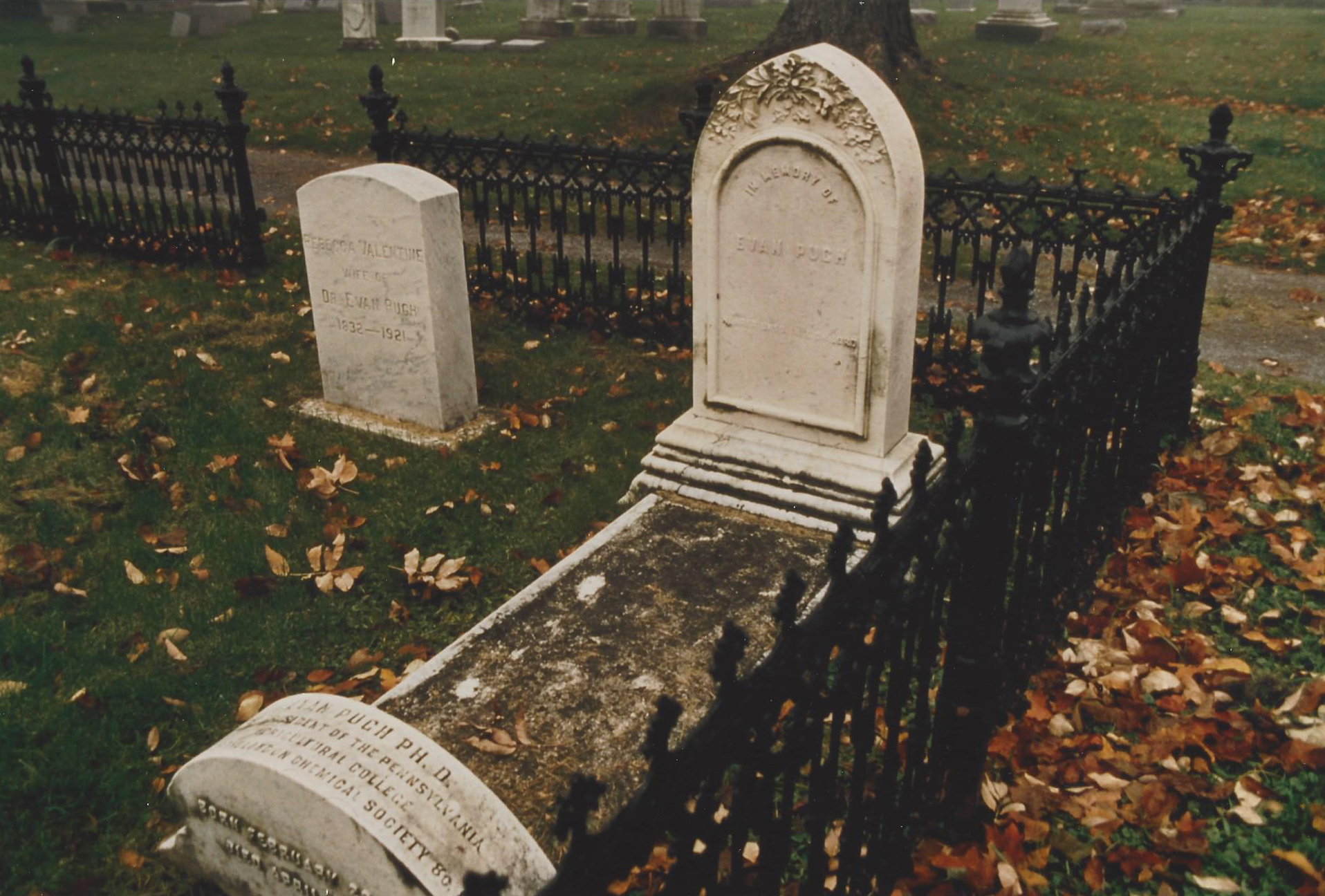
    President Atherton is famously interred right along Pollock Road adjacent to Schwab Auditorium, while Milton Eisenhower finds his final repose in Centre County Memorial Park along the Benner Pike. Evan Pugh, Penn State’s founding president and one of the most consequential personalities in the Valley’s history, whiles away eternity just a short journey from the flowering campus whose humble seeds he planted. He is memorialized as a scholar, scientist, and leader at his gravesite in Bellefonte’s Union Cemetery.

    Soon after his arrival here, Pugh began courting, and eventually married, Rebecca Valentine, daughter of one of Bellefonte’s most important families. He is buried alongside her in the family plot. Once a hub of power and influence throughout the commonwealth, attractor of wealth and exporter of governors, modern Bellefonte retains much of its historic character, but only a fraction of its practical significance. So it is with the gravesite of its once-famous socialites. In their time, Pugh and Valentine were the Nittany Valley’s original power couple; now their place of honor lies in silent neglect. The community that inherited their legacy bustles on ahead, its founder largely forgotten.

    The first president of Penn State deserves better.

    Over its 160 years, Old State has weathered wild turbulence blowing in from the wider world—civil war and world war, social revolution and heart-breaking scandal—more than once it has teetered on the brink of extinction, yet always it has persevered. Pugh deserves to be remembered as the progenitor of that hardy nature, our penchant for defiant survival.

    While barely remembered or recognized today, Pugh is the perfect central character for Penn State’s origin story. Erwin Runkle, the University’s first historian, painted him as possessing “a rugged, energetic physique, a straight-forward common sense manner, combined with the heart of a child, and the integrity and moral robustness of mature manhood.” A bull-necked he-man built to tame the wild, but with a keen, inquisitive mind better suited to conquering a more esoteric landscape.

    When he assumed the presidency of a fledgling agricultural college situated in what, to most, seemed like the middle of nowhere, but Pugh called “splendid isolation,” the entire notion of bringing the baser study of agriculture and industry to the hallowed enterprise of higher education was itself a risky proposition. Only through Pugh’s dogged leadership and dedication to a revolutionary vision for American education did the Farmers High School find its footing, and though he tragically died young, so impactful was his short time that its influence echoes through the ages.

    The man deserves a statue or memorial on campus. As things stand today, we’ve failed even to honor his memory by caring for his burial place. Seemingly abandoned by the family line, the Valentine plot has fallen into disrepair over the decades. The tombstones have become grimy and covered in lichen; the landscaping, such as it is, overgrown and unkempt, and the once-ornate wrought iron fence enclosing it crumbles. Intermittent efforts have been made throughout the years to rectify this neglect, for which former trustee George Henning deserves a great deal of the credit. However, none of these has been long sustained.

    A challenge exists for those Penn Staters willing to take it up: systematically repairing the aesthetics of Evan and Rebecca’s resting site. While the simplest tasks—bagging leaves, cutting grass, washing off the grave stones—are accomplished easily enough, the issues of repairing the fencing and routinizing the maintenance will be heavier lifts. The work will be rewarding, and if the Penn State Alumni Association and others work together, the work could come to serve as one the most powerful public witnesses to the depth of respect and honor that Penn Staters have for their founders.

    The journey of exploring Pugh’s back story has revealed much that might not be expected: Finding an original handwritten copy of Rebecca Valentine’s will at Bellefonte’s Pennsylvania Room, encountering the Bog Turtle Brewery in Pugh’s hometown of Oxford, PA and their limited run of Evan Pugh Vanilla Porter, discovering a forgotten memorial marker placed by the University on family lands still inhabited by Pugh’s distant descendants.

    We can take pride in restoring some luster to the memory of our Penn State family’s “first couple,” and we enjoy the pleasant surprises along the way.

    Why all the fuss? If, today, so few people venture out to honor Evan Pugh’s memory that his grave has fallen into disrepair in the first place, why bother with some long-dead historical figure whom it seems most people can’t be bothered to remember?

    Because whether you are an individual or a community, knowing your story—and honoring its heroes—builds confidence and strength. There is an intrinsic quality to humbling ourselves by acknowledging our place within a community and its continuum, a process that is best experienced with sacred retreats where this reverence may be felt most keenly.

    Roger Williams, former Penn State Alumni Association executive director and author an upcoming Evan Pugh biography, has called him, “Penn State’s George Washington.” That seems someone worth remembering, even if by only a few.

  • Bog Turtle Brewery’s ‘Evan Pugh Vanilla Porter’

    Bog Turtle Brewery’s ‘Evan Pugh Vanilla Porter’

    Penn State’s first president Evan Pugh was born in 1828 at Jordan Bank Farm, three miles south of the city center of Oxford, Pennsylvania, an hour west of Philadelphia, in Chester County. One-hundred eighty-nine years later, an Oxford brewery is honoring one of the preeminent champions of public higher education in the form of a delicious porter.

    Bog Turtle Brewery, located right off the main street in downtown Oxford, started serving Evan Pugh Vanilla Porter in early November. It’s a true local operation — the brewery, which is just more than a year old, services several local bars and is open itself for a few hours five days a week for growler fills only (Growlers, for the uninitiated, are glass jugs you fill with beer to take home. There is no on-site consumption). The beer itself is a mild, light bodied porter, perfect for the winter months.

    Bog Turtle’s decision to name a beer after Pugh happened in a completely random way. According to Chris Davis, the Bog Turtle’s financial guru, the brewery is located in what used to be municipal offices for the Oxford Sewer Authority. In one of the closets, the brewers found the Pennsylvania Historical Marker for Evan Pugh — previously posted near Jordan Bank High School — which had been damaged by a snowplow and removed some years before. It was this chance discovery that inspired the group to name its seventh-ever beer after one of the most important figures in Penn State history.

    The vanilla porter isn’t the only reminder of Pugh in his hometown. Drive three miles south of Bog Turtle, deep into Pennsylvania farmland and adjacent to a Mennonite Church, and you’ll run into another subtle reminder of Oxford’s most important former resident. Jordan Bank Farm still exists, and two houses still inhabited by the Pugh family sit on the 56-acre plot on Media Road. A seldom-seen marker placed up against the roadway 50 years ago by Penn State and the local historical society marks the spot where Pugh was born.

    Oxford is one of those magical, increasingly rare Pennsylvania towns that allows us to go back in time, even if just for a short visit, unimpeded by the distilled culture creeping into most places today (you won’t find a Target in downtown Oxford, for instance). If you’re ever in the area — it’s just a short detour on the way to State College from Philadelphia — take the opportunity to have a pint of a good beer and experience the world for a few moments like Evan Pugh did before he took on the responsibility as the founding president of the Farmer’s High School.

    The Evan Pugh Vanilla Porter is not the first beer paying homage to an important Penn State figure brewed in recent years, but it is definitively the best tasting.

  • Our Founders Were Real

    Evan Pugh was Penn State’s first president.

    It’s great if you happen to know of Evan Pugh. In fact, it’s likely that knowing about him already puts you in the minority among students and alumni. But just knowing this bit of raw information isn’t worth much in and of itself. It’s available to anyone curious enough to wonder and with access to Wikipedia. Why care?

    As Penn Staters, we’ll be celebrating Founder’s Day on February 22. It’s a special time on the calendar set aside to honor and remember the men and women who built Dear Old State. Today, we often act as if Penn State’s prestige flows from its numbers—the number of students enrolled globally, the number of living alumni, the number of academic colleges and majors, etc. Evan Pugh’s Penn State wasn’t defined by staggering numbers, but rather by people, as Erwin Runkle’s first official history of the University records:

    “Despite the [Civil] war, the school grew in numbers; 142 were enrolled in 1863, and 146 in 1864. Thirty-eight to forty counties of the State were represented. Two graduate students appeared in 1862, and in the following year, the number reached eleven.”

    Our founder wasn’t the overseer of a vast corporate institute, but of a startup—so to speak—focused on a few dozen individuals. As president, Evan Pugh’s job was to know the particularities of student life—their family situation, their political loyalties during a time of conflict, their educational pursuits, their ambitions and skills. How many administrators, even in Penn State’s Office of Student Affairs, have similarly intimate human knowledge about our current students?

    Today, what feels like a small army of faculty and staff are required to manage the modern Penn State. At its beginning, however, the school required an individual of extraordinary vision and singular purpose to chart its destiny.

    And Evan Pugh himself was a remarkable man. Born on February 28, 1828 in Chester County, Pennsylvania, his father was a farmer-blacksmith. But his father died when he was only 12 years old, and he was raised by his grandfather. In time, young Evan hungered for knowledge and wisdom rather than money, which led him to eschew the inheritance of his father’s farm. Instead, he went off to study at some of the finest universities in England, France, and Germany. His research earned him membership in the Royal Society of Science and the American Philosophical Society. His achievements burnished his reputation as a man of character that led to his invitation to the founding presidency of a young, experimental “Farmer’s High School” that in time would become the Penn State of history.

    Indeed, Evan Pugh’s vision and devotion to the early Penn State was remarkable in its own time, but perhaps is even more remarkable in our own. Perhaps best exemplified by the carousel of football coaches since 2011, we seem to be exiting an era when one arrived in the Nittany Valley to make Penn State their life, not simply their job. Pugh, a man whose ability and professional qualifications meant he could choose his own career path, gave himself fully over to the fledgling cause of Penn State, internalizing the dream of higher education for the commoner in the “splendid isolation” of this place. He writes to Professor Wilson, Penn State’s Vice President, on September 18, 1863:

    “I am resolved to stay with our College, while God gives me strength to perform my duties there, whatever may be the pecuniary inducements or prospects of honor elsewhere. It is my duty and my destiny to do so, and I shall seek honors in the path of duty and of destiny…”

    But Evan Pugh didn’t build Penn State’s early foundations alone. He was joined by Rebecca Valentine, the Bellefonte native who captured his imagination from the time he first arrived to live in Mount Nittany’s shadow. Runkle doesn’t record nearly enough about the woman who is easily the most fascinating among our founders:

    Evan Pugh met Rebecca Valentine on a trip to Bellefonte in 1861, while on a visit to an iron master to compare methods of smelting iron. Their love grew over the course of a three-year engagement that began almost immediately after they met, and they were married on February 4, 1864. As a native of Central Pennsylvania, Rebecca was distinct in speaking for the Nittany Valley’s soul and character to a man who grew up outside of Philadelphia and earned his doctorate in Germany. But as significant as Evan’s devotion to Penn State was in its first, formative years, and as much love as Evan and Rebecca shared during their courtship, their marriage was short-lived. Evan took ill and passed away at 36, only months after they wed. Runkle records:

    “Mrs. Pugh, a woman of culture, refinement, and of rare sweetness and purity of soul, kept faithful tryst of the poignant romance so ruthlessly shattered until her own death on July 7, 1921—fifty-seven years of widowed, worshipful, romantic devotion.” At the time of founder Evan Pugh’s death, J.B. Lakes of Rothamstead Station, England, wrote to Rebecca: “I felt certain that if he lived he would be the founder of a great college.”

    Though they could not have known it at the time, Evan Pugh was, in fact, the founder of a great college, among the greatest and most resilient ever known. However briefly the bold, bright beacon of his influence flashed across the firmament of our Valley, such was its potency that traces linger even today. This Founder’s Day, every Penn Stater who comes to know the story of Evan and Rebecca Pugh should celebrate this man and woman in a special way.

    In 2015, Penn State published this short video on the enduring love shared by Evan and Rebecca:

  • A Penn State Love Story: Evan and Rebecca Valentine Pugh

    In The Legends of the Nittany Valley, a unique and fun mythology emerges for the places in and around Penn State, but our community also has its own real-life fairy tale: The story of the tragically short-lived love between Rebecca Valentine and Evan Pugh, the University’s founding president.

    Pugh is a truly remarkable figure. If it’s true that the strength and character of any institution are rooted in its founding, then an understanding of Evan Pugh can explain Penn State’s astonishing resilience over the last three years. His audacious vision for the school that would become the Pennsylvania State University, and the vigor with which he pursued it, are great stories of themselves. Equally captivating is the account of his courtship of Bellefonte’s Rebecca Valentine, a lasting love that not even death could conquer. Pugh died young, not long after marrying Rebecca, but she never took another husband, remaining forever faithful to the love of her life.

    I was excited to see the University release this video yesterday, summarizing the story of Evan and Rebecca in a format that can bring it to the Penn State family. It was especially satisfying to hear several quotes from Erwin Runkle, the first Penn State historian. In 2013, Nittany Valley Press released The Pennsylvania State College 1853-1932: Interpretation and Record, a never-published history of the school written by Runkle in the 1930s. As a contemporary of many key figures in Penn State’s early years, Runkle offers invaluable perspective on the people and events that shaped Old State in a formative era. His affection and story-teller’s instincts for the Penn State story come through in his quotes here.

    Watch the the short video, and learn about the tragic, but touching love story at the heart of Penn State’s origins.