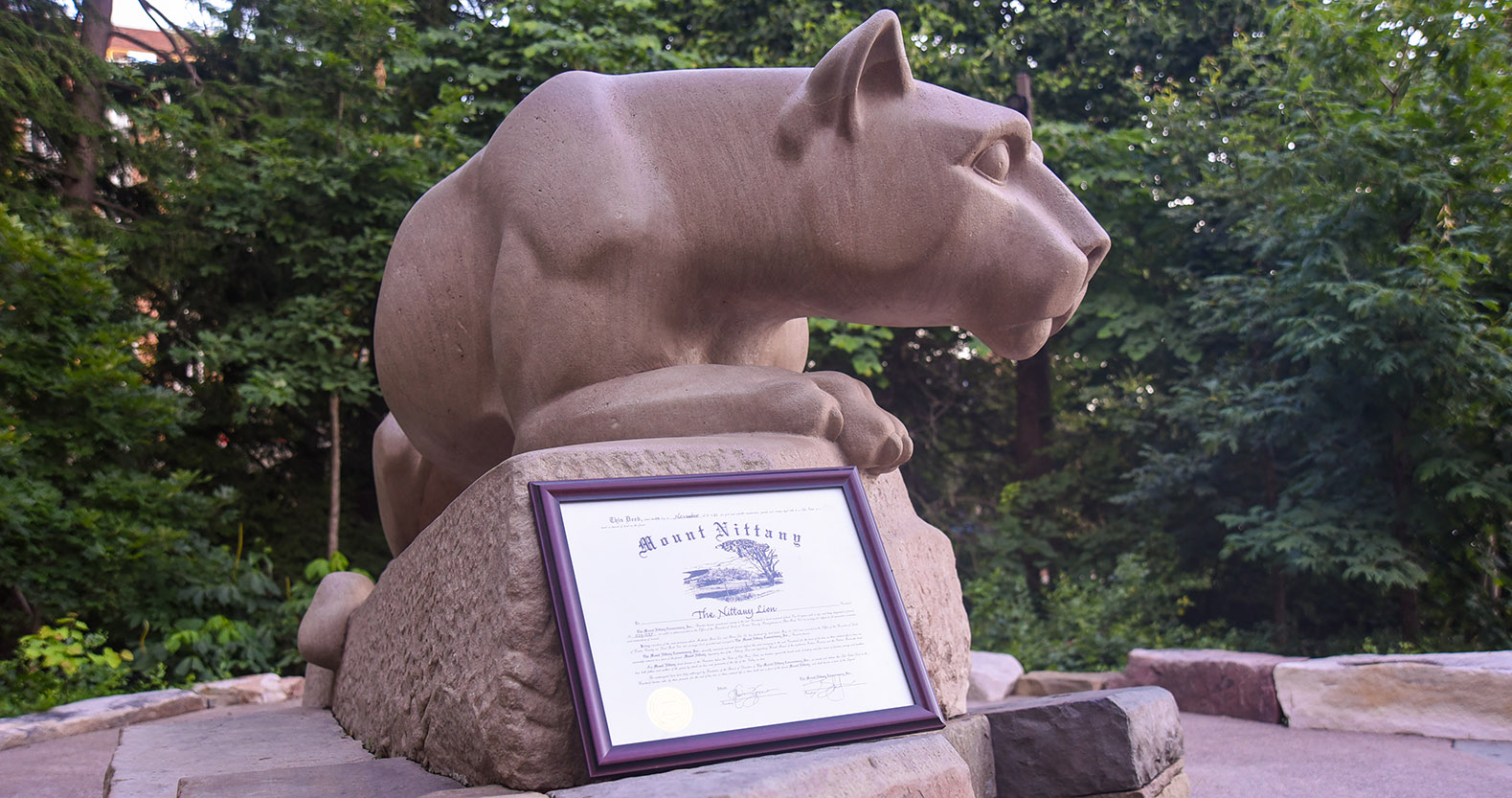
Roughly 14 years ago, Penn State unveiled the enhanced pedestal and landscaping for the Nittany Lion Shrine funded by the Class Gift of 2012. Stonework for the Lion’s new “perch” was provided by local master craftsman Phil Hawk, and the delicate project was managed by campus landscape architect Derek Kalp, whom the Mount Nittany Conservancy is lucky to have serving on our board of directors. The entire process was chronicled in detail in the article linked below. Derek is quoted extensively, explaining the meticulous care taken in refreshing the home of Pennsylvania’s second-most-photographed landmark (behind the Liberty Bell in Philadelphia).
As Derek Kalp and his colleagues in Penn State’s Office of Physical Plant pondered the future of the Nittany Lion shrine, the most important thing to them was that it have a setting worthy of its stature.
Seventy years, thousands of visitors, and frequent repairs had brought the University’s beloved shrine to a point where extensive changes were desperately needed to ensure its continued beauty and accessibility.
Kalp, landscape architect, and his coworkers in Campus Planning and Design considered that challenge for the better part of three years — until the University’s Class of 2012 stepped up and made a gift to improve the existing shrine and its surroundings.
The Penn State Alumni Association commissioned a short documentary film that chronicles Hawk’s work creating the Shrine’s new stone pedestal. It’s worth a watch and is sure to warm any heart that loves the name of Dear Old State. Check it out…
The Penn State News article linked above includes three additional vignettes further expanding on the Lion Shrine’s restoration. Those are embedded here for the enjoyment and convenience of our readers.
Lemont Pennsylvania inhabitant and master stone mason, Phil Hawk has worked on long list of projects, applying his talents to create waterfalls, unique decks and facades. His work is remarkable. If you have ever been to Beaver Stadium at the corner of Porter Road and Park Avenue and noticed the the beautiful Penn State sign shrouded in stone, you can begin to appreciate his work. He was contracted to refurbish probably the most iconic landmark in the minds and hearts of all Penn Staters– the Nittany Lion Shrine. Listen and watch as Hawk explains his approach to redressing this beloved Penn State landmark. Credit: C Roy Parker.
While physical plant landscape architect, Derek Kalp was overseeing the Lion Shrine remodel, crews came upon an abundance of white chips scattered at the base of the statue. Discover what those chips were as Derek Kalp explains.
Many have seen it. Austere. Stoic. Those words and others have been used to describe the Nittany Lion Shrine. If you’re a PSU graduate, you should have a picture or two of you and the Lion in an album or a hard drive somewhere, but most are taken in the daytime. When university officials placed the initial lighting around the landmark, security may have been the overriding concern– not aesthetics. See how physical plant utilized the on-campus expertise of a lighting design expert from the School of Theatre to recreate the shrine area. Credit: C Roy Parker.
This article first appeared in the September 2014 issue of Town&Gown magazine, which was dedicated to women’s athletics at Penn State. It was also complemented by an online companion piece. Both are a product of their time, anticipating the as-yet unrealized transformation that would reshape college sports over the decade that followed.
When Title IX of the Education Amendments of 1972 became law, prohibiting gender discrimination within “any education program or activity receiving federal financial assistance,” university athletic departments across the country suddenly faced important decisions. The defining choices made at Penn State form one of the school’s great, yet largely unappreciated, success stories.
Some 40 years earlier, State’s librarian and first historian, Erwin Runkle, noted that though “always in the general stream of college life, Penn State has nevertheless had a ‘way of her own.’” Amidst national confusion and backlash in the wake of Title IX’s passage, PSU held true to his words.
In the minds of many sports fans, “Title IX” conjures vague notions of a law designed to promote women’s sports that also forced a bunch of schools to close down their wrestling programs. Closer examination reveals a much more complex web of good intentions, misguided interpretations, and a lot of political maneuvering in the ample space between them. Just one aspect of a broader educational reform package characterizing the equality movement of the time, Title IX, which makes no explicit mention of athletics, aimed to codify the expectation of equal access for women in education. The extent to which compliance eventually resulted in reduced opportunities for male athletes at many institutions speaks more to their own priorities, and lack of foresight perhaps, than the merits of the law itself.
When it became clear the new law would have massive implications for the burgeoning big business of college sports, the nation’s universities had arrived at a crossroads: Adapt, or resist; embrace the spirit, or do legal battle over the letter, of the law. For its part, the NCAA chose the latter, filing a 1976 court challenge on behalf of its member institutions, many of which chose to slow walk the implementation process while the case played out. Although this suit was dismissed, it marked the first of several, mostly fruitless, legal and legislative fights over Title IX’s enforcement. When neither Congress nor the courts delivered lasting relief, those schools that had long resisted the tides of change were all but forced to eliminate men’s sports as a matter of last resort. Penn State did things differently.
By the late 1960’s, the leaders at many colleges realized that the long-recognized potential of big-time sports to energize alumni donors and promote a brand image could be supercharged through mass media, compounding their substantial marketing value several times over. This sparked a steady migration of responsibility for athletics oversight within collegiate administration, away from academic deans and toward business-minded athletic departments. The trend came late to Happy Valley, and in 1972, athletics fell under the supervision of Bob Scannell, dean of the College of Health, Physical Education, and Recreation, hearkening back to a time when intercollegiate student competition, though far from immune to excess, was viewed as complementary to the educational mission of a university. This increasingly antiquated academic approach may help explain the University’s openness to offering opportunities for female athletes.
The accommodating attitude bore immediate fruit. Over the course of the decade, national media, including Sports Illustrated and ABC, would hold up Penn State as the face of a new era in women’s sports. TIME’s June 26, 1978 issue, which examined the impact of Title IX, featured a cover image of Lions lacrosse player Karen Pesto and quoted PSU’s Dr. Dorothy Harris, a pioneer in women’s sport psychology. Penn State produced three field hockey players who were selected for the 1980 and 1984 Olympic teams, among them Char Morett, who would go on to a decorated coaching career at PSU and enshrinement in the U.S. Field Hockey Hall of Fame. Barbara Doran, another varsity athlete and Title IX activist of the era, played on both the U.S. field hockey and lacrosse teams and would be elected to the University’s Board of Trustees in 2013.
None of this should suggest that the path forward was always smooth. In today’s climate, where coach of the Big Ten champion Lady Lions Coquese Washington appears alongside other pillars of the community on the Hiester Street Inspiration Mural, and where we honor Russ Rose’s six national titles in women’s volleyball alongside Joe Paterno’s legendary career in football at the Berkey Creamery, it becomes easy to forget that, even here at Penn State, the struggle for equality in women’s athletics was often exactly that.
“We Are a Strong, Articulate Voice: A History of Women at Penn State,” by Carol Sonenklar, records the tireless efforts required of field hockey and lacrosse coach Gillian Rattray and Sports Information director Mary Jo Haverbeck to achieve such elementary concessions as uniform logos and numbers. Their persistence, joined with the visionary leadership of many other women like Marty Adams, Della Durant, and Sue Scheetz, tells an uplifting tale. When faced with obstacles at critical junctures, Penn Staters consistently found the wisdom and initiative to surmount them.
That we today celebrate Penn State’s 14 women’s varsity sports reflects an inclusionary posture that is evident throughout the University’s history. Indeed, the first president, Evan Pugh, founded the school on what, at the time, was the audacious notion that serious study of agriculture and the mechanical arts belonged on equal footing with literature and the arts within the academy. In 1871, six years after Pugh’s untimely death, Penn State became the first institution of higher education in Pennsylvania to admit female students. A century later, the humble beginnings of The Farmers’ High School had yielded a thriving university where Pugh’s successors welcomed the promise of Title IX. Consciously or no, they inherited a legacy of the egalitarian impulse that animated the land-grant movement, and to their lasting credit, they rose to the occasion of upholding its values and expanding its scope.
If we are to embrace the notion of the Nittany Valley as a place apart, these connections are integral to that understanding. If there is, in fact, a certain spirit or magic to the place, it may be in its enduring capacity for attracting a special brand of people, its power to captivate the hearts and imaginations of those who will enrich and sustain it.
To discern a thread connecting 19th century educational pioneers like Pugh with the likes of Durant, Scannell, Scheetz and Haverbeck – understanding them as interrelated characters in one still-unfolding narrative – is to appreciate the slow, but steady taking root of a distinct “Penn State Way.” It has been discovered and proudly carried forward, and often reinvented along the way, by one generation after another. At a time of profound cultural change, one such group helped make Penn State a national standard bearer for an emerging social consciousness.
This history should spark pride in any heart that loves the name of Dear Old State. The story, however, continues.
Even as we now laud the landmark hiring of the institution’s first female athletic director, new challenges loom just over the horizon. Several high-profile court cases and greater autonomy for the so-called “Power Five” conferences could dramatically reshape the funding model of college sports. Such changes could very well align with the fast-approaching time when a prohibition against reduced support for PSU’s existing sports, part of the NCAA consent decree, will expire.
Penn State will inevitably face another moment for choosing. Remembering its story and reflecting on a proud tradition of making the choices that elevate opportunity and reinforce the very best of the student-athlete ideal can help us find the resolve to carry forward and renew a legacy of leadership.
Special thanks to Dr. Scott Kretchmar and Dr. Mark Dyreson for their time and input.
A little over a decade ago, I published an anthology of three times Penn State’s head football coach addressed the crowd at THON – Joe Paterno near the end of his career; Bill O’Brien during his short, but memorable stint in the role; and James Franklin, at the very beginning of his time in Happy Valley. With Matt Campbell, the 17th full-time coach of the Nittany Lions, making his debut at the Spring semester’s signature event this year, I thought it an appropriate time to revisit and update that compilation.
“I wish the whole world could see and feel what’s in this room right now. Love and commitment… in 58 years at Penn State, I’ve never been more proud than right now.” —Joe Paterno
In 2009, one of his final seasons on the sidelines, Joe Paterno famously spoke to an enthusiastic audience at the BJC, as seen in the video above. As the years pass, the name, image, and memory of Paterno seem increasingly remote, more and more like icons or totems, further separating us from the simpler reality of the flesh-and-blood creature. I still love this clip for the ways in which it distills and captures Joe the person, earnest and disarmed. Brief, but from the heart. It recalls a happier time and reminds us of the actual human being who undeniably gave copiously of himself to better the institution and his community.
“Just having arrived at Penn State, you don’t know anything about THON until you’re in the arena. It’s awesome… I have all the respect in the world for everything that you guys do.” —Bill O’Brien
THON 2012 was probably one of the most emotional weekends of a uniquely tumultuous year. Under siege from outside and bitterly divided within, the community rallied around THON and its irrefutable statement about who and what “We Are” and clung tightly to it, comforted by the reminder that no amount of venom could dilute all that good done each year in Penn State’s name. It was with this backdrop that new head football coach Bill O’Brien took the stage. Only two weeks into his tenure, O’Brien was tasked with establishing credibility with a hopeful, but unsteady and unsure (in some quarters, quite skeptical) Nittany Nation, beginning the process of injecting enthusiasm and drumming up support for his football program, comforting a reeling and grieving community, and paying proper respect to the event and its purpose. His success here was a sign of things to come.
O’Brien stayed for only a short time, but probably two of the most critical years in the history of the town and school. He is seen here passing one of his first (of many) tests, standing in the same spot as his legendary predecessor and praising the special qualities of Penn State in that direct and honest way that endeared him to so many of us so quickly.
“What makes us special is the people, the people that understand we are part of something greater than just ourselves. We can make a difference in people’s lives. We can make a difference in the community.” —James Franklin
If Bill O’Brien’s tenure represented the time of painful transition, the energy and optimism of James Franklin captured our hopes for a gradual return to normalcy, the true arrival of a new era. Few who stood in the Bryce Jordan Center back then, before even the steady rollback of NCAA sanctions had begun, could have imagined that Franklin’s team was less than two years away from a magical run to the Big Ten title. Names like Trace McSorley and Saquon Barkley were barely spoken, to say nothing of future icons like Sean Clifford, Micah Parsons, Tyler Warren, or Kaytron Allen. In over a decade at the helm of Penn State football, Franklin reinvigorated the program and helped lead the Nittany Lions back to national prominence. The mutual belief shared by coach and fandom that energized his inaugural THON appearance captures the very best of a stretch in Penn State football history that I hope will ultimately be remembered favorably.
“Everybody keeps talking about ‘the power of Penn State.’ And quite honestly, being here tonight, this is the power of Penn State. What I would tell each and every one of you, along your journey, the most powerful thing you can do is make a difference in the lives of others.”—Matt Campbell
Matt Campbell represents, in many respects, Penn State’s first “normal” head football coach hiring since 1966. He may not be the orator that his predecessor was, but in his straightforward delivery, there is an earnest authenticity that, early on, is resonating with Penn Staters. It has been fun to see him encountering the culture and spirit of the place as he and his staff acclimate to their new home. And yes, Coach, that “We Are” still needs some more work, but the longer you stay, the deeper the personal meaning – it will keep getting easier and more natural as you go.
As I said following Franklin’s debut back in 2014 and reiterate now, these moments with Campbell are just the latest in a long line that carry us ever further away from the living memory of Joe Paterno and that night in February 2009. Almost undeniably, time slows down in Happy Valley, but most assuredly, it never stops. The story continues. New pages are added and new chapters written. In looking back, we are reminded of our own resilience in the face of adversity and strengthened by that knowledge as we return our gazes forward, ready “for the future that we wait.”
A view circa 1930 to 1945 according to this post card, where Pollock Road would be:
These gardens were still there in 1980 but dorms had taken away the view by then. According to a quick search, the Joab L. Thomas building was finished in 1992. The gardens then went to Bigler and East Park. And then to the Arboretum when the Law building was added.
“Old Willow has a lot to do with our history,” Flynn told Penn State News. “Penn State’s land-grant mission was very integral to our founding. There was obviously a great emphasis on agriculture, rural practices, and then eventually the sciences and engineering. Legend has it that Evan Pugh, Penn State’s first president, got the first Old Willow from Alexander Pope’s garden, and as it came from a poet, it gave a nod to more of the liberal arts.”
Tom Shakely, author of Conserving Mount Nittany: A Dynamic Environmentalism and President of the Mount Nittany Conservancy, spoke to the Centre County Report in March 2021 on Old Willow as a symbol that is both legendary and true. After this spring’s planting of the fourth generation of Old Willow, Shakely offered further reflections on the tree’s role as a living symbol.
“Our affection for Old Willow springs from the same source as our love for Mount Nittany,” said Shakely. “We are motivated by the conservation of living symbols and landscapes. We recognize that environmental conservation is impossible apart from an underlying conservation of culture, of the lifeways of a people and place. True symbols point to those realities we know through experience.”
“When we see Mount Nittany, we know we are home. And when we visit Old Willow at the heart of Penn State’s campus, we recognize our place as receivers of a tremendous gift from generations past as well as trustees of a living symbol for generations yet to be.”
Derek Kalp, a Mount Nittany Conservancy board member, is also playing a significant role in Old Willow’s conservation. Penn State News reported that Kalp is “working closely with our Commonwealth Campuses and other locations across the state to ensure they receive their own Old Willow. Lion Surplus has offered to assist with the transportation logistics for the trees across the state. We currently have 18 additional sites where Old Willow will be planted. We’re trying to disperse this Penn State tradition and get it to quite literally grow outside the confines of the University Park campus.”
This will be the first time in Penn State’s history that Old Willow is not only being conserved through replanting at its original home, but also is being conserved by having new sapling descendants take root at Penn State campuses across the Commonwealth.
The fact of Old Willow’s conservation as a living symbol is due in significant part to Dr. Ben Novak, founder of the Mount Nittany Conservancy. Over generations, Dr. Novak shared the history and tradition of Old Willow, which contributed to today’s significant awareness for the tree and Old Willow having been named one of Penn State’s Heritage Trees.
In his book, “Is Penn State a Real University?: An Investigation of the University as a Living Ideal“, Dr. Novak writes: “In the 18th and 19th centuries many new institutions were founded. One of the ways people chose to show their faith in them was by planting a tree at the time of the founding. It was a symbol of faith that the new tree, like the new institution, would outlive its founders.”
Spencer McCullough, a Mount Nittany Conservancy Ben Novak Fellow, created this short film in 2017 on Penn State’s Heritage Trees and Groves program, of which Old Willow is a part:
Chris Buchignani, a Mount Nittany Conservancy board member, was invited to speak as a part of this spring’s Old Willow replanting ceremony.
“We were honored that the event organizers invited the Mount Nittany Conservancy to be a part of this historic moment,” said Buchignani. “Since the founding of Penn State, Old Willow has only been replanted three times prior to this. It was meaningful to share the poetic words of Penn Staters from more than a century ago, providing a glimpse of the past life of Penn State and our timeless love for this Penn State tradition. Old Willow is a living connection between Penn State’s past, present, and future.”
Chris Buchignani recited “The Willow,” a poetic tribute to the first generation of Old Willow that appears in the 1894 edition of the La Vie student yearbook:
Sentinel thou art! Dear old Willow! ’Neath thy waving, verdant tresses, Ever coming, ever going, Pass the tides of busy students, Ever ebbing, ever flowing: Untamed Freshmen, all-wise Sophomores, Stately Seniors, hearty Juniors, In a motley, ceaseless thronging, ’Neath thy ever-faithful guarding, Chatting, laughing, thinking, studying As they go.
Standing where the pathways part, Dear Old Willow! Where the maidens fair pass onward To the cottage, sweetly smiling, And the handsome youth tip lightly, Parting with the face beguiling. There the half-backs in their moleskins, And the runners in their medals, Hear the whispered benedictions, Get new love for Alma Mater, Borrow strength for greater strivings In the field.
As sweet as any Homecoming victory at Beaver Stadium may be, even sweeter for many students, alumni, and friends is a Penn State Homecoming hike on Mount Nittany.
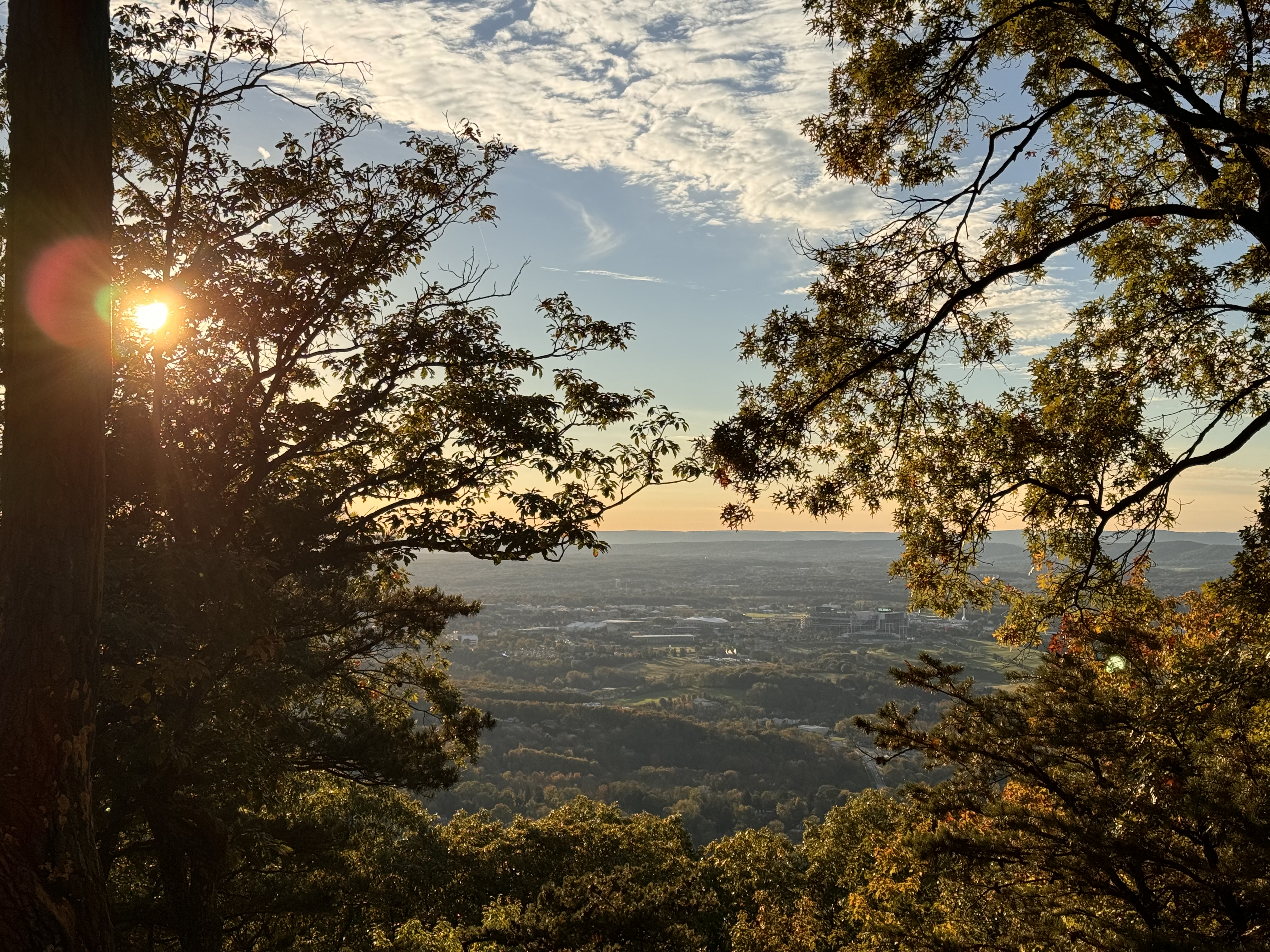
Penn State Homecoming, in its own words, exists to “celebrate tradition and instill pride in all members of the Penn State family through active engagement of students, alumni, faculty and staff across the community.” Tens of thousands of Penn Staters and friends return to Happy Valley for Homecoming, and hundreds make the special journey into Lemont and up to the Mount Nittany Trailhead, either to the Mike Lynch Overlook or to Mount Nittany’s other overlooks across its miles of trails.
The journey to Happy Valley for Homecoming is a special tradition in itself, as one recalls the highs and lows of days gone by, but the journey from Penn State’s crimson-hued campus to the top of the Mountain stirs in the heart not only the memories of the past but a clarity and recognition of the sweetness of our presently-unfolding lives. Our loyalty to Penn State, and our love for Mount Nittany, bear witness to a deeper reality: as a people who share common loves, we also share a common future.
We hope that Mount Nittany remains forever a treasure for Penn Staters, Central Pennsylvanians, and friends, and that these scenes from Penn State Homecoming 2023 and a hike to the Mike Lynch Overlook remind you of a place you will always be able to call home.
Approaching the Mike Lynch Overlook
Near sunset at the Mike Lynch Overlook
Consider making a one-time or recurring financial gift to the Mount Nittany Conservancy to support our perennial work of conservation. Together, we will ensure Mount Nittany remains accessible and for the public benefit for the future.
Nostalgia is defined as a sentimental longing or wistful affection for the past, typically for a period or place with happy personal associations. It seems to fill the air this time of year on college campuses. Soon-to-be graduates scampering around to have their final photos taken in their favorite places on campus. This year, I’ve felt this sense of nostalgia more for some reason; perhaps the wind-felled Old Willow awoke some of these feelings or the series of nostalgic pieces that I’ve come across in just the past month. Three pieces to be exact—reminds me of how my wife always says good and bad things come in threes—that have stirred my wistful sentimentality for Dear Old State. I thought you too might find them interesting.
Some of my predecessors at the Penn State Alumni Association have been some of our University’s best writers over the years. Roger Williams is well-known for his writings that have kept the legacy and memories of Evan Pugh and George Atherton alive in Happy Valley. John Black and Ridge Riley’s accounts throughout our storied history on the gridiron. Both of their writings extended far beyond sports on the staff at the Daily Collegian and the respective versions of the alumni magazine that they both edited. Ridge had a way with words. Following a 14–7 loss at Nebraska, he wrote “on Saturday in Lincoln, Nebraska, the rains on the plains fell mainly on Penn State,” a most certain nod to the Broadway play “My Fair Lady.”But the piece that I came across was from Ross Lehman ’42. Ross served as the executive director of the Penn State Alumni Association from 1970–83. During his lifetime, he was a conservationist and was integral in the purchase of hundreds of acres on Mount Nittany to preserve her forever.
He was a recipient of both the Lion’s Paw Medal for lifetime service to the University and the designation of Distinguished Alumnus. To know Ross was to know how important Penn State was to him. Here is the excerpt from his Open House column which appeared weekly in the Centre Daily Times and recently caught my attention.
Ross wrote:
“I was a naive, unsophisticated, partly uncultured lad when I came to Penn State. As I entered the Nittany Valley, the first sight to greet me was the beautiful tower of Old Main. When I entered the classroom, I encountered such unusual professors as Hum Fishburn, Nelson McGeary, Lou Bell, Bob Galbraith, and many others who exposed me to the awe of new worlds unfolding. They opened a door to challenging ideas, and another door beckoned, and another … endless, and I felt that knowledge was forever moving and lasting in my life. If I had felt lonely and isolated in these hills it was not for long. I became part of the heart throb of Penn State, and it was a new, exciting world. I fell in love with this unique place.
The campus was, and is, something rather special. It houses the “Penn State spirit,” which is a difficult thing to define because it is composed of so many things.
Perhaps it can be called a feeling, a feeling that runs through Penn Staters when they’re away from this place and someone mentions “Penn State.” The farther we are away, in time and distance, the stronger the feeling grows.
It is a good feeling, a wanting-to-share feeling. It is full of a vision of Mount Nittany, which displays a personality of its own in all its seasonal colors, from green to gold to brown to white. It is the sound of chimes from Old Main’s clock, so surrounded by leaves that it’s hard to see; it is getting to class not by looking at the clock but by listening to it.
It is the smell of the turf at New Beaver Field after a game, and the memories of Len Krouse, Leon Gajecki, Rosey Grier, Lenny Moore, Mike Reid, Franco Harris, Lydell Mitchell, Todd Blackledge and Curt Warner helping to swell our fame … and the top of Mount Nittany as seen from the grandstands in autumn.
It is the quiet of Pattee Library, facing two rows of silent elms; sunlight falling gently through those elms on a misty morning; a casual chat under a white moon on the mall.
It is talk, too: a great deal of talk, here, there, all around … in fraternity and sorority bull sessions or over a hasty coffee in The Corner Room or at Ye Olde College Diner, talk un-recalled except for the feeling of remembrance and the heart-tugging wanting some of youth.
It is the smell of a laboratory, the wondering about a tiny cell and its pattern—in its own tiny universe like that of a Milky Way galaxy—and the professor’s scintillating comment that prompts a lone wrestling with a sudden intriguing but frightening thought about our awesome cosmos.
It is a dance in Rec Hall; a beer in the Rathskeller; a kiss in a secluded campus niche; the romance that bloomed into marriage; the smell of a theater; the laugh of a crowd; the blossoming of spring shrubs and the blend of maple, oak, birch, and aspen colors in the fall; the ache of a night without sleep; and the sharing of a thousand other little things and incidents that honed our “Penn State spirit.”
It is the flash of many faces and of the single one that touched our lives forever.
It is here that Penn State molds a person’s life from the raw and unsophisticated into the conscious and cultured. We learned that a person must first be responsible to [themselves] before [they] can be responsible to [their] university, [their] society, [their] world.
It is on this beautiful campus that we learn, as my wife Katey wrote,” A [person’s] soul and [their] life are [their] own, and even if [they] give [themselves] away in hundreds of careful and loving pieces, [they’re] still [their] own [self] with [their] own life span, and no one [else] has a claim on it, …”
And here, in this lovely, intriguing spot called Penn State, each of us staked our own special, precious and eventful life.
Penn State is a benediction to all of us who have graced these beautiful halls and malls.”
If you change a reference here or there, insert the names of the football players from your era, could this describe your feelings for Penn State?
The second piece was an essay titled “Play it Again” by Sam Vaughan ’51 that appeared in the Jan/Feb 2020 edition of the Penn Stater magazine and recently produced as a video for the Alumni Association. You can watch the video on our YouTube page.
Finally, a recent conversation on the Penn State Parents Facebook site caught my attention. An alumnus and current parent asked, “Do the students still sing ‘We don’t know the <blank> words’ during the alma mater like we did in the 80’s when I was a student?” This post was met with a barrage of responses proclaiming that the students of today actually know the words and are proud to sing it loud. In fact, it is now one of our most cherished traditions and sung at many events including each time our Nittany Lions compete.
The alma mater always stirs emotions in me, but it is this version that we have used several times during the pandemic that wakes up the echoes of the past and provides hope and optimism for the future, I hope it does the same for you.
You can watch this special rendition of our alma mater here.
The great thing about feelings of nostalgia and your memories of Penn State is that they go with you, this experience is portable and lives forever in your heart and in your mind. I think that President Eric Walker said it best when he said, “Wherever you go, Penn State will go with you. You are now a part of her. Her image will be cast in your image. Your reputation will become her reputation.”
I hope your memories of Dear Old State have been a comfort to you during this time that we have all been apart. And as we are now able to see the light at the end of this long tunnel, I hope your longing for Penn State brings you back this fall to make even more memories. WE ARE looking forward to that day! Until then, WE ARE grateful for your continued support of the Alumni Association. We Are Penn State! Thank you for all you continue to do to “swell thy fame.”
WeStillAre was a student-created project launched in November 2011 in response to the Jerry Sandusky scandal at Penn State. During a time of intense media scrutiny and institutional pessimism, Penn State students created WeStillAre as a way to gather community remembrances and spotlight historical memories that captured the best aspects of the Penn State spirit as a means to guide the community through the scandal with a confident “sense of self.”
WeStillAre’s original website was shut down in 2017, but its archives (including approximately 400 posts) was gifted to the Mount Nittany Conservancy as a cultural/digital artifact.
WeStillAre
Capturing Our Spirit, For Our Future
Mission
The Penn State Honor Code states, “A good name is earned by fair play, square dealing and good sportsmanship in the classroom, on the athletic field and in all other college relations. We earnestly desire that this spirit may become a tradition at Penn State.”
So many of us have spent so much of our lives holding these values deeply in our hearts. Now, leaders who have been entrusted with Penn State’s honor and glory have failed in their obligations to uphold these shared ideals. As a result of this betrayal, the pride of many in the Penn State community has been severely fractured and the current mood is grim. Many are calling for answers and explanations, while others are demanding radical change. It is important to remember in this time of uncertainty that it is not within the legacies of our leaders where our strength resides; rather, it burns inside the core of each of us, and manifests itself in the pride, worldview, and actions of our fellow Penn State students, faculty and alumni.
We still are Penn State. We still are dedicated to consistently enriching the world with our degrees. We still are believers in the principles on which this University was founded in 1855.
Our strength, honor and integrity will provide us with the determination to weather this crisis, and in turn the spirit and ideals of Penn State will endure. But they will not endure without our help. We are now, more than ever, the guardians of Penn State. We have lived and learned here, our lives forever enriched by our experiences as students, faculty and alumni. We must acknowledge the wrong doings, seek justice and rebuild the integrity and tradition that have defined our University for 156 years. If we refuse to accept the challenge of rebuilding the standard of integrity and honor we believe in, then we have failed all past, present and future Penn Staters.
No misrepresentation of the University by a select few can take our spirit away from us. These actions will not outweigh the spirit and impact that Penn State has, and will continue to have, on the world. So long as we continually strive to live by the traditions and principles to which we have assigned our unending commitment, no acts of ours shall ever bring shame to Penn State.
“The Class of 1950: A Nostalgic Look Back” were the remarks of Thomas E. Morgan, Penn State Class of 1950, delivered February 29, 1980:
No one could have mistaken Penn State for a sedate Ivy League college during those strained elbow-room-only days of ’46-’50 when GIs and their little sisters and brothers crammed into Pollock Circle, into other dorms, fraternities, sororities, town residences in search of an education. The main campus of Penn State was a unique combination of students—probably unlike any student body before or since in the Nittany Vale.
It was a mass situation. All those incoming students and nowhere to put them! It was push, push, push. Confusion. At one point, student registration and a wrestling-boxing-fencing meet were scheduled at the same time, same place, Rec Hall. Penn State was suffering some pangs of sudden large enrollment under the GI Bill.
State ’50 grads who went through World War II—or who went through college with combat-conditioned classmates—had a combination of experiences that hasn’t been truly matched since. They chose their careers and studied in an era of success and triumph coupled with anxiety over lost time and drive to knuckle down and get on with the business of making a living.
The stampede of students started in 1946 and those who really pushed got through school beginning in 1948 with a few more in 1949. But the biggest group was the Class of 1950. Ours was the largest Penn State class in history until then, and remained the largest until exceeded by the Class of 1960 and, incidentally, by all classes since ’60 at the College—excuse it, the University. Members of our ’50 Class have seen ours and other colleges grow from relatively small, intimate campuses to bursting, scattered complexes in a short time.
Because the main campus couldn’t take us, many of us were “farmed out” to state teachers colleges for our freshman year. They weren’t ready for us either. For example, at California, Pennsylvania, where our ranks included our freshman football team, we took up residence in the gymnasium. Well, vets were excused from the gym class anyway, and basketball would wait till second semester. The drafty gym, a sea of cots, became our home.
Until the Class of ’50 hit Penn State—primarily in the fall of ’46 and early in ’47, freshman had traditionally come to the Nittany Valley directly from high school. Their classmates, though from different parts of the state or country, were basically of the same age and background. But the high schoolers entering Penn State in 1946 had some surprises in store. Instead of a nice, homogeneous group of fun-loving teen-age peach-fuzzed youngsters, they found themselves shoulder to shoulder on the crowded campus with young men. These men had spent anywhere from two to four or more years of their lives in the military, often in foreign lands with all manner of men in all manner of situations—some life-and-death.
As a younger member of the Class of ’50 puts it, “College was not what I expected, coming right out of high school. Instead of horsing around with a fun-seeking teen-age gang as I did in high school, I found myself living in a married students’ place and going to Penn State with bomber pilots, infantry platoon leaders and veterans of Omaha Beach. It wasn’t what I thought college would be like.”
The returning veterans, for the most part, had had enough of wild experiences and unsettled living. They were anxious to study hard to get through college and on with their lives. Coming off an often mean and miserable wartime life, vets had to clean up their language and learn some Penn State manners. They dominated the student population and a considerable part of campus life. They introduced married life to Penn State. And their general maturity and seriousness had a profound effect on their younger classmates.
In later years there were veterans on campus, after the Korean and Vietnam Wars, too, but nowhere near the percentages in the ’46-’50 era, and their influence was diluted.
The GIs of World War II came back tremendously motivated because they felt they had been a part of a great, great accomplishment in the life of America. They were self-confident. A lot of that rubbed off on the high school students.
For the coeds (That’s what we called the girls, remember?) who managed to make it to Penn State, the place was a paradise. The ratio was five men to one woman! Dean of Women Pearl O. Weston had a rough task looking after her girls.
And there was no Pill then!
The era of the Class of ’50, with its amalgam of seriousness and fraternity, is gone. That social and academic mix was a healthy one, a balance the current generation of Penn State students may not have. For example, many of us of ’50 were much in favor of a fraternity-sorority system, but it isn’t as popular with young people today. Leave out the rah-rah Penn State thing if you wish and think only of the values of relationships with people developed over three or four years that last to be strong even 30 years later. Penn State students today don’t have the relationships like ours. Their milieu reflects the social times. It emphasizes more sexual freedom, less marriage, live-in love partners in the dorm, and other aspects of today’s x-rated world. When television was only in its infancy and before the Pill changed the world, students of the era of ’50 were of a different Penn State mold and stripe.
In 1950 our country was coming off two decades of Depression and war. But it was also the beginning of a period of reawakening in America—with a re-emphasis on the importance of the individual, on his rights and opportunities in a free society. It was the beginning of a period of increasing affluence and leisure time. Many of our Class of ’50 went out from Penn State to become successful in our chosen fields and to enjoy it. In retrospect, we owe a lot to our University for that ’50 sheepskin signed by Judge Milholland, acting president, and to the start it gave us.
A fleeting, biased look at the times of the Class of ’50 at Penn State seems in order. Apologies to the realists who may not appreciate a tendency to nostalgia. What follows, then, is dedicated to those equipped with a special Blue and White sense enabling them to feel something extra when thinking, even 30 years later, about things that happened in or about 1950 in the Nittany Lion’s lair. There is no special order. Do you remember?
Despite a new dial telephone system on campus, young bucks still had to dial 5051 till kingdom come, beginning at 9 p.m., in quest of a damsel’s voice. That’s as far as you got. Coeds had to be safely in their dorms by 10 p.m.
What used to be time-honored “C&F” majors at Penn State (for commerce and finance) were about to be of the past, as that department changed curricula and re-named that one.
The Inkling, a new student literary magazine, was born. Like others before and after, it didn’t last long. Its greatest distinction was to be its first editor, who has since become a top U.S. publisher.
The first of many “Nittany Lion Roars” throughout the year in the Daily Collegian went to the esteemed Five Hundred: the frosh women who marked the return of the first freshman to campus in four years, in our senior year. Today would they be called “freshpersons”?
Perhaps surprising in the no-nonsense attitude of vets, the Class of ’50 reinstated freshman customs at Penn State. They had been a war casualty. Maybe we were proud of being college boys and wanted to see more spirit … of dorm, class and school. Although some bugs cropped up in customs for ’50 frosh femmes, it was a valiant attempt and helped pave the path for bringing back customs in ’51 for the first on-campus male frosh in five years. Hat Society Council in ’50 decided not to reinstate the old Penn State tarring and feathering of frosh nor “will they strike much fear in frosh hearts.” But customs were deemed a new start. By the way, today at Penn State there are hardly any “class” distinctions because of the new four-term academic year. It’s hard to tell who are the seniors, and so on. Everyone is of this numbered term or that.
The year ’50 was packed with foundings and firsts.
One far-reaching action by a creative All-College Cabinet was founding a new school ring which boasted a closer connection with the University in its design. The Lion, Old Main and the graduation year replaced time-honored duplicate seals of The Commonwealth on the ring sides. The Board of Trustees agreed. Our new ’50 design remains today.
Cabinet, in fact, achieved a pinnacle in attention not only to student matters but also, in a period of college transition, to matters of an overall Penn State nature. It made the campus Cabinet-conscious, the student-government conscious.
Our year was marked by some new student events, or renewal of some old ones that had fallen to war-time. Two brand new ones were Mad Hatter’s Day and the Spring Week Parade. The parade was replete with flashy bands, queens, floats and the military. Both events expanded Spring Carnival, begun in ’49, to a week.
The Penn State Farmer was reorganized after a six-year lapse.
To fill a need recognized by both the College and the students, a new junior hat society, Androcles, was established by the Class of ’50. It stressed lionine tradition and service, and its new members were tapped each year from a broad spectrum of campus life—not sports only. Androcles has lasted 29 years, has apparently just now fallen victim to the new term system with cloudy definition of who are juniors. Maybe someone will apply the fable of “Androcles and the Lion” to Penn State once again.
A 13-year desire for a Student Union Building at Penn State involved lots of talk, lots of plans, that’s all. No funds. Till 1950. A collegian editor had captured the need for the building back in ’40 when he cried, “Can’t we rest just a minute, catch our breath, fill out this vast hollow shell we call a college with more of the real stuff of life? Why can’t we have a SU building?” Well, it remained for the Class of ’50 to score the bold stroke that caused the much-discussed building to reach fruition. Through All-College Cabinet with Trustee approval, our Class did an unheard-of thing: We students slapped a $15 year assessment on ourselves for the purpose of financing construction of the SU. That did it. As they say, the rest is history. During the post-’50 Korean War, construction was delayed but the fund grew. Today, the HUB—Hetzel Union Building—is a vital and expected part of student life.
A dating bureau was set up to help boys and girls get together. It was a partial help to remedy a situation in which “many coeds are having to pass up the future greats in the engineering field.”
A new court of appeals was created as a compromise between All-College Cabinet and WSGA—what was that? Oh yes, the women on campus. Each wanter to hear appeals from Judicial decisions involving coed infractions of rules. The new Court would do it instead.
In 1950, coeds were in trouble who did not live in a dorm on campus, stayed out later than 10 p.m. weekdays, failed a famous peanut-butter breath test upon return to the dorm, did not get permission from the house mother to go home weekends, stayed overnight anywhere but the dorm. These are some rules remembered. There were others.
Honoring the last PSU president our Class knew, we established the Ralph Dorn Hetzel Award to a top student leader. Also the Hetzel Room in Old Main.
In other firsts, foundings and reactivations, the CORE barbershop was established, AIM held for the first All-College hike since 1942 to Mt. Nittany, providing lunch for 35 cents; after some minor clamor about it, the Blue Band moved over to join us students on our side of Beaver Field football games.
Inter-fraternity Council conducted a realistic drive against fraternity theft. About 20 houses were “robbed” late at night by IFC teams whose “thefts” went without a hitch.
We were unhappy about this first: The year ’49-’50 was the first since the war that we had no girl cheerleaders.
Highlighting ’50 was the arrival of the two E’s: Eisenhower and Engle. Collegian issued the second and third extra editions in its history to report the two appointments. (The first extra appeared two years earlier on the day “Prexy” Hetzel died.)
In what was billed as the Rally of the Half Century at Penn State, half the student body turned out to the Old Main steps to see and hear President-elect Milton S. Eisenhower on February 27. It was his first visit to the campus. The happy occasion had been set partly through a prior exchange of shortwave-radio “Milkshake Letters” featuring an offer and acceptance of “enjoying a milkshake with the students.” He was later pictured in papers nation-wide, sipping a shake with Nittany coeds prior to his July 1 coming to Penn State from Kansas State.
It was an important milestone in the history of the College—that is, the University, the arrival of this famous man who was to preside over many changes of the post-1950 era. For us students as well as the faculty and the Administration, it was also a relief that Penn State was to have a full-time president again. For most of the time of the Class of ’50 on campus—for 2.5 years, it did not.
Like the onset of the new president, the 1950 coming of Charles A. “Rip” Engle as head football coach was preceded by intense and vocal student interest. Prompted by reports that Penn State football was to be “de-emphasized,” Skull & Bones led a student uprising calling for “A Big-Time Coach for the Big-Time College.” News wires covered us. Then “Rip” was appointed, coming from Brown University, and everyone was glad. A spontaneous roar of welcome rocked Schwab (Yes, it’s still there!) when Mr. and Mrs. Engle appeared, unannounced, at a Spring Week event. Big-Time football at Penn State seemed secure. Incidentally, Rip brought along his quarterback named Paterno.
Long-time Penn State watchers declared in ’50 that no greater display of student concern and enthusiasm had ever blossomed on campus than that attending the advent of Dr. Eisenhower and Coach Engle. These were happy times.
We had our share of campus controversies, though today they seem to pale when compared to the frenetic anti-establishment ’60s.
In ’50, several student groups, including IFC and NAACP, objected to Penn State’s granting a charter to Alpha Kappa Psi, a national commerce fraternity, because of its constitution restricting membership to “white gentiles.” After a tempest on campus, AKPsi remained chartered but the College in our year set rules against chartering any group in the future with restrictive membership clauses. And IFC launched a program to cause all 52 social fraternities in Happy Valley to examine their own national rules. There was growing liberalism on campus.
Receiving widest press coverage outside the College was controversy between an assistant math prof, Dr. Lee Lorch, and the College. His teaching contract was not made permanent, he claimed, because of his activities to combat discrimination in New York. The College claimed his dismissal had nothing to do with that. Students were divided, with strong sentiments expressed in Daily Collegian letters. All-College Cabinet defeated a motion to ask the Board of Trustees to renew the Lorch Case.
There was a student uproar in ’50 over seating at home football games. We wanted to be on the west, or home, side, where our team’s bench traditionally was; instead, we students were on the east side with the opposing team. A kind of compromise resulted in the Nittany Lion grinders, not us, making the move. They came to the east to be with us. Thirty years later, so we can see them through our bifocals, we want to be on the west and bring our team back to our side, don’t we?! Fat chance.
Independent men living in Nittany Dorms and Pollock Circle, born of the war, were said by their councils to be up in arms over College plans to put 1,000 new freshman and 650 upperclassmen in the modern new West Dorms. Where was seniority? So application blanks went out from AIM to all independent men to assay interest. The crusade fizzled when not many applied. Apparently they’d become accustomed to that certain color and ambience of jerry-build Nittany-Pollock.
Then there was that flap about who were to be named ’50 Campus Personalities in LaVie. Eight more were added.
A squabble took place over Panhel’s practice of “selecting” its president by rotating the office among the 19 sororities on campus.
Collegian caused a stir by claiming the only reason girls go to Penn State is to get a man. Isn’t that so?
More seriously, our student leaders found what they termed inadequacies in the College Health Service in view of the burgeoning student body. With 10,000 students, there was no College ambulance. The nearest hospital was in Bellefonte. And so on. It can be reported today that Penn State now has a Centre County Hospital—not far from the Stadium.
And on to some other aspects and events of ’50:
When we were at State, there weren’t many blacks among us. Their day came later. Our football team, when it was invited to a year-end southern bowl, had to make separate arrangements for housing and feeding our few black athletes. And do you remember that in our time many southern teams wouldn’t play us if we had blacks in the lineup? Sports and the University changed.
The skeleton of Coaly, the mule which helped carry stones to erect Old Main, was found in an Ag Hill hayloft.
We had our quota of campus queens, all female. Searching for new titles, we came up with Miss Penn State for the Mid-Century Year. Where are you today, Mary Anne Hanna?
Penn State debaters could call 1950 one of their most triumphant in history. The men’s team captured first place in four tourneys, which topped previous Nittany efforts. But the crowning achievement came when ten of our debaters—men and women—came back from the grand national tournament with a tie for the national championship, an outright women’s championship, and five individual national titleists. One of our debaters and classmates destined to become an illustrious Penn Stater, Dick Schweiker ’50, earned a five-column Collegian headline: “Schweiker Blasts Administration.” He was unhappy with lack of college bookstore progress as All-College parliamentarian and student spokesman. He later gained headlines in the U.S. Senate.
There were no drive-in movies at State, nor fast food places. Some of us went to the Nittany or Penn State diner, or of course, the Corner Room. No liquor was sold or served in State College (It is now). The student “rum run” to Bellefonte was a weekly tradition before weekend parties.
Thespians and Players gave their usual full dose of campus entertainment in ’50. The former struck gold with “Girl Crazy” and Players celebrated their 30th anniversary by tackling “Life With Father” and “Romeo and Juliet.”
Sigma Delta Chi, journalism honorary, restored the campus Gridiron Banquet in which college administration, profs and anyone else within earshot were “roasted.” Replete in tails and tales, Dr. Kent Forster defended The Establishment.
Froth, our lamenting and lamented humor magazine, flourished in 1950. It increased circulation from 2800 to 4200 and averaged 48 pages per issue—more than any other college humor rag in the nation. The “Saturday Evening Most” issue set a record by selling 4000 copies in six hours. Do you still have your copy? Probably not. So here’s one joke from it for your laugh of today: “She passed. I saw, and smiled. She turned and smiled. To answer to my smile. I wonder if she, too, could know. Her underwear hung down a mile.” What, you didn’t laugh! Well, that’s 1950 humor. Froth was then risqué by ’50 standards, tame by today’s. A slogan printed on every page of the parody issue at hand was “You Get the Most on Saturday Night.” It was rejected by Lou Bell, then Froth advisor, so the staff had to re-make the issue. Years later, Froth really got out of hand in its humor, according to University authorities, and was banned. Then it was resurrected and banned again.
Many of the excessive hijinks of Hell Week in fraternities were fading—probably because of the influence of war veterans. Not much paddling of pledges’ bare behinds remained. Hell Week was becoming Work Week.
So you wondered, “When is he going to get to our sports heroes?” these memoirs of ’50 maybe save some of the best for last, because we were so good in sports. Let us set them down briefly:
The zone-defense basketball team scored a major upset by finishing second in the pre-season Dixie Classic.
Jim Maurey ’50, Homer Barr, Rudy Valentino and Chuck Drazenovich ’50 captured Eastern titles in 145-pound wrestling, heavyweight wrestling, and tumbling and heavyweight boxing, respectively.
Outstanding Jim Gehrdes ’50 and Victor Fritts, the boy who was born with feet pointing in opposite directions, became IC4-A champions in the hurdles and high jump, respectively.
Gangling Marty Costa ’50 broke two all-time Penn State individual basketball scoring records: 299 points for a season and 32 points in a single game.
The College gained immeasurable prestige through playing host to the 1950 Eastern Intercollegiate Gymnastics Championships and National Collegiate Boxing Tourney. They were exciting.
Soccer was a “secret” sport. Few were aware, but we were undefeated, once-tied in ’50. We then tied San Francisco for the championship in the first national Soccer Bowl in St. Louis.
Will Lancaster ’50 equalled Barney Ewell’s Penn State mark of 9.6 seconds in the 100-yard dash. And the mile relay team of Gehrdes, Guy Kay, Bill Lockhart and Lancaster established a new Nittany mark of 3 minutes, 21.2 seconds.
The remarkable Drazenovich brothers achieved double prominence in the Penn State sports scene. On top of his football prowess as an outstanding single-wing quarterback and his national boxing championship in 1950, Chuck ’50 set a new all-time shotput mark of 48 feet, 7.25 inches for Penn State. And brother Joe ’50, in addition to being a foremost Nittany guard for three years on the gridiron, was a top player on the ’50 lacrosse squad.
Gehrdes graduated with a host of all-time Penn State track records tucked under his sheepskin. Principal ones were the 120-yard high hurdles mark of 14.2 seconds and the 220-yard lows record of 22.9. What’s more, he became the holder of every Penn State hurdles mark at every indoor distance from 40 through 75 yards.
Another all-time Penn State football great is Francis “Punchy” Rogel ’50. He may be the top fullback in the history of the University. Old-timers of ’50 compared him only with Pete Mauthe, captain of the ’12 team. “Rogel up the middle” was a familiar cry at football games, and he usually garnered the necessary yards.
We’ll remember that magnificent first half of the Army football game at West Point, when Coach Joe Bedenk’s dauntless first team withstood the onslaught of favored Army, and led 7 to 0 at half-time. And remember, in our day football was not a game of platoons. Players went both ways, playing offense and defense. There were 60-minute iron men. It was different.
“Beat Bucknell!” faded from the scene while we were in school. The last game was in ’48.
Our football team was 5–and-4 for the ’49 season. Our biggest wins were over Nebraska and two traditional foes, Syracuse and West Virginia. Our ’50 gridiron classmates—some already mentioned—had fine careers for several years at State, including the vaunted Cotton Bowl team of ’47. That team, when we were sophomores, still holds the all-time Penn State and intercollegiate records of 9-game rushing defense, 153 yards, and total defense, 691 yards.
After football, the most popular sports at Penn State were wrestling, boxing and gymnastics. An enthralling event was any Rec Hall doubleheader comprising two of these sports. Rec Hall was jammed. Collegian complained that a larger facility was needed. Today it still is, with triple the students! To watch a good figure-four hold on the mat or a brilliant 90 score on the bars, are they hanging from the rafters?
A sad note of ‘50 was the death of Leo “Fred” Houck, boxing coach.
Our exasperated varsity ski team had all its dual meets cancelled for lack of snow.
We had our building boom on campus. By comparison, the decade of the ‘70s had none. Simmons and McElwain, girls’ dorms, were opened in ‘49-‘50. The magnificent Water Tunnel was built and dedicated. New Mineral Sciences and Plant Industries buildings were erected. A foods building was completed. And several Old Main offices moved over to the new Willard Hall. Then there was the newly-constructed curve in the seating plan of old Beaver Field, providing 15,000 more seats for home football games in our ‘49 season. Further, in our senior year, the University announced plans for 15 other new buildings.
Critics cried that all this construction meant the campus would assume more and more that citified look of stone, steel and concrete. Many already lamented, “Where is the campus?” But buildings had to be built to cope with overwhelming demands on Penn State as the place, theoretically at least, where any boy or girl of this State could apply for and get an education.
Physical changes wrought on campus after our departure would take another article. Over-all, we thought we were big but today the campus is infinitely larger. More buildings. New walkways—paved after students trod them to a frazzle in the grass. Problems of parking, intense in our day, are more acute today. The campus is so big today, it must be tough sprinting between classes from one end to the other.
The imposing barn close-in at Curtis Road, with its beautiful cows and massive bulls, is gone—put farther out to pasture. Our Old Beaver Field, as you know, was dismantled to become New Beaver Stadium farther out. The classic Armory on the Mall is gone, replaced by offices and computers. Some things haven’t changed:
Hort Woods, albeit smaller as it bowed to encroachment of progress, remains. You can still buy the best ice cream cone at the Campus Store as in ‘50, made with milk from Penn State cows. Remaining too is the grande tree-lined Mall—almost as much a symbol of Penn State as the Lion Shrine and Mount Nittany.
So there you are, a nostalgic look at ‘50. It has been claimed that our creative ‘50 Class was unique at Penn State. Be that as it may, one thing is certain: Our Class possessed the Penn State Spirit. Perhaps dimmed a little after 30 years, it’s still recognizable in many of us.
I spoke to Penn Staters at this year’s “State of State” conference about the “spirit of place” that pervades the Nittany Valley and what Penn Staters (and every friend and visitor) can do to conserve that spirit and pass it along to new generations.
Eric Porterfield, a friend of the Mount Nittany Conservancy, recently shared these historical State College photos. These photos show in a dramatic way the development of State College from something less than a speck on the map into the place we know it as today. They’re a witness to our community’s past, to Pennsylvania’s past, and to the “splendid isolation” and enchanted seclusion that still define places like Mount Nittany:
1876- College Avenue and Beaver Avenue as taken from Old Main tower. The frame house on the left, along East College Avenue, was the John Foster home. This house remains today at 130 East College Avenue:
1890- South of West Beaver Avenue. A child stands in a field on the William Foster farm, the site of present day Memorial Field and Central Parklet:
1924- A view of our growing town from the Old Main tower:
Three Penn State presidents have been laid to rest here in Centre County.
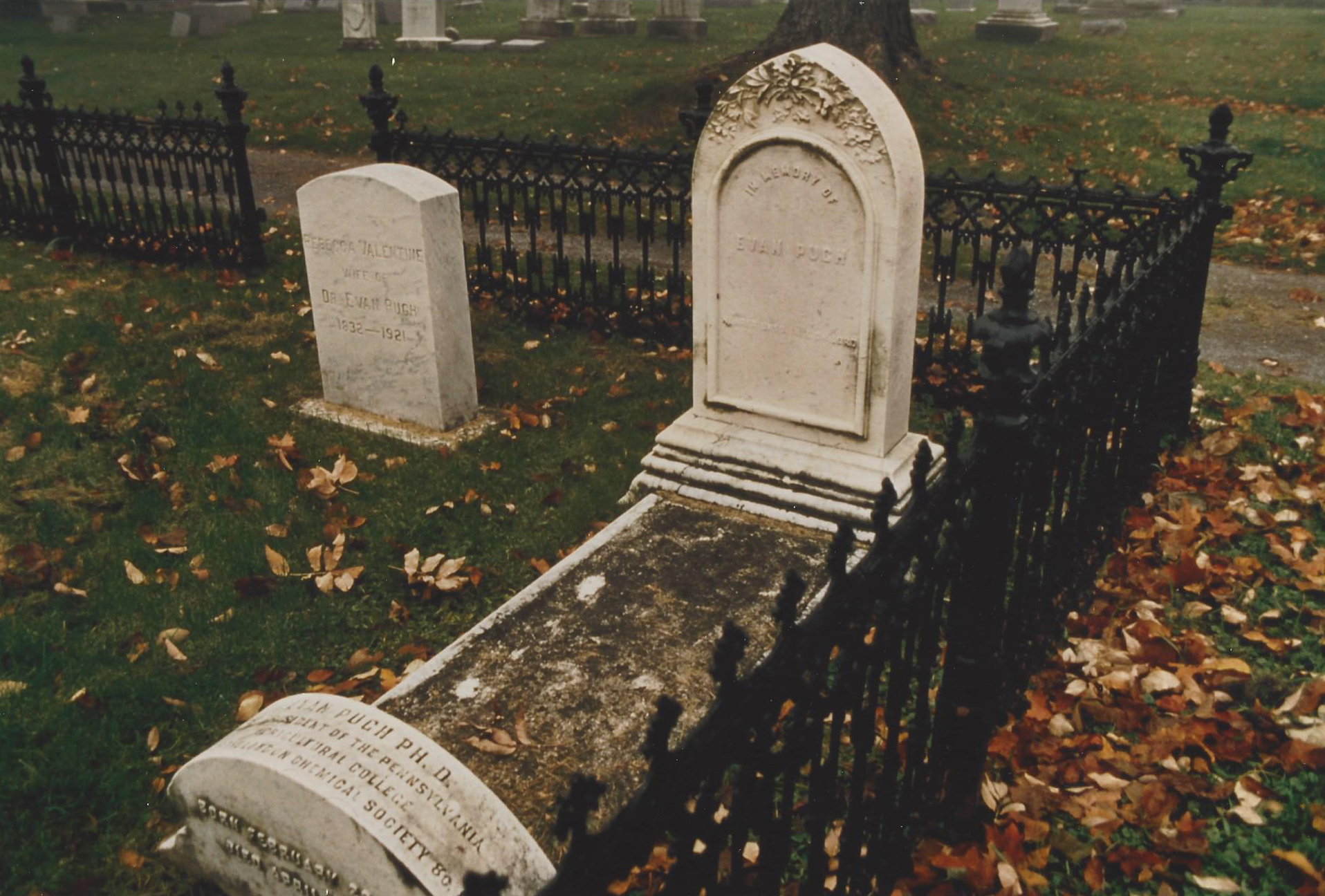
President Atherton is famously interred right along Pollock Road adjacent to Schwab Auditorium, while Milton Eisenhower finds his final repose in Centre County Memorial Park along the Benner Pike. Evan Pugh, Penn State’s founding president and one of the most consequential personalities in the Valley’s history, whiles away eternity just a short journey from the flowering campus whose humble seeds he planted. He is memorialized as a scholar, scientist, and leader at his gravesite in Bellefonte’s Union Cemetery.
Soon after his arrival here, Pugh began courting, and eventually married, Rebecca Valentine, daughter of one of Bellefonte’s most important families. He is buried alongside her in the family plot. Once a hub of power and influence throughout the commonwealth, attractor of wealth and exporter of governors, modern Bellefonte retains much of its historic character, but only a fraction of its practical significance. So it is with the gravesite of its once-famous socialites. In their time, Pugh and Valentine were the Nittany Valley’s original power couple; now their place of honor lies in silent neglect. The community that inherited their legacy bustles on ahead, its founder largely forgotten.
The first president of Penn State deserves better.
Over its 160 years, Old State has weathered wild turbulence blowing in from the wider world—civil war and world war, social revolution and heart-breaking scandal—more than once it has teetered on the brink of extinction, yet always it has persevered. Pugh deserves to be remembered as the progenitor of that hardy nature, our penchant for defiant survival.
While barely remembered or recognized today, Pugh is the perfect central character for Penn State’s origin story. Erwin Runkle, the University’s first historian, painted him as possessing “a rugged, energetic physique, a straight-forward common sense manner, combined with the heart of a child, and the integrity and moral robustness of mature manhood.” A bull-necked he-man built to tame the wild, but with a keen, inquisitive mind better suited to conquering a more esoteric landscape.
When he assumed the presidency of a fledgling agricultural college situated in what, to most, seemed like the middle of nowhere, but Pugh called “splendid isolation,” the entire notion of bringing the baser study of agriculture and industry to the hallowed enterprise of higher education was itself a risky proposition. Only through Pugh’s dogged leadership and dedication to a revolutionary vision for American education did the Farmers High School find its footing, and though he tragically died young, so impactful was his short time that its influence echoes through the ages.
The man deserves a statue or memorial on campus. As things stand today, we’ve failed even to honor his memory by caring for his burial place. Seemingly abandoned by the family line, the Valentine plot has fallen into disrepair over the decades. The tombstones have become grimy and covered in lichen; the landscaping, such as it is, overgrown and unkempt, and the once-ornate wrought iron fence enclosing it crumbles. Intermittent efforts have been made throughout the years to rectify this neglect, for which former trustee George Henning deserves a great deal of the credit. However, none of these has been long sustained.
A challenge exists for those Penn Staters willing to take it up: systematically repairing the aesthetics of Evan and Rebecca’s resting site. While the simplest tasks—bagging leaves, cutting grass, washing off the grave stones—are accomplished easily enough, the issues of repairing the fencing and routinizing the maintenance will be heavier lifts. The work will be rewarding, and if the Penn State Alumni Association and others work together, the work could come to serve as one the most powerful public witnesses to the depth of respect and honor that Penn Staters have for their founders.
The journey of exploring Pugh’s back story has revealed much that might not be expected: Finding an original handwritten copy of Rebecca Valentine’s will at Bellefonte’s Pennsylvania Room, encountering the Bog Turtle Brewery in Pugh’s hometown of Oxford, PA and their limited run of Evan Pugh Vanilla Porter, discovering a forgotten memorial marker placed by the University on family lands still inhabited by Pugh’s distant descendants.
We can take pride in restoring some luster to the memory of our Penn State family’s “first couple,” and we enjoy the pleasant surprises along the way.
Why all the fuss? If, today, so few people venture out to honor Evan Pugh’s memory that his grave has fallen into disrepair in the first place, why bother with some long-dead historical figure whom it seems most people can’t be bothered to remember?
Because whether you are an individual or a community, knowing your story—and honoring its heroes—builds confidence and strength. There is an intrinsic quality to humbling ourselves by acknowledging our place within a community and its continuum, a process that is best experienced with sacred retreats where this reverence may be felt most keenly.
Roger Williams, former Penn State Alumni Association executive director and author an upcoming Evan Pugh biography, has called him, “Penn State’s George Washington.” That seems someone worth remembering, even if by only a few.
Suffering through a prolonged period of frustration and despair, the Penn State football team faces a do-or-die moment in an early Big Ten contest: Trailing in the fourth quarter and needing an unlikely game-extending play to keep hope alive, the Lions thread the needle, capping off a precarious come-from-behind win with an explosive score from their star playmaker. This escape turns a potentially season-unraveling disaster into the catalyst for the program’s return to glory.
Two weeks later, following a blowout home victory, the Lions score a destiny-altering upset win over a highly-ranked Ohio State team under the lights, sealed with an unforgettable play sure to grace highlight reels for years to come. The team then blossoms into the sort of powerhouse that recalls Penn State’s tradition of gridiron dominance, quickly obscuring memory of a decidedly lackluster recent past. The denizens of Nittany Nation are treated to one of those unforgettable Autumns for the ages—everything from merchandise sales and hotel reservations to alumni donations and season ticket renewals pick back up—as Penn State cruises to an improbable conference crown, one made all the sweeter for just how completely unlooked-for it was before the season began.
Just like in 2005, it is probably true that the crowd inside the Lasch Building—Penn State’s players and coaches—had an inkling of the squad’s potential. It is equally fair to say that they were probably the only ones. So the ’05 comparisons may be the most obvious—especially for me, perhaps, as I wrap up work on a book about that season—but in this year’s climb back into college football’s highest echelons, the Nittany Lions offered other echoes of the program’s rich past. Let’s try this one…
After back-to-back uninspiring seasons with identical winning, but underwhelming records, grumbling and skepticism about the head coach is bubbling to the surface with increasing frequency and volume. Into the fold steps a dynamic, but previously unheralded dual-threat quarterback who’d shown the first hints of his potential in the team’s last bowl game. He replaces a multi-year starter, a prototypical pocket passer (wearing number 14) who arrived on campus as an elite recruit, but went on to frustrate and confuse observers with on-field struggles. Despite lacking his predecessor’s recruiting star power, the young man proves to be a heady winner, running and passing his way into the school record books and fans’ hearts as he commands a potent offense that leads Penn State to the Big Ten title, but the bittersweet finish of a Rose Bowl loss to USC.
Did I just describe Daryll Clark succeeding Anthony Morelli for the 2008 Nittany Lions or Trace McSorley’s ascension following the rocky tenure of Christian Hackenberg? Appropriately for this age of the remix, the mashup, and ‘The Force Awakens,’ parallels and callbacks to the past abounded for Penn State this year, as a new generation of Lions inspired nostalgia for the program’s winning ways.
Although 2016 was an up-and-down year for Old State’s defense, in its brightest moments, the unit seemed to channel the very best of their predecessors, such as the stalwart 1986 national champions (right down to linebacker Jason Cabinda’s neck roll). Not since that ’86 season, when the late John Bruno was arguably the Fiesta Bowl MVP, has a punter meant as much to a Penn State team as Blake Gillikin. An invaluable weapon all year in the crucial battle for field position, the true freshman’s heady dash to track down an errant snap and prevent an Ohio State touchdown meant just as much to his team and its season as any time Bruno pinned the Hurricanes deep that night in Tempe.
Penn State’s last outright Big Ten championship came in 1994 (Ohio State earned a share of the 2005 and 2008 titles despite losses to PSU), a year when the Lions unleashed a potent, score-from-anywhere offense. With Trace McSorley playing a more mobile Kerry Collins and Mike Gesicki a rangier Kyle Brady, Joe Moorhead’s group made a fair impersonation of that legendary crew from ’94. But then, as now, the running game powered the juggernaut, and sophomore sensation Saquon Barkley is the team’s most superb tailback since the electrifying Ki-jana Carter. And not since ’94 (and maybe even then), when Carter was joined by Mike Archie and Stephen Pitts, has State enjoyed an assemblage of backfield talent like the current crop of Barkley, Andre Robinson, Miles Sanders, and Mark Allen.
An early season clash with Temple this year marked the 50th anniversary of Penn State’s 1966 opener against Maryland, which commenced Joe Paterno’s head coaching career and brought his first of 409 career wins. But one win this season managed to reach even deeper into the memory bank, back to the days of Rip Engle.
The 2016 campaign went to another level when an unranked Penn State upset the number two team in the nation, duplicating a feat the Lions had accomplished only once before, also against the Buckeyes in 1964, except that time in Columbus. It should be noted that the connection did not go entirely unnoticed in the lead up to the game (and if damage from the post-game celebration this year was disappointing, at least nobody dumped a car into the duck pond at Hintz!). Echoes of the past, but with a twist. Appropriate for a season that opened the door to reclaiming the program’s cherished history while simultaneously launching it into a new epoch.
But for the whims of a fickle playoff selection committee, the Big Ten champs could have joined their counterparts from 1978, 1982, 1985, and 1986: Penn State teams that finished the season with an opportunity to capture the national title by winning it on the field. Instead, group them in with the ’68, ’69, ’73, and ’94 squads that staked a legitimate claim on championship contention, but for various reasons, lacked the chance for a decisive game (the wisdom of 1994 New York Times computer analysis notwithstanding). What’s exciting now is the chance that they’ll be back – and soon.
Unlike the memorable squads of 2005 and 2008, this year’s team does not represent a “last, best shot,” an all-or-nothing opportunity for a senior-laden roster to leave its mark with an unforgettable final act. In one other important way, this season reminds us of those past: In the talent that returns or is soon to arrive via recruiting, the current state of Penn State football recalls the halcyon days when Joe’s teams would reload, not rebuild. Even as it rekindled memories of a rich legacy, 2016 also brought with it promise for the future.
Penn State’s first president Evan Pugh was born in 1828 at Jordan Bank Farm, three miles south of the city center of Oxford, Pennsylvania, an hour west of Philadelphia, in Chester County. One-hundred eighty-nine years later, an Oxford brewery is honoring one of the preeminent champions of public higher education in the form of a delicious porter.
Bog Turtle Brewery, located right off the main street in downtown Oxford, started serving Evan Pugh Vanilla Porter in early November. It’s a true local operation — the brewery, which is just more than a year old, services several local bars and is open itself for a few hours five days a week for growler fills only (Growlers, for the uninitiated, are glass jugs you fill with beer to take home. There is no on-site consumption). The beer itself is a mild, light bodied porter, perfect for the winter months.
Bog Turtle’s decision to name a beer after Pugh happened in a completely random way. According to Chris Davis, the Bog Turtle’s financial guru, the brewery is located in what used to be municipal offices for the Oxford Sewer Authority. In one of the closets, the brewers found the Pennsylvania Historical Marker for Evan Pugh — previously posted near Jordan Bank High School — which had been damaged by a snowplow and removed some years before. It was this chance discovery that inspired the group to name its seventh-ever beer after one of the most important figures in Penn State history.
The vanilla porter isn’t the only reminder of Pugh in his hometown. Drive three miles south of Bog Turtle, deep into Pennsylvania farmland and adjacent to a Mennonite Church, and you’ll run into another subtle reminder of Oxford’s most important former resident. Jordan Bank Farm still exists, and two houses still inhabited by the Pugh family sit on the 56-acre plot on Media Road. A seldom-seen marker placed up against the roadway 50 years ago by Penn State and the local historical society marks the spot where Pugh was born.
Oxford is one of those magical, increasingly rare Pennsylvania towns that allows us to go back in time, even if just for a short visit, unimpeded by the distilled culture creeping into most places today (you won’t find a Target in downtown Oxford, for instance). If you’re ever in the area — it’s just a short detour on the way to State College from Philadelphia — take the opportunity to have a pint of a good beer and experience the world for a few moments like Evan Pugh did before he took on the responsibility as the founding president of the Farmer’s High School.
The Evan Pugh Vanilla Porter is not the first beer paying homage to an important Penn State figure brewed in recent years, but it is definitively the best tasting.




.jpg)