Penn State Spirit

  • Yule Ales Add to Advent Spirit

    Yule Ales Add to Advent Spirit

    Today, it is not unusual to enter a bar and find a laundry list of exotic beers on tap or to hear news of a local brew pub or microbrewery opening up. Such was not the case in 1984 (only five years after the legalization of homebrewing) when the editor of the Centre Daily Times approached local lawyer Ben Novak about writing a bi-weekly beer column for the paper. The following excerpt appears in The Birth of the Craft Brew Revolution published by Nittany Valley Press, which collects those columns, the very first of their kind in the United States, and makes them available for the first time since their original publication. They harken back to a time when only a small American subculture had discovered the endless, delicious possibilities of good beer.

    ***

    ‘Tis Advent, that holy time of the year when we begin to prepare ourselves for the coming of the Infant. In ancient days this time of year was exciting in a much different way than excitement is generally experienced today.

    Nowadays, it seems, excitement is experienced as something that is thrilling because it is new, unknown, risky, sexy and dangerous. Today’s young people seem to look for excitement at the edge of life.

    But the ancient excitement of Christmas was something quite different. Christmas wasn’t something which happened at the edge of life, but something that happened at the heart of life. It wasn’t a search for something new and dangerous. On the contrary, Christmas was as predictable as clockwork, and as familiar as one’s most favorite feeling. Each year Christmas came on exactly the same day, and everyone tried very hard to do the same things in the same way they had done them in the past.

    To today’s young people that might sound boring. And yet … and yet … in those days it had seemed so very exciting. To me, Christmas had always seemed like a challenge without equal. It was an adventure in time. Every year people tried to see if they could rekindle and pass down the same feeling that had been felt on that first Christmas morn.

    They all knew and believed with childlike simplicity that something wonderful had happened on that hallowed night almost 2,000 years ago. They believed that hearts had been opened and changed in a way that had never happened before. They naively believed through all the years since then that the original joy had been rekindled again and again each and every year at Christmas, just as it had been experienced on that first blessed eve.

    Oh, the excitement of it all! Each year they wondered: Could it happen again? Would it? Could the magic still work? The anticipation grew to the highest levels of expectation and awe: If they did all the same things, heard the same stories, ate the same foods, drank the same drinks, rejoined in the same ways, would they again feel the excitement of their own first Christmas when they were children? Did they still have it in them to unlock all that joy one more time?

    The wonder of it! Could their joy be great enough to renew again for one more year the tremendous joy of that first blessed eve in the year One, when the time of our time began? And so, on the 4th day after the winter solstice, when they were absolutely sure that the sun had begun to rise again in the heavens, they celebrated Christmas.

    In ancient days everyone had worked so hard to make it happen again each year. They bought presents which they believed would bring out each person’s most childlike joy. They baked Christmas cakes and cookies, worked for weeks to prepare festive decorations for every room and window, searched out old recipes for Christmas goose or turkey stuffing, hung mistletoe in their hallways, hauled in the Yule logs, and brushed up on the ancient Christmas stories and carols to tell over again to their children and themselves. Old fights were ended, debts forgiven and friendships renewed in this season.

    One of the smallest and least significant contributions to the annual challenge to rekindle the ancient joy was made by the brewers of Europe and early America. In those days everyone felt the obligation to contribute whatever they could to the annual renewal of the community’s joy. Each year the brewers made their small contribution by brewing special Christmas ales and holiday beers for the season.

    The ancient tradition is undergoing a rebirth in America. Since the early 1970s, when there were only one or two remaining Christmas ales available in America, both small and large brewers are taking up the challenge to deepen the joy of the Christmas season by bringing out special seasonal brews.

    Christmas ales and holiday beers are normally brewed deeper and darker than beers for other seasons. At Christmas time, one was expected to sip slowly to enjoy the deep contentment of the season and the memories of childlike joy.

    As I write this column in advance of the season, most Christmas ales and holiday beers have not yet come on the market. But here are some names you might look for to taste the challenge of Christmas past:

    – Aass Jule 01 (pronounced “Arse Yule Ale”) from Norway. This is a special, rich, malty, dark lager developed specially for the winter holiday season.

    – Noche Buena Cervesa Especial from the Montezuma Brewery in Mexico. This is a Marzen-style brew in the old tradition of the Austro-Hungarian Empire. This is a dark brown, medium-bodied beer with a delicate malt taste.

    – Anchor Christmas Ale. This is a special ale brewed to a different recipe each year. It is always a real ale, brewed especially dark, heavy and hoppy for the season.

    – Newman’s Winter Ale. This is brewed in Ithaca, New York, as a “winter warmer,” and is a real ale, truly dark and different.

    – Sierra Nevada Celebration Ale. This is brewed in Chico, California, by two of the most traditional-minded, dedicated micro-brewers in America.

    – Boulder Christmas Ale, made by the “second largest brewery in the Rockies,” but nonetheless a very small micro-brewer. It is modeled after 17th and 18th century English mulled ales.

    – F.X. Matt’s Traditional Season’s Best from Utica, New York. This is an amber, Vienna-style holiday special made by true craftsmen. It is trucked right through Pennsylvania to Washington, D.C., Virginia and Colorado, but is not marketed here in the Keystone State. Perhaps we must be more sincere this year in extending holiday greetings to our neighbors in the empire state.

    Some other Christmas ales and holiday beers one might encounter in one’s travels are: Hudepohol’s Christmas Beer from Cincinnati; August Schell’s Xmas Beer from New Ulm, Minn.; Fred Koch Holiday Beer from Dunkirk, N.Y. (The Koch Brewery was recently purchased by Genessee); and Grant’s Christmas Ale from Yakima, Wash.

    It is hoped that the Spirit of Christmases past will inspire many more brewers to introduce new Christmas ales and holiday beers in 1985 to reawaken the ancient joy of the season. And it is hoped that we all should imbibe them in the spirit in which they are brewed.

    Ein Prosit der Gemutlichkeit!

  • A Salute to Veterans and the Veterans’ Education and Advancement Fund

    The great stories of any age are often best understood by tracing the tiny threads of personal experience. In following these winding strands, seeing where and how they intersect, we come to understand how the collective weight of countless individual acts underpins the forces that shape our world.

    On the afternoon of April 11, 1945, General George S. Patton’s 6th Armored Division, including a young soldier from western Pennsylvania named Albert Edward Matyasovsky, rolled in to liberate Buchenwald, one of the largest of the Nazi concentration camps. Among the 21,000 prisoners set free that day was a teenage boy named Elie Wiesel.

    In a bustle of thousands of anonymous faces that day, the two never met. For a brief and meaningful moment though, the threads of their life stories intersected.

    Wiesel, who passed away earlier this year, counted among the lucky few to survive the horrors of the Holocaust; he grew up to author over 50 books and win the Nobel Prize. Elie Wiesel was able to share his gifts with the world because of the sacrifice and bravery of American and other Allied soldiers. One of them, Matyasovsky, returned from war with a lifetime’s worth of experiences spanning Normandy to the Ardennes and beyond, fortunate enough to have come back home at all. He did not gain great wealth or notoriety in his post-war life, but as a father, he created a legacy and influence that will positively impact the lives of future Penn State students.

    Al Matyasovsky, Jr., who recently retired from Penn State after decades overseeing the University’s waste management and recycling programs, has established the Veterans’ Education and Advancement Fund (VEAF), a scholarship endowment with the Penn State World Campus. He and his wife, Sharon, cite their parents, particularly Al’s father and mother, as their inspiration in launching this effort, which will provide financial assistance to veterans, active duty military, and their family members who are enrolled in the University’s online programs.

    “We lived in a coal mining town for six years, very meager surroundings. My father used to have to carry water from a community pump up to our house that we drank, bathed in, and cooked with, and I never heard him complain,” the son recalls. Al absorbed the lessons of his father’s work ethic, but also the man’s oft-repeated core values: “Treat people with respect. Be fair. Be honest. Don’t lie. Don’t cheat.”

    The “American Century” that blossomed in the wake of Allied victory in WWII brought widespread educational and economic opportunity to a generation of Americans. Despite an impoverished upbringing, Al’s commitment to following his father’s example brought on the academic achievement necessary to open those doors. As a senior, a meeting with his high school guidance counselor put Matyasovsky on the path to a college education.

    “She said, ‘We send guys like you to college,’ and she got me all the money that I would go to college on… that changed my life. It demonstrated to me how people outside the family who have faith in you can affect your life in a tremendous way.”

    Matyasovsky graduated from Lock Haven University, and after a few job and location changes, he obtained a position with Penn State that turned into a long career. Over more than 30 years of service, Al was in charge of many of the University’s solid waste management and recycling efforts. He managed gameday operations at Beaver Stadium for a quarter century, including post-9/11 security measures, and he also implemented some of the school’s most innovative and recognizable sustainability efforts.

    These include the now-ubiquitous blue recycling bags that dot the tailgating fields during football season and, probably most notably, the annual Trash to Treasure sale at Beaver Stadium, where departing students donate items they would otherwise discard that are then sold to benefit the county United Way. Matyasovsky proudly notes that, since its inception, the event has raised over $750,000 for the charity while repurposing “stuff that was going to the landfill.”

    After retiring, Al sought to finally make good on a long-held ambition to philanthropically support veterans, thinking of the inspiring role his father had played throughout his life. While considering the creation of a new foundation, he also spoke with staff at the University about his idea. Those discussions led to the creation of the Veterans’ Education and Advancement Fund scholarship within the Penn State World Campus. “The logic is that a veteran and their family don’t have to uproot themselves to come to University Park. They can receive a Penn State degree from anywhere in the world.”

    An especially unique facet that distinguishes the VEAF, according to Matyasovsky, is the flexibility to also support family members of service members and vets.

    “The love and admiration that we have for our parents is still very strong today. We feel that the family also deserves credit for supporting the veterans who defend our freedoms and support our way of life. Our fathers were in the military, and our mothers taught us the way of keeping family together and being part of the neighborhood and so on.”

    The VEAF will hold its first fundraising event, a dinner at the Penn Stater Hotel and Conference Center, in April 2017. The fund is now a permanent part of the veterans’ support programming offered by the World Campus, which has been consistently ranked as the top online education program for veterans and active-duty military in the nation. As the lead donors, Al and Sharon are dedicated to growing the fund continually to amplify its impact.

    “I’m not a hero for it. My father was the hero. I just did what my father and mother advised me to do. My mother used to say, ‘Being poor has nothing to do with who you are as a person.’ Both my parents told me, ‘Study hard. Get good grades, and good things will happen to you.’”

    Follow the thread.

    Through courage and fortitude, a generation of Americans like Al Matyasovsky, Sr. won battlefield victories that changed lives for millions, including a young Elie Wiesel. He returned home to support and inspire a son who went on to make a lasting impact on life here in the Nittany Valley, first as a long-time Penn State employee and now again with the VEAF.

    Motivated by the memory of veterans who so strongly influenced their lives, Al and Sharon Matyasovsky’s efforts will enable the dreams of education and opportunity for future generations of America’s service men and women and their families. Until all is said and done, who can know how many more lives they will touch, how many more threads will cross their own and end up better for it?

  • The Penn State-Wisconsin Rivalry That Never Was

    Recently, I found myself caught in Park Ave traffic behind a car adorned with an obnoxiously large Ohio State Buckeyes magnet. With merely a glimpse of it, my pulse quickened and my palms tightly gripped the steering wheel. As an ardent Nittany Lions fan, I recoiled at the unwelcome reminder of our rival.

    And there it was, that loaded term.

    A lot of ink, real and virtual, has been spilled debating what defines a genuine “rivalry” in college football. Because we have imbued the term with a certain sacred quality, participation in a recognized rivalry is its own form of cultural currency. Fans even seek to insult one another by denying that they consider an opposing school their “rival.” So what makes a rivalry?

    When your new coach gives his introductory press conference, a rival is the team against whom he goes out of his way to promise wins (the lack of such most likely contributed to the recent job opening). When Jim Tressel arrived at Ohio State, he guaranteed wins against Michigan. Urban Meyer did the same. A couple years later, Jim Harbaugh returned the favor. In the ESPN documentary Trojan War, about the powerhouse USC teams of the early 2000’s, a newly-arrived Pete Carroll is shown listing his top priority for rebuilding the program: Beat UCLA.

    Rivals face off on a regular basis; they play meaningful games at key points in the year. Rivals ruin each other’s seasons. Rivalries develop over time, organically; they thrive on geographic proximity (familiarity breeds contempt). They get nicknames, like the Civil War, the Apple Cup, the Red River Shootout, and the Iron Bowl. Speaking of which, sometimes great rivalries get a little out of hand.

    And so I got to thinking, “Would a Penn State magnet in Buckeye country elicit a comparably visceral reaction?” When we classify Ohio State as a rival, do their fans reciprocate? Probably not. They’re still settling scores from the War for Toledo.

    Ditto, Michigan. The M Club measures success in victories against the hated Buckeyes. What about traditional end-of-season foe Michigan State? Nope. Despite the best efforts of George Perles, Spartans fans will always care more about defeating the in-state Wolverines. Minnesota and Iowa have certainly played the role of antagonist at certain points in program history, but few, if any, of Penn State’s many wins over the Gophers and Hawkeyes carried similar significance. So do the Nittany Lions actually own a piece of that national conversation? Does Penn State have an undisputed, reciprocal “rival?”

    Once upon a time, such a question would never be asked. Between 1896 and 1993, Penn State played 96 times, their Thanksgiving weekend clash resonating with media and fans nationwide. We got a glimpse of that again when the two teams staged their epic prize fight last month, the first of four meetings scheduled out until 2019. Pitt-Penn State was once a rivalry, and perhaps it can be again (here’s hoping). But at best, this latest renewal looks like no more than a fleeting echo of the past. The series is set to expire with no sign of further renewal on the horizon. The changing landscape of the sport conspires against it. True gridiron animus needs to flow through regularly-scheduled antagonism. The Lions still lack that one special somebody to clash with year-in and year-out in games of consequence. In the modern era, such consistency can only be found within your school’s athletic conference.

    So what about Wisconsin? The Badgers, really? Stay with me here. It could have happened, and here’s how it almost did.

    In 1993, Penn State completed its historic transition from football independence and began competing in the Big Ten. The Nittany Lions arrived bearing one of the sport’s great brand names, an asset that carried surprisingly little cache in a discriminating club with a century’s worth of tradition whose members had embraced the change with obvious reluctance. Most Big Ten teams had been facing off since the Depression, and Penn State was the new kid in the old neighborhood. The fit was (some would say “is”) awkward at times.

    Three years earlier, in 1990, Wisconsin had hired head coach Barry Alvarez, a man destined to quickly lift the program out of three decades of malaise that its Wikipedia entry charitably terms “Limited successes.” While JoePa and the Lions were earning laurels and playing for titles as independents, the Badgers had been languishing as an afterthought in the conference often known as “The Big Two and Little Eight.” In the 22 years following Alvarez’s arrival, the Badgers would claim the Big Ten crown six times. Almost immediately, these two “square pegs” found, in each other, a reliable measuring stick in their mutual efforts to overthrow the regime of Ohio State and Michigan:

    1995 – In their first conference meeting, Alvarez and the Badgers humbled the sixth-ranked defending conference champions with a 17-9 win at Beaver Stadium.

    1996-97 – Two of the nation’s best runners, Curtis Enis of Penn State and Wisconsin’s Ron Dayne, faced off in two slugfests won by the Nittany Lions.

    1998 – With Enis gone to the NFL, Dayne got his revenge, leading the Badgers to a 24-3 win.

    2001 – A somber pall hung over the proceedings in the first week of games after 9/11, and an 18-6 victory for the Badgers denied Joe Paterno a chance to tie Bear Bryant’s all-time wins record in front of the home crowd.

    2002 – Penn State scored a hard-fought 34-31 victory at Camp Randall Stadium, highlighted by four field goals from Robbie Gould.

    2004 – Quarterbacks Zack Mills and Michael Robinson were knocked out of the game with injuries while Wisconsin fullback Matt Bernstein, fasting for Yom Kippur and running only on IV liquids, gutted the Lions’ defense for 123 rushing yards in a 16-3 win.

    2005 – The last meeting between Barry Alvarez and Joe Paterno, a contest for sole possession of first place in the Big Ten, became a Senior Day to remember for the likes of Michael Robinson and Tamba Hali, who helped advance Penn State’s incredible comeback season with a 35-14 victory.

    2006 – Wisconsin won 13-3, and new coach Bret Bielema earned the enmity of Penn State coaches, players, and fans by abusing a short-lived kick off rule to run out the first-half clock. Both events were obscured by a sideline collision that sent Joe Paterno to the hospital with a broken leg.

    2007 – Unranked Penn State again reclaimed bragging rights in the series by pasting the #19 Badgers 38-7 in Happy Valley.

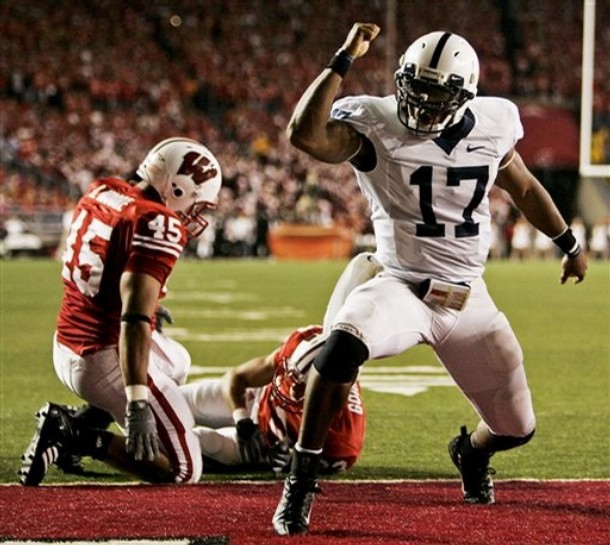
    2008 – Derrick Williams took a punt to the house; Aaron Maybin burst onto the scene, and Daryll Clark created an iconic image. Badgers fans probably just wanted it to end, as Penn State grabbed the national spotlight with a 48-7 road win in prime time.

    In 2010, the Big Ten welcomed Nebraska in a move that shook college football to its foundations and once again disrupted the equilibrium of the staid conference. For the first time, “the B1G” would divide its teams into divisions whose winners would play in a championship game. With Michigan State sorted into the other division, newly-minted division rival Wisconsin filled the void at the end of Penn State’s conference slate. By that time, these two programs – both outsiders in the kingdom of Woody and Bo, the newcomer and the nouveau riche – had staked their own claims to a share of that vaunted Big Ten tradition. From the very beginning, their new arrangement yielded excitement:

    2011 – Battered and reeling from the Sandusky scandal firestorm, Penn State traveled to Madison playing for a berth in the inaugural Big Ten championship game. Russel Wilson and Co. claimed that spot decisively, winning 45-7.

    2012 – Badgers tailback Montee Ball set the FBS career touchdown record, but the Nittany Lions won the day. Emotions ran high as one of Old State’s greatest teams honored injured leader Michael Mauti by wearing his number 42 on their helmets and leaving their hearts on the field. When a Wisconsin field goal attempt fell short in overtime, embattled sophomore Sam Ficken’s successful try from the previous series became the winning points in one of the most memorable victories in program history.

    2013 – O’Brien’s Lions walked into Madison as 24-point underdogs; they left with a 31-24 win that derailed Wisconsin’s hopes for a BCS bowl. The stunning upset, which brought the all-time series to 8-9 in favor of Wisconsin, also saw Penn State equal the series’ longest winning streak – two games (if you don’t count the Badgers’ three-game “streak” carried over from the early 1950’s to their ’95 win).

    The pattern was established. Penn State and Wisconsin, Big Ten party crashers both, would close out against one another, with bowl berths, and potentially division titles, on the line; already in the short series history, each had handed humbling losses to the other.

    That scheduling move to end each year’s campaign with the Penn State-Wisconsin game was the key to shifting the matchup from proto-rivalry to genuine article. Virtually all of my key ingredients for a bona fide, both-fanbases-agree, referenced-as-such-on-GameDay college football RIVALRY were there: regular meetings, consequential outcomes that cut both ways, bad blood that develops over time. Yes, proximity worked against it, but in the coming age of the “super conference,” rivals will increasingly be found as close as the nearest airport. The Nittany Lions and Badgers were just on the cusp of playing an often meaningful, usually unpredictable, and gloriously contentious annual capper to their regular seasons. Both were perhaps only a few more meetings away from finally finding a year-in, year-out rival they could both love to hate. It was that close.

    For a few fleeting moments, all of this was possible, and then, like so many things in life, it was ruined by Rutgers and Maryland.

  • Why Honoring Joe Paterno Still Matters

    Why Honoring Joe Paterno Still Matters

    Writing anything about Joe Paterno at this point is futile. If you’re reading this, your mind has already been made up. If you are not a Penn Stater, we’re an unapologetic cult. If you are a Penn Stater, you’re probably nonplussed, irrationally angry that the news about Paterno being honored before the Temple game is too little too late, or part of the smarmy faction that believesthey are morally superior for having lived inside the cult but made it out alive.

    I understand this. I don’t intend to change your mind on Paterno — I’ve already tried — but missing in the conversation is any discussion about why honoring Paterno, or university history in general, is even an important endeavor at all. This becomes incredibly challenging, because making any salient point about Paterno requires another ten points of requisite context. Anything without that nuance on this topic is irresponsible, but including it can become a drag, or make it seem like the author is trying to “explain away” facts (or worse, feeling unsympathetic to child sexual abuse victims). Nor has the pro-Paterno crowd been the most tactful advocates for its cause, at least online. All of these factors make this topic so toxic and impossible to manage.

    Knowing full well I’m wading into an abyss, here’s my best crack at it.

    ***

    Before that, there is one important caveat (I told you the context was important).

    If you are 100 percent certain that Joe Paterno was the ringleader of a calculated coverup of child sexual abuse, you are irredeemable. A conversation of this sort is impossible to have without the acknowledgement the facts aren’t as clear as some have made them out to be and that many smart, decent people outside of Penn State (Bob Costas, Jerry Sandusky’s prosecutor, Mike Kryzewski, etc.) have serious doubts about Paterno’s culpability and the Freeh Report’s conclusions. The unfortunate reality is that the people who know the most about this case are also the most susceptible to bias. It’s what makes real conversations about this topic so difficult — Penn Staters are easier to dismiss as lunatics out of hand, but virtually everyone outside of the bubble understandably doesn’t follow this story on a daily basis because it doesn’t impact their lives or their Alma Mater.

    But to the caveat: If Paterno knowingly and systematically covered up child sexual abuse for decades, then all of this is moot. The evidence, by any objective mind, does not support a coverup assertion. It is not impossible that it happened that way, but the evidence, objectively, makes it seem increasingly unlikely. If you’re one of the thousands of Twitter heroes who has chimed in on this topic in the last day or so, this is probably unthinkable to you — the equivalent of me denying the moon landing. After seven years as a student — trust me — I understand that. But one does not usually commit a coverup if one tells three other people about what happened — knowing that at least nine people would know in total — without some quid pro quo to buy silence. Frankly, a case to prove such a thing would be laughed out of court, and there’s a reason no charges were ever brought against him when they were with the other administrators. And I’ll say this without qualification: Anyone who is 100 percent certain (or near 100 percent certain) that a coverup occurred is not a serious thinker or interpreter of the facts. I’m not talking about people who think that Paterno should have done more at the time — he, himself, admitted this, knowing what we know in hindsight. But the moral gap between “coverup” and “misjudgment” is vast and important to note. Unfortunately, judging the conversation based on Twitter alone, it seems like a large swath of the country is unwilling to consider the distinction or the nuance. I suppose this should come as no surprise by now, but the discourse yesterday was as bad as it’s been since 2011 or 2012.

    In any case, if you are unwilling to consider the possibility that there wasn’t a coverup, you are not intellectually serious and this column is not for you. Serious people do not speak in absolutes about situations like this, although I suppose the national sports commentariat has never been accused of being serious. I am speaking instead to the many people — Penn Staters and otherwise — who know Paterno wasn’t evil, but still don’t understand why we should still care about a guy who has been dead for five years, especially at the cost of infuriating a significant number of people nationally.

    ***

    To understand why honoring Joe Paterno still matters requires a thoughtful understanding of the Penn State Spirit.

    And here’s another thing: Sports don’t matter, unless they’re put in the context of life. Teenagers and young adults running around a field throwing balls matters little unless you view it as a metaphor for the extension of the spirit of the university (or in the case of professional sports, an extension of the spirit of a city). What are the moments you think about at Penn State over the last five or so years?

    For me, it’s not the score of a game. It’s guys like Michael Zordich saying things like this:

    “We want to let the nation know that we’re proud of who we are. We are the true Penn Staters. We’re gonna stick together through this. As a team we don’t see this as a punishment; this is an opportunity. This is the greatest opportunity a Penn Stater could ever be given. We have an obligation to Penn State and we have an ability to fight not just for a team, not just for a university, but for every man who has worn the blue and white on that gridiron before us.”

    When I think of the 2013 Wisconsin game, I don’t think about the X’s and O’s, how many yards Allen Robinson or Zach Zwinak had, what play so-and-so-ran, or really, anything about the game. I think about what Bill O’Brien said after the game:

    “Seniors…What you meant to this program. What you meant for this university. We will remember you forever.”

    “We will remember you forever.” Let those words sit for a moment.

    Sports don’t matter unless we insist on remembering instead of forgetting. The Penn State Spirit is a collective of these memories from the past, all while pushing us forward to form a better future. What does it say about us as people if we choose to forget people like Michael Zordich, Bill O’Brien, or those Penn State seniors?

    What does it say about us as a community if we choose to forget about people like Joe Paterno?

    Consider the ancient story of the great medieval King Arthur.

    When the young boy, Arthur, pulled the sword Excalibur from the stone, he did not automatically become the rightful King of England. Many of the lords and nobles of the realm withheld their fealty and allegiance from him, until he should prove in combat and in battle his qualities of courage and leadership.

    The last battle was the greatest and most trying. But Arthur and those who believed in him were victorious. That night, when the battle was over, his men gathered together, fresh from combat, covered with sweat, and blood, and bandages, but elated in their victory and the triumph of their King.

    As the story goes, the wizard Merlin came forward, and he said to them: “Remember this moment. Catch now the spirit of victory and joy that wells up in you and overflows. Catch it at full tide, and hold it. For out of this spirit and feeling shall the future be wrought.”

    And King Arthur stepped forward and said, “Yes, let us catch the spirit and remember it. For this, I shall build a round table, and all of you shall sit around it, and whenever we are together, this we shall remember. It shall not pass away, as deeds of others pass away into forgetfulness, but shall be remembered down through the ages. For thanks to the wisdom of wise Merlin, we shall not forget, not suffer the doom of other men, who, though accomplishing greater deeds, were buried under the veil of forgetfulness.

    “No, this spirit and this moment shall live down through the ages, and wherever men shall gather to wonder if they can do great deeds, they shall remember us, and in remembering, take heart. And in every future time, when faith and courage are put to the test and emerge triumphantly, they shall say: Arthur and his Knights, and the Spirit of the Round Table still lives!”

    And today, fourteen hundred years later, King Arthur and his Knights of the Round Table are remembered.

    Put this in the context of Penn State, a place that so many people hold as a part of their soul. Who will we remember in fourteen hundred years? It will be great presidents, like Evan Pugh, George Atherton, Ralph Hetzel, and Eric Walker. It will be transformative students, administrators, and townsfolk, like Fred Lewis Pattee, Frederick Watts, James Irvin, Calvin Waller, and Rebecca Ewing. It will be sports heroes, like Wally Triplett, Lenny Moore, Bob Higgins, Jesse Arnelle, and the football players who stayed after 2011. It will be dozens of other women and men who will come along in the next hundreds and thousands of years and leave their mark on this place.

    And, perhaps more than anyone, it will be Joe Paterno.

    All of these men and women who have left their marks on the Nittany Valley deserve their place at the Round Table, deserve to be remembered, and deserve to be honored appropriately so that future generations may know their greatness and strive for it themselves. For without them — and countless others — there is no Penn State. Without the spirit of these people and those times, the present and future have less meaning, and we as a community have a thinner, less stimulating culture.

    As Penn Staters, we can celebrate James Franklin’s Nittany Lions this season as hard as we ever had, all while appreciating the context of the now in the spirit of the institution as an aggregate of its past. James Franklin and his players will write their own stories. The ghosts of the past do not hinder their progress, but give meaning to their goals — give meaning to our identity. The student newspaper, predictably, editorialized today that any sort of Paterno acknowledgement is “insensitive to the future.” What a good many well-intentioned people fail to realize is without an appreciation for the past, the spirit of now has less meaning. In fifty years, we all hope we will be able to tell our children and grandchildren tales of Saquon Barkley hurdling foolish-looking linebackers and James Franklin returning the program to its past prestige. The great people of Happy Valley today will be remembered tomorrow — and we will learn from their triumph and disaster — but only if we allow the nihilism behind the phrase “move on” to fade away.

    Ben Novak, a retired four-term Penn State trustee and author of “Is Penn State a Real University?: An Investigation of the University as a Living Ideal,” writes about the Penn State Spirit:

    “The past, because it was lived, cannot really be destroyed. It can only be covered over, like a lush jungle that gets condensed into a pool of oil or a vein of coal, just waiting to be drilled or mined to have its energy released. But you have to dig for it, and you have to know how to use it. When we don’t know what is in the past, we cannot use it, and we cannot release its power.

    “Fortunately we do not live in a world where the past, present, and future are in airtight cubicles that we must look at separately as though the past is dead and gone, the present stinks, and the future is always bright. Rather, the past, present, and future are fluid, and keep washing over each other. There were a lot of good things in the past that can brighten the present, and a lot of things in the past that seem to be missing in the present, but which could brighten your future.”

    “Spirit,” Novak writes, “is indestructible. But only if, in a practical sense, we allow it to come alive in us.”

    Which is to say this: If you’re worked up or disappointed about the fact that Penn State might play a video and invite some lettermen on the field during a football game in two weeks to honor a man who is on the Mount Rushmore of the institution, I would encourage you to think harder about what Penn State really stands for.

    ***

    There’s also a second position — that honoring someone so controversial will result in so much negative PR that it will damage the institution to the point of not being worth the hassle and discomfort or somehow overshadows what the current team is trying to accomplish.

    And to that, I say this: You are selling the Penn State Spirit short.

    Consider these words from the documentary “Sanctioned” by Chris Buchignani about what the last five years in State College have proved:

    “It’s really enheartening and strengthening to know that what you always believed was right about the place is real. That we don’t have to believe anymore, now we know. And not just that it’s real. As close as you can come to damn near invincible on this earth. That’s what Penn State is.”

    Virtue is doing the right thing even when you know you will be criticized for it. This is the last great test of the Grand Experiment that Paterno inadvertently left for us. Will we, as a community and as an institution, all bonded together in the Penn State Spirit, do the right thing despite the backlash?

    Judging from yesterday’s news, it looks like the answer could be yes.

    Consider all Penn State has been through in the last five years. No academic institution in the history of the world has been the recipient of as much vitriol. And yet, we have endured. Penn State just admitted the largest freshmen class in the history of the institution — freshmen who walked across this campus when searching for colleges and felt the Penn State Spirit enter their hearts, as it has for 161 years. Academic rankings across the university continue to rise. Application numbers continue to set records and exceed the wildest expectations. People from all over the world are beating down the doors to attend Penn State, despite it all. Athletics teams across the board continue to excel and compete at high levels. Arguably, the health of the institution has never been stronger.

    All this, despite the millions of tweets, columns, articles, and nonsense that has been said about Penn State for the last five years.

    This pattern is all too familiar. A major Paterno or Sandusky-related news incident occurs. The national conversation, driven by folks who aren’t interested in nuance, turns against Penn State. It lasts for a day, maybe two, sometimes three. And then the Penn State Spirit continues on, unchanged. Students continue to pour in for a life changing education. Alumni continue to get great jobs. And we, the people of Happy Valley, continue to survive — nay, thrive.

    The “opening old wounds” argument only has meaning if there is a tangible negative effect on the institution beyond a few days of keyboard heroes having their fun. Put away your keyboard. Turn off Twitter. Walk across campus when classes are changing and take it all in. There was a corporate career fair all week. There will be a football game on Saturday, and all eyes and minds will be focused on the 2016 Nittany Lions.

    Is an on-field ceremony — hell, even a statue — and another day of “Penn State just doesn’t get it!” columns going to change any of that?

    I insist that it already would have.

    “As close as you can come to damn near invincible on this earth. That’s what Penn State is.”

    Virtue is doing the right thing when you know it will be hard. That’s what Joe Paterno preached. And that is how we should — and will — press forward, with our sights set on the future of the institution and an unwavering appreciation for its past greatness — Joe Paterno, and otherwise.

  • Why Learn the Penn State Story?

    The creation of a Penn State undergraduate course on the university’s history is a source of great excitement and pride for many who dwell in body and in spirit in Mount Nittany’s gentle shadow.

    In early 2013, Sean Clark and Zach Zimbler suggested that Penn State ought to offer a class on the history of the University itself. This prompted discussions with faculty in Penn State’s History department that eventually sparked development of a full course curriculum. Although final approvals will take some time, the near future will see the availability of a three-credit course on Penn State history, History 148 (appropriate, as it corresponds to the number of Centre County’s Civil War regiment, which was led by future Penn State President James Beaver). We were happy to have helped catalyze what we believed to be a worthy endeavor, but we wanted to do more.

    Steve Garguilo stepped up to make an extraordinary financial commitment to establish the Stephen D. Garguilo Nittany Valley Society University History Endowment in Penn State’s College of the Liberal Arts. This endowment will provide sustaining financial support year-in and year-out for the course—funds are intended to defray expenses associated with the academic examination and teaching of the institution’s history, including, but not limited to, enrichment and support for the course.

    This will be the first such class ever offered at Penn State and only the second of its kind to be found in the Big Ten. I expect the course, while suitably rigorous, will also be a lot of fun and instantly rank among the most popular options come scheduling time. Penn State has never suffered from a shortage of school spirit, so the subject matter should certainly help keep students engaged. The key is what happens after you have their attention. A studied examination of Penn State’s past has a lot of practical utility here in the present.

    In a 2015 talk, Penn State Lunar Lion mission director Michael Paul spoke about how striving to reach the Moon is opening up incredible opportunities for the institution and its students. Hands-on learning and connections with the global aerospace community are invaluable byproducts of what is, in itself, ground-breaking work. By identifying new innovations and cost efficiencies in lunar exploration, Penn State could make significant, tangible impact on how humanity reaches for the final frontier in the 21st century.

    After Michael’s talk, I commented that, in their quest to land a lunar module, his team represents a modern extension of founding president Evan Pugh’s vision for a college where practical pursuits would be afforded the same serious study as the humanities were in classical universities. Perhaps more than any other single undertaking at Penn State, the Lunar Lion captures the pioneering spirit upon which the school was founded.

    It is easy to forget now, when the STEM fields are in such high demand and, as a result, the darlings of politicians and academics, that conventional thinkers once scoffed at the notion of teaching agriculture and engineering in the same hallowed halls as art, literature, and philosophy. The sentiment animating the land-grant movement of the late 1800s, which recalled self-made Renaissance man Pugh from Oxford to his native Pennsylvania, once seemed hopelessly provincial. “Farmers and thinkers belong in different rooms, and never the twain shall meet.” So went the conventional wisdom.

    Pugh’s vision for teaching the advanced study of agriculture and the mechanic arts in the “splendid isolation” of the Nittany Valley was, in its time, a radical experiment in democratizing higher education. Yet history teaches us that the rise of the public research universities laid the groundwork for the American Century, and as they grew, these schools became places that both reflected our society and challenged it to change and grow.

    As we struggled to reconcile our national identity, college campuses often led the charge in breaking boundaries and incubating new ideas. We see this play out in microcosm throughout the University’s life cycle, sometimes with a progressive sensibility and sometimes not. There is a lot to learn, not all of it pretty, but there is plenty in which Penn Staters should take pride. Penn State was the first institution of higher education in the Commonwealth to admit female students; football star Wally Tripplett came to Happy Valley on an academic scholarship at a time when many black Americans were denied entry to universities on any grounds.

    In learning these stories, which are grounded in the people and places that surround them during one of life’s most exciting times, students will gain perspective on national history in a way that tethers abstract concepts to something closer to home, something more real. There is more.

    We hope that becoming more familiar with the details of the University’s history will help strengthen students’ sense of themselves as Penn Staters, as inheritors of a distinct narrative that is unique to this community they have chosen to join. It is an incredible saga full of remarkable stories:

    How our “Second Founder” George Atherton revived a failing college by believing in the “university that was to be,” how Milton Eisenhower sought the favor of his brother, the President of the United States, to build it up, or how Joe Paterno used the occasion of a football championship, not to demand a higher salary or better facilities for his team, but to challenge the University’s trustees to raise the money needed to elevate Penn State’s academic standing.

    The endowment’s legacy statement explains that we seek “to provide future generations of Penn Staters with a stronger sense of themselves and our world through studied consideration of their University’s story.” Thanks to the leadership of administrators and faculty in the College of the Liberal Arts, particularly in the History department, this new and exciting learning opportunity will soon become reality.

    As we continue to add new chapters—perhaps even one day making the “Nittany Nation” the fourth nation to land on the Moon—the Stephen D. Garguilo Nittany Valley Society University History Endowment will provide the sustaining financial support that ensures we never forget our story or its valuable lessons.

  • A Brief History of Penn State Astronomy

    A Brief History of Penn State Astronomy

    For years, they stood unused and largely unremarked upon: Two single-story brick structures capped with white domes adjacent to the Eisenhower Auditorium.

    In the years before they were torn down during one of the latest campus facelifts, people would occasionally ask about them. These buildings obviously served some function related to observing the night sky, and though they remained shuttered and locked, surely somebody somewhere knew what it was. Not necessarily; at least not until one clear evening a little more than 10 years ago.

    That night, Dr. Chris Palma, a Penn State alumnus who is now a senior lecturer in astronomy, was leading one of his regular stargazing sessions on the roof of Davey Lab when someone in the group inquired as to what, exactly, was in those domes. Palma gave his standard answer: “I don’t know.” But unlike every time before, that wasn’t the end of it.

    Another attendee believed his wife’s grandfather, a former faculty member, had been involved in their construction. He didn’t know details, but he had one vital piece of information. “My wife’s maiden name is Yeagley,” he told them.

    That name became the crucial clue that launched a search for long-forgotten details about the origins of Penn State’s astronomy department. Motivated by a curiosity about what had come before and furnished with a way to begin his investigation, Palma turned to the digital archives of The Daily Collegian. He was joined by his colleague Dr. Richard Wade, a now-emeritus professor of astronomy with a penchant for historical research, particularly genealogy (through which he discovered a family connection to Penn State president Joseph Shortlidge).

    In searching the Collegian’s archives, they discovered Dr. Henry L. Yeagley, an associate professor of physics from 1928 to 1958 who can fairly described as the father of astronomy at Penn State. Although astronomy did not separate from physics to become its own department until the 1970s (another revelation resulting from Wade’s archival research), Yeagley brought his love for the field to campus decades earlier, teaching telescope making and holding public stargazing sessions.

    Yeagley, Palma says, was “pretty much working by himself on some of these things in the 1930s and 1940s… maybe it was only one person, but it really traces back 40 more years than people think of.”

    It was through that happenstance encounter on the roof of Davey Lab (during public stargazing, appropriately enough) that Yeagley’s name reentered the departmental discourse, but insight into his legacy and the department’s roots didn’t stop there.

    A 1950 Daily Collegian article about a fire in the Osmond Building reported on damage to Yeagley’s and “the adjoining planetarium.” To that point, the common belief was that Penn State’s first planetarium was constructed in the 1980s.

    “We were trying to look up information on these domes, and we were like, ‘woah,’” Palma remembers. A bit more digging and a Google search for 1940s-era Spitz-brand planetariums yielded an even more monumental realization by Palma – “I’ve seen that thing in a closet.” Thanks to their research, the projector – a novel relic from an earlier era – was rescued from storage and restored.

    Richard Wade expanded their search to the University archives, and in four boxes of materials filed under Yeagley’s name, he discovered ambitious, but largely unfulfilled plans to expand the study of astronomy and engage the local community.

    “What we uncovered was… there was a planetarium here in the 1940s,” says Palma. “The Class Gift of 1936 was a telescope, and the gift of the Class of 1938 was those observatory domes to house those telescopes in. We discovered this history of Penn State doing outreach in astronomy and planetarium shows and inviting people in to stargaze through telescopes dates back 40 more years than anyone working here now really remembered. It was all about making the University and the department open to the public.”

    So why all this effort? Why did two professors in the hard sciences spend so much time digging deep into the past? Part of it boils down to the glory of Old State.

    “I’m an alum. I love this place,” Palma says. “On some level, it’s just that I’m interested in Penn State history.”

    But there’s more.

    “I don’t want the class gifts to be forgotten. They’re on a list, but the physical things are gone. Students donated money to the University for this, and because of ‘progress,’ they got torn down. My biggest regret in this whole thing is that those class gifts couldn’t have been preserved in some way.”

    With this historical perspective comes practical modern application. Palma serves on the committee that will plan fundraising efforts for a public planetarium at the H.O. Smith Arboretum. The effort will benefit from his relatively-newfound knowledge of nearly a century spent exploring the idea of public outreach with far more talk than action.

    “I found notes that an exactly identical committee went through this exact same exercise in the Eighties and essentially made the same recommendations to Penn State that we made a few years ago, and then when we dug even deeper, we found out that here was this guy trying to make the exact same arguments and trying to sort of build capacity for the exact same kinds programs 40 years before that. There’s been at least three documented generations of Penn Staters trying to make the same thing happen for the community and the University.”

    As Penn State looks to expand the Arboretum with the addition of a planetarium, we can now orient this latest development within the context of a long history of reaching out to the community and exposing the people of State College and the students of Penn State to the wonders of the cosmos. That’s really what all this is about – creating context, dispelling mystery. Just as our probing the depths of outer space offers perspective on our place in the universe as a species, a deeper understanding of where we have been and what is around us in our community grants a greater sense of place and purpose as a people.

    “The hope is that we’re going to build a planetarium at the Arboretum some time in the next five years,” explains Palma. “I think we need to have the history of planetariums at Penn State. That projector has got to go in a case somewhere.”

    For the late Henry L. Yeagley and others, the planned state-of-the-art public planetarium represents a dream long deferred, but one day, visitors will pass by his old projector and feel the connection between past and present manifest. It’s all thanks to the detective work of a two Penn State faculty members who realized that uncovering the lessons of the past could enrich appreciation of their work as it exists here, in the Nittany Valley, distinct from similar scholarship occurring anywhere else.

  • The First History of Penn State

    Over its 161 years, Penn State has twice sanctioned books chronicling the University’s history, once in the 1940s and again with an updated version in the 1980s.

    While history professor and Penn State historian Wayland Dunaway’s 1946 “History of The Pennsylvania State College” was the first official account of Old State’s history to be published, it was not the first to be written. More than a decade prior to the creation of Dunaway’s text, Erwin W. Runkle, Penn State’s librarian from 1904 to 1924 and Dunaway’s predecessor as the school’s first official historian (you may recognize the name from Runkle Hall), compiled a complete record of the institution from founding to the present day.

    Penn State commissioned Runkle to assemble an authoritative account of its first century. Upon its completion, his book, “The Pennsylvania State College 1853-1932: Interpretation and Record,” became the first comprehensive history ever written about the school. Unfortunately for Runkle, the Board of Trustees rejected his effort, and it was never approved for publication. Penn State eventually turned to Dunaway to produce a replacement. In 1985, Michael Bezilla’s “Penn State: An Illustrated History” built upon and updated the efforts from Dunaway’s initial foray.

    Penn State retained the copy of Runkle’s full manuscript despite its rejection. In order to protect the original document, a few complete duplicates were created over the years by photocopying the type-written onion paper sheets. One of these was bound and kept on file in the Special Collections Library. For 80 years after its completion, Dr. Runkle’s take on the Penn State story remained unpublished and largely unrecognized.

    The exact circumstances underlying the board’s dissatisfaction with Runkle’s work product are somewhat unclear, although one can surmise that the author’s frequent injection of his own, occasionally blunt, observations may have been a contributing factor. For example, on the tumultuous one-year presidency of Joseph Shortlidge:

    “Candor compels the reflection, however, that viewed in the large, no more blame attaches to President Shortlidge than to the Board itself… Add to this, the unwise transplanting of a Secondary School atmosphere and scheme of regulations, a rather stern, uncompromising and apparently haughty demeanor in personal relations with the student body, a curious attitude of suspicion toward the major part of the Faculty, you have the factors that led to loss of influence, to lack of co-operation, and finally to open rebellion.”

    “Open rebellion.” It stands to reason, I suppose, that University leadership—in any era—would be uncomfortable with such an unvarnished view of affairs expressed through official channels. But it was exactly this personal touch that compelled our attention.

    In 2013, we received permission from the University Libraries to create and release an heirloom version of Runkle’s book in print and digital formats, marking the first-ever publication of the original history of Penn State. The project presented challenges.

    The photocopies were too blurry for optical character recognition (OCR) software, which necessitated a painstaking process of transcribing hundreds of pages by hand. Total fidelity to the source material—from the formatting of tables and lists right down to decisions about correcting individual typos and errors—was not only of paramount importance to us, but a condition of our publication agreement with the Libraries. Many people assisted with this process, including most of our founding board members, but our editor, Andy Nagypal, earned special thanks and recognition for his exhaustive attention to detail.

    As with all Nittany Valley Press books, we sought to produce a final product whose aesthetic reflected the quality of its content. Jonathan Hartland’s cover design beautifully captures the essence of its subject. As a finishing touch, we turned to former Trustee George Henning, proud owner of a renowned collection of Penn State artifacts and memorabilia, to write an original foreword placing the work in context for a contemporary audience.

    Certainly, Runkle’s version of the Penn State story is not for everyone. The text is undeniably dense. As an Ivy League-trained historian, his penchant for quoting primary source documents and delving deep into picayune detail frequently bog down the pace, and his early 20th century style can seem remote and inaccessible to modern readers. However dry and impenetrable his academician’s prose at various points, Runkle also imbued his work with a genuine spirit of affection for this place. He goes beyond merely documenting fact to share first-hand recollections and opinions. Today, Runkle’s writing is the closest we can come to hearing a voice speak to us from our past, commenting on facets of life in the Nittany Valley both foreign and familiar. He concludes the book’s introduction by noting:

    “There is a Penn State Spirit… Always in the general stream of college life, Penn State has nevertheless had a ‘way of her own’.”

    Long before the University required an entire office dedicated to managing an unmistakable “brand” based on tradition and loyalty, folks like Erwin Runkle still felt moved by the special spirit of Penn State. While his lessons about our school’s growth and development are important, perhaps his most vital contribution is this simple reminder of the constant and immutable nature of the Nittany Valley magnetism.

    Last month, I wrote about the impulse that motivates efforts to resurface history. Our work to finally publish Runkle’s book after 80 years on the shelf exemplifies it in action.

    I initially encountered “The Pennsylvania State College 1853-1932: Interpretation and Record” amidst the emotionally raw days of Fall 2012. I found rare comfort in Runkle’s meticulously constructed account of Penn State’s turbulent first 50 years, which included a true existential crisis over Pennsylvania’s allocation of Land Grant Act funding. Knowing that Penn State had survived and thrived, despite teetering more than once on the brink of total dissolution, gave me confidence that the University could survive what no longer felt, at least not indisputably, like the worst period in its history. Speaking to me from the past, Runkle’s gifts were context and perspective.

    For a select group of Penn Staters with certain tastes and interests (namely, a high tolerance for heavy reading), Runkle’s book will provide a similarly edifying experience. Many others will buy it simply to display on their bookshelves, and that’s fine too—I don’t blame them; the cover art is gorgeous. The key point is that now an opportunity exists to engage with this obscure relic of the community’s past. Projects like this are born from a passion to create these new opportunities, a constant pursuit of untapped sources of potential for making the Nittany Valley a better, richer place.

  • Looking Back to Move Forward

    Looking Back to Move Forward

    Why should we care about the past?

    The potential answers to this question are many and varied, but certainly, in looking back to understand what came before, we can see something of ourselves reflected back at us, extracting value from the experience. It is not without peril. Genuine self-examination risks exposure to the truth about our flaws. Likewise, we must resist the allure of romance; if infatuation with a fictional ideal commands our full attention, we miss the view of all that is around us and ahead.

    And yet a part of us cannot help but yearn to know. As human beings, we are natural storytellers, creatures of narrative. We seek knowledge of our past to better orient ourselves within our own stories—personal and communal. These journeys of exploration can yield many benefits, but ultimately, we undertake them because to do so is fundamental to our nature.

    Tom Shakely has written about “why place matters” and the importance of Mount Nittany and conserving both “human and environmental ecologies.” As challenging as it is fulfilling, this sort of work evolves.

    In college towns like ours, the relationship between past and present is closer to the surface in everyday life than most other places.

    Today, the clarion of Old Main’s bell tower, an immediately recognizable sound seared into the memory of generations, no longer requires an actual bell. Powerful speakers, however, do blast a digital recreation of the real bell, long since permanently silenced, whose tolling across campus once marked each day’s passage. Here, the technology of the present resurrects the sounds of the past. The stately central administration building itself, among the most recognizable and “collegiate” of our symbols, sits just a couple blocks from the Millennium Science Complex, which looks more like the stuff of modern sci-fi than an image from the bucolic campus ideal.

    Similarly, the Hotel State College, home of the Corner Room, retains all the charm of the simpler age in which it was built. As a symbol, it exemplifies the town as surely as Old Main does the college. The local skyline behind it, unchanged for decades, is now dominated by the construction of two new high-rise complexes, especially significant in their breaking a long-held resistance against the encroachment of “tall buildings.” This distinctive landmark will soon be literally overshadowed by towering monuments to emerging trends and changing attitudes.

    But many established communities mingle old architecture with new. What distinguishes the Nittany Valley—and most similar college towns, I imagine—is its unique population, an ever-churning mixture of locals and alumni, with their long-held affection for the area, and students, who are only just falling in love with it. In a place whose very existence derives from thousands of young people undergoing one of our society’s most cherished rites of passage, there is a natural fascination with how those who preceded us experienced those same rituals in these same locations. The past lingers here, fraught with potential.

    In his book “Is Penn State A Real University?”—the first publication released under the Mount Nittany Conservancy’s Nittany Valley Press publishing imprint—Dr. Ben Novak, a former Penn State trustee, muses:

    The past, because it was lived, cannot really be destroyed. It can only be covered over, like a lush jungle that gets condensed into a pool of oil or a vein of coal, just waiting to be drilled or mined to have its energy released. But you have to dig for it, and you have to know how to use it. When we don’t know what is in the past, we cannot use it, and we cannot release its power.

    Recently, when Kevin Horne addressed the Board of Trustees about shared governance at Penn State, he noted, “Memory of our past can improve the present and change the future.”

    So there is power buried in the past, a positive energy that, once unleashed, can be harnessed to animate and inspire our best thinkers and doers. It can teach lessons, but also engender a sense of shared identity and foster stronger, more cohesive community relationships. Those who seek to preserve memory for future generations do so with the goal of improving lives; no small task.

    The challenge is twofold. To start off, the work of historical preservation and reclamation is difficult and requires hours of effort, attention to detail, and not a small degree of luck to be successful. And yet, despite the obstacles, this first stage in the process is still the less daunting. Because once all of the information has been collected, the knowledge harvested, then the real work, the most valuable aspect of what we do, comes in bringing it to people in a way that affects their lives in a meaningful way. This is the challenge of making what no longer exists, and is therefore unknown and often unfamiliar, accessible and relevant.

    We all long for a sense of our own story, and we draw strength from understanding the ways in which others share a common background. We care about the past because of its power to enrich our spirit.

    The magic of the Nittany Valley, that is, the spirit of this culture we aim to conserve, is potent and inspires important work by many groups that often share compatible motivation and goals—the Centre County Historical Society, Lion Ambassadors, and the Mount Nittany Conservancy, just to name a few.

    We constantly need to work together to retell the stories of our past so that the knowledge and experiences of those who came before us can make a tangible impact on the present.

  • Our Founders Were Real

    Evan Pugh was Penn State’s first president.

    It’s great if you happen to know of Evan Pugh. In fact, it’s likely that knowing about him already puts you in the minority among students and alumni. But just knowing this bit of raw information isn’t worth much in and of itself. It’s available to anyone curious enough to wonder and with access to Wikipedia. Why care?

    As Penn Staters, we’ll be celebrating Founder’s Day on February 22. It’s a special time on the calendar set aside to honor and remember the men and women who built Dear Old State. Today, we often act as if Penn State’s prestige flows from its numbers—the number of students enrolled globally, the number of living alumni, the number of academic colleges and majors, etc. Evan Pugh’s Penn State wasn’t defined by staggering numbers, but rather by people, as Erwin Runkle’s first official history of the University records:

    “Despite the [Civil] war, the school grew in numbers; 142 were enrolled in 1863, and 146 in 1864. Thirty-eight to forty counties of the State were represented. Two graduate students appeared in 1862, and in the following year, the number reached eleven.”

    Our founder wasn’t the overseer of a vast corporate institute, but of a startup—so to speak—focused on a few dozen individuals. As president, Evan Pugh’s job was to know the particularities of student life—their family situation, their political loyalties during a time of conflict, their educational pursuits, their ambitions and skills. How many administrators, even in Penn State’s Office of Student Affairs, have similarly intimate human knowledge about our current students?

    Today, what feels like a small army of faculty and staff are required to manage the modern Penn State. At its beginning, however, the school required an individual of extraordinary vision and singular purpose to chart its destiny.

    And Evan Pugh himself was a remarkable man. Born on February 28, 1828 in Chester County, Pennsylvania, his father was a farmer-blacksmith. But his father died when he was only 12 years old, and he was raised by his grandfather. In time, young Evan hungered for knowledge and wisdom rather than money, which led him to eschew the inheritance of his father’s farm. Instead, he went off to study at some of the finest universities in England, France, and Germany. His research earned him membership in the Royal Society of Science and the American Philosophical Society. His achievements burnished his reputation as a man of character that led to his invitation to the founding presidency of a young, experimental “Farmer’s High School” that in time would become the Penn State of history.

    Indeed, Evan Pugh’s vision and devotion to the early Penn State was remarkable in its own time, but perhaps is even more remarkable in our own. Perhaps best exemplified by the carousel of football coaches since 2011, we seem to be exiting an era when one arrived in the Nittany Valley to make Penn State their life, not simply their job. Pugh, a man whose ability and professional qualifications meant he could choose his own career path, gave himself fully over to the fledgling cause of Penn State, internalizing the dream of higher education for the commoner in the “splendid isolation” of this place. He writes to Professor Wilson, Penn State’s Vice President, on September 18, 1863:

    “I am resolved to stay with our College, while God gives me strength to perform my duties there, whatever may be the pecuniary inducements or prospects of honor elsewhere. It is my duty and my destiny to do so, and I shall seek honors in the path of duty and of destiny…”

    But Evan Pugh didn’t build Penn State’s early foundations alone. He was joined by Rebecca Valentine, the Bellefonte native who captured his imagination from the time he first arrived to live in Mount Nittany’s shadow. Runkle doesn’t record nearly enough about the woman who is easily the most fascinating among our founders:

    Evan Pugh met Rebecca Valentine on a trip to Bellefonte in 1861, while on a visit to an iron master to compare methods of smelting iron. Their love grew over the course of a three-year engagement that began almost immediately after they met, and they were married on February 4, 1864. As a native of Central Pennsylvania, Rebecca was distinct in speaking for the Nittany Valley’s soul and character to a man who grew up outside of Philadelphia and earned his doctorate in Germany. But as significant as Evan’s devotion to Penn State was in its first, formative years, and as much love as Evan and Rebecca shared during their courtship, their marriage was short-lived. Evan took ill and passed away at 36, only months after they wed. Runkle records:

    “Mrs. Pugh, a woman of culture, refinement, and of rare sweetness and purity of soul, kept faithful tryst of the poignant romance so ruthlessly shattered until her own death on July 7, 1921—fifty-seven years of widowed, worshipful, romantic devotion.” At the time of founder Evan Pugh’s death, J.B. Lakes of Rothamstead Station, England, wrote to Rebecca: “I felt certain that if he lived he would be the founder of a great college.”

    Though they could not have known it at the time, Evan Pugh was, in fact, the founder of a great college, among the greatest and most resilient ever known. However briefly the bold, bright beacon of his influence flashed across the firmament of our Valley, such was its potency that traces linger even today. This Founder’s Day, every Penn Stater who comes to know the story of Evan and Rebecca Pugh should celebrate this man and woman in a special way.

    In 2015, Penn State published this short video on the enduring love shared by Evan and Rebecca:

  • The Origins of ‘Happy Valley’

    Most of have heard at least one theory on the origins of our “Happy Valley” nickname. Did it arise during the Great Depression, an expression of area’s economic resiliency? Or perhaps it was the tongue-in-cheek lament of would-be 1960s activists, frustrated by a stubbornly docile pace of life. We are pleased to present this thorough examination of the question, written nearly 15 years ago by long-time local Nadine Kofman, widow of Mayor Bill Welch:


    Happy Valley is a well-known place that isn’t on any local road map. It has been around for only 50 years, but it’s very well established.  Unlike most places, its population includes both residents and visitors. Geographically—depending on your perspective—it is Nittany Valley, Centre County or a Beaver Stadium football Saturday.

    Looking at it from the viewpoint of the fellow who is credited with coining it, Happy Valley is a positive state of mind.

    It was late 1949 or early 1950.  In their circa 1937 Plymouth sedan, Pat and Harriet O’Brien and children Patty and Danny were regularly spending weekday afternoons or Saturday mornings on the road – motoring around Centre County and beyond.

    “We were just enamored with the lovely countryside, in contrast to the city,” says Harriet.  She and her husband, who were both natives of Pennsylvania’s hard-coal region, lived in Washington, D.C., after the war.   Harold James “Pat” O’Brien then taught briefly at Clearfield High School, after which – in order to allow him to finish his PhD in speech communication – the family relocated to Centre County.  Penn State hired him as a speech instructor and he later became the men’s debate team coach.

    The second-hand Plymouth was their first post-World War II auto. Living in Boalsburg at the time, they needed one, to get back and forth.

    “It was just a ritual to take a drive somewhere,” says Harriet   “We drove around the farmlands of Spring Mills, Centre Hall, Pleasant Gap, Belleville, Allensville.  Pat got to know the farmers.  He especially liked the Amish.”

    They had moved, says Harriet, “from city life, to bucolic life” and found it peaceful and beautiful.

    The O’Briens, like the rest of the country, had come through much, to reach a happier place and time.  “This whole generation went through a Depression and war, before they could land on their feet,” says Harriet.

    Sgt. O’Brien had been a tank commander on Saipan, in the South Pacific.  He came home with war memories, shrapnel wounds and a purple heart.

    In the late 1950s, at a conference on one of the Penn State campuses, he met Ross Lehman, another coal-cracker and wounded World War II veteran who also came home with a purple heart. A member of a bomber crew, he had lost a leg when his plane was shot down near Vienna, Austria.

    “From then on,” says Harriet, “they saw each other all the time.”  Both were witty raconteurs and enjoyed breaking into song. “They loved to sing Penn State songs and other songs,” she says.

    The two couples became close friends, and Ross and Katey Lehman heard, many times, Pat’s reference to this “happy valley” where he and his family had relocated.

    That friendship, research shows, gave birth to Happy Valley, the geographical euphemism.

    Ross, executive director of the Penn State Alumni Association, and writer/homemaker Katey wrote a Monday through Friday hearth & fireside column for the Centre Daily Times. A prominent CDT column, it was printed on page four, the editorial page, and just about everybody read it.

    From spring of 1954 to autumn of 1980, their somewhat alternating “Open House” columns (Katey wrote most of them) shared warm and often wry snapshots of family life with musings on their small-town landscape. A Happy Valley reference therein was a perfect fit, and Katey fitted it into several of her columns.

    In one such mention, her November 27, 1963, “letter” to her out-of-town husband, she wrote:

    “My dear old hitch-hiker, your dog Sam, even though he loves Happy Valley, is apparently not completely housebroken.  Therefore, please hitch-hike home soon.  Sam listens to you better than he does to me. Please remember to look respectable but fairly pathetic when you’re hitching that ride home.  I’ve spent most of your money — except a little for soup and our Thanksgiving dinner.”

    In a spring column – June 25, 1962 – she tells us, in a contemplative piece headlined “Happy Valley And Jet Age,” that Ross mistook a clap of thunder for the sound of an overhead jet. Questioning his hearing ability, Katey continues on and informs readers that, as a child,  “The first time I heard a jet breaking the sound barrier over Hort Woods, I knew very well that it wasn’t thunder, but having never heard it before, I had to think for a minute before I realized that even our happy little valley is subject to the jet age.”

    No one knows how many readers Katey taught to say “Happy Valley.”  Other opportunities would come along.

    “It was such a subtle thing – probably something said on the radio” – stimulating people to think, “‘That was cool,’ and it caught on like a leaky kitchen sink,” suggests Donna Clemson, former CDT reporter and retired Penn Stater magazine editor.  For a publication mentioning Happy Valley,  “There was a time when it couldn’t be used except in quotes (as though it weren’t a real place), and now it’s an acceptable term,” she says.

    “It seems appropriate in so many ways,” Clemson adds.  “For kids going to college here, it’s kind of like going to Oz.” It’s a “magic time” in their lives. “You have to live in a happy valley to be in a magic time.”  For herself, as a Bellefonte resident, “I wouldn’t want to rear my children anywhere else. It’s beautiful here.  Why not call it Happy Valley?”

    Not all of the Penn State students who picked up the term viewed it with a smile. Some were heard to use it sarcastically, as an isolated place away from the real world.  Between 1965 and 1973, the real world meant the draft; young men were being sent off to fight in Vietnam. Staying in school, kept them from it yet, “Happy Valley is a joke” was in the air.

    But use of Happy Valley was spreading, as an affirmative.

    Gil Aberg, retired PSU Public Information writer, moved to State College from Chicago in 1955. “I heard the expression shortly after I came here,” he says, positing that it was probably “from my first boss, Frank Neusbaum,” under whom Aberg wrote for the Penn State film school’s motion-picture studio.  It seemed to him that the usage was a “common currency. I thought it went back to forever,” he says.

    Wendy Williams says he didn’t use the term, himself, during his early years as a local radio announcer, but did hear it used on the air.  “I don’t ever recall hearing that term when I was at WMAJ (1961 to 1966).  My earliest recollection would have been when I was at WRSC in the late 1960s.”

    Fran Fisher, long-time radio voice for Penn State football, associates Happy Valley with the game. “I don’t ever remember hearing that before the Paterno era,” he says.  He didn’t use it on the air until 1966. “I think the reason I started to use it was that everybody else was using it.”

    According to Penn State Sports Information, the first televised football game at Beaver Stadium was on November 5, 1966.  That football year was JoPa’s first as head coach.

    It was these national football broadcasts that put “Happy Valley” on the U.S. map, says retired Sports Information director Jim Tarman.  “It was the success in football, all those golden years, that triggered it,” he says.

    “That’s when it got the wider recognition,” says CDT sports editor Ron Bracken.  “Back in those days (late 1960s, early 1970s), it was a big deal to get on TV.”

    How did national broadcasters pick it up in the first place?

    Art Stober, who produced award-winning 60-second, then 30-second videos about Penn State for football telecasts in the mid 1970s, guesses that TV broadcasters “just heard people using it and thought it was a very appropriate term.”

    Panning around to show the stadium’s picturesque mountain setting, the tailgating parties – as network cameras are wont to do – the place “looked idyllic.  It was only natural to use the term.”

    Former Sports Information director Dave Baker agrees with that.  “On an October broadcast day,” the cameras would show beautiful foliage amid a “serene” farming area.  For the TV audience, “It made a nice little story to start the game,” he says.

    Here in Happy Valley, not everybody knows today where the name originated; there would have been far fewer seven years ago.

    Jan Gibeling, who, with her husband, Howard, moved to State College from Connecticut in 1997, was curious.  “We heard the expression used so many times,” she says, but most people, when asked, “would say they didn’t know where it came from.”

    Deciding in 2000 to audit a Penn State course on Pennsylvania history (History 12), she took the opportunity to answer her own question; she did a history paper on Happy Valley.  Her research sources included State College old-timers, as well as old CDTs. The latter yielded a couple of crucial Katey columns.

    Katey had died in January of 1981. Talking to Ross, Gibeling was directed to Harriet O’Brien, because Pat, who retired in 1976 as Penn State associate dean emeritus of Liberal Arts for the Commonwealth Campuses, had died in 1997.

    Gibeling concludes her history paper with:

    “From an innocuous beginning, the expression ‘Happy Valley’ has gradually gained in popularity.  It is now used nationwide by major network sports announcers when broadcasting college sports, by weathermen when reporting the weather for our area, and by The Weather Channel, to name a few.

    “As reported in the New York Times in an article dated July 22, 1981, when the federal government added State College to its classification of Federal Metropolitan Statistical Areas (as a result of the 1980 census), ‘many of the people who can live anywhere prefer the unhurried life of a college town.  Even traveling salesmen, tired of cities and suburbs, have been settling in what they call ‘the happy valley,’ where rolling farmland and villages are surrounded by forest-covered Appalachian ridges.”

    As a submission for an audited course, the paper wasn’t given a grade, but “I had fun doing this,” Gibeling says, and she also developed an interest in doing research.

    There was a third reward: she – though not her name – has gone down in history.  She got a mention in the Oral History Project interview which Ross gave before his death a year ago. The interview, conducted by Bill Jaffe, was part of a Community Academy of Lifelong Learning project, sponsored by the Centre County Historical Society.

    For the record, Ross said he hadn’t recognized the Pat O’Brien-Katey Lehman legacy until “a woman” contacted him about it. “She said that the first mention of Happy Valley that she found in her research was in Katey’s column,” said Ross.

    Unlike the Open House co-author, Pat O’Brien had an inkling of his role.

    Patty O’Brien Mutzeck recalls her father telling her one day, in bemused tones, “’I think I may be the one responsible for this phrase’.”

    To his mind, “happy valley” had to do with beauty and intangible positive qualities.  “‘We’re blessed here’,” Patty often heard him say.

    “In those days,” she says, “life was filled with spirit and optimism and enthusiasm” and, she adds, “he was all that.”

    “He liked words, language – the written word, the spoken word,” says Harriet, who is pleased her husband “came up with something everybody likes and uses.”  Although she hears from neighbors that the O’Brien coinage of “happy valley” makes the family famous, she prefers to think otherwise.

    “After all,” says Harriet, “it’s just a little phrase that caught fire.”

  • Our Street Names Are Memorials

    Our Street Names Are Memorials

    It’s always great when we come into deeper contact with the life and history of the place we live. That happened last year with a column for Town & Gown about a project cataloging the CBICC historical archive:

    Vince Verbeke, immediate past president of the Mount Nittany Conservancy, left a comment on the article that included some pretty cool information on the origins of State College’s many unique street names. I think it’s great to have that knowledge in the back of your head as you’re out navigating around town, because it helps remind of its unique character and history and enhances the experience of the place. It’s a little thing, of course; but those often are the very details that enrich our lives, no?

    Vince comments: “Did you know that Fairmount Ave is so named because of its higher location gave it the best view of Mt. Nittany from town?”

    He then adds the following, which is drawn from the History of State College, 1896-1946:

    “Our Street Names Are Memorials”

    Frequently asked by newcomers to the town, and occasionally by “oldtimers,” is the question, “From what source were such unusual street names derived?” State College streets are in a sense memorials to outstanding residents and faculty members. For instance, the name “Foster” has always been prominent in the history of the town. At one time, there were nine Mrs. Fosters in the village! Today there are seven telephones listed under that name. The inclusion, here, of a list of street names and their sources may prove interesting. Several of those listed are not yet within the borough limits. A part of this list is included in Mr. Ferree’s thesis. (Name of street is given first and for whom named follows.)

    Allen street – Dr. William Allen, president of the College, 1864 – 1866.
    Atherton street – Dr. George W. Atherton, pres. f the College, 1882 – 1906.
    Barnard street – Prof. L. H. Barnard, professor of civil engineering.
    Beaver Ave – Gen. James A. Beaver, early landowner, influential in gaining aid for College; president of Board of Trustees, 1873 – 1881 and 1897 – 1915.
    Buckhout street – W. A. Buckhout, professor of botany and a prominent citizen.
    Burrowes street – Dr. T. H. Burrowes, president of the College, 1868 – 1871.
    Butz street – George C. Butz, professor of horticulture, first president of borough council.
    Calder Alley – Dr. James Calder, president, 1871 – 1880.
    College Ave – Proximity to College.
    Corl street – Several Corl families of the town.
    Fairmount Ave – View of Mount Nittany.
    Fairway Road – Named for J. T. McCormick’s first wife, Anna Maria Fair.
    Foster Ave – Named for many Foster families who featured in the town’s history.
    Frazier street – Gen. John Fraser, president of the College, 1866 – 1868.
    Garner street – Samuel Garner, former landowner and farmer of State College.
    Gill street – Rev. Benjamin Gill, D.D., chaplain for many years.
    Glenn Road – For the Dr. W. S. Glenn Sr. family.
    Hamilton Ave – John Hamilton, former landowner and for 37 years treasurer of the College.
    Hartswick Ave – Henry Hartswick, son – in – law of John Neidigh, early settler.
    Heister street – Gabriel Heister, one of the first trustees of the College.
    Hetzel Place – Ralph Dorn Hetzel, president of the College, 1927 – 1947.
    High street – Because of its location on high ground.
    Highland Ave – Named for home of Prof. John Hamilton, “The Highlands.”
    Hillcrest Ave – Named for its location on a ridge.
    Holmes street – Holmes family, active in the borough organization.
    Hoy street – W. A. Hoy, fourth burgess of the borough.
    Irvin Ave – Gen. James Irvin, once part owner of Centre Furnace Lands, and donor of 200 acres of land for College.
    Jackson street and Ave – Josiah P. Jackson, professor of mathematics, 1880 – 1893; and his son, John Price Jackson, dean of the School of Engineering, 1909 – 1915.
    James Place – James T. Aikens estate.
    Keller street – The Keller family of State College.
    Krumrine Ave – Fred and John C. Krumrine families.
    Locust Lane – Named from trees bordering the street.
    Lytle street – Andrew Lytle, supervisor of roads in College township at time borough was formed.
    Markle street – “Abe” Markle, early landowner and town’s first butcher.
    McAllister street – Hugh N. McAllister, promoter of the College and designer of the original Old Main.
    McCormick Ave – John T. McCormick, who helped organize the First National Bank.
    McKee street – James Y. McKee, acting president, 1881 – 1882. Also vice – president for many years.
    Miles street – Col. Samuel Miles, part owner of Centre Furnace ore furnace until 1832.
    Mitchell Ave – Judge H. Walton Mitchell, president of the Board of Trustees, 1915 – 1930.
    Nittany Ave – Nittany Valley and mountain.
    Osman street – David Ozman, first blacksmith.
    Park Ave – Formerly called “Lovers Lane,” changed to Park because its many trees resembled a park.
    Patterson street – W. C. Patterson, the second burgess of State College.
    Pugh street – Dr. Evan Pugh, first president of the College, 1859 – 1864.
    Ridge Ave – Because it is higher than Park Ave.
    Sauers street – John Sauers, first shoemaker.
    Shattuck Drive – Professor Shattuck, first borough engineer, appointed 1907.
    Sparks street – Dr. Edwin E. Sparks, president of the College, 1907 – 1920.
    Sunset Road – Because it runs directly toward the sunset.
    Thomas street – Dr. John M. Thomas, president of the College, 1920 – 1925.
    Thompson street – Named for Moses Thompson whose early aid helped establish the College here.
    Waring Ave – William G. Waring, first agricultural superintendent of the Farm School.
    Woodland Drive – Location in a natural woodlot.

  • Elliot Abrams: The More Things Change…

    To even the most casual radio listeners here in the Valley (and in many other markets throughout the country), Accuweather meteorologist Elliot Abrams is the familiar voice of the morning weather forecast. Abrams has been with Accuweather since its early days; even as he has become a fixture of an expanding international corporation, for residents of Patton Township, he has also been a constant presence in their local government.

    Today, Elliot Abrams has the distinction of being the longest-tenured elected official in the Nittany Valley, having served on Patton’s Board of Supervisors for 32 out of the 34 years since being elected to his first six-year term in 1981 (with a brief interruption from 2000 to 2002). He has enjoyed a unique insider’s perspective on decades of slow, yet inexorable change, as the University and region around it have been transformed.

    “There’s been a great amount of growth of all kinds, and at each stage, there were people who wanted the government to stop allowing it, and you had forces who wanted it to grow even faster,” he said.

    A native Philadelphian who arrived here as a Penn State undergrad, Abrams was first drawn into the realm of local government through an early, but critical driver in the area’s shifting complexion – the push to bring regional airport service from the Philipsburg area to State College.

    “Back in the Seventies, as Accuweather was getting started, I thought that we should be represented in the community, and so I joined the chamber of commerce, and became active on its transportation committees and government affairs committees,” recalled Abrams. “It struck me that everybody was complaining and not getting anything done.”

    That revelation led to deeper scrutiny of the opportunities and challenges facing the region, and soon after, his concerns about snow plowing for local school bus routes found him in front of the township supervisors. In a classic case of the “squeaky wheel” effect, Abrams ended up being recruited to get more involved, first through the township’s sign review board, then an appointment to the planning commission.

    “You become very knowledgeable about the community on the planning commission. I felt I was more aware of what was going on on the planning commission than at the supervisor level. All developers come in with their plans, and they’re vetted very carefully.”

    After a stint on the planning commission, handling nuts and bolts issues like ensuring that planned parking for a new building matched the number of actual spaces, Abrams was encouraged to run for a supervisor position and elected in 1981.

    “I found that things change very slowly. But I liked the idea of people being able to come in and actually tell us about problems that were occurring,” he said. “It’s not a glamourous thing, but the roads have to be maintained; you have to have a police department, and if people have problems, they have to know some place they can go where someone is actually going to listen to them and hopefully fix them. That’s all the job really is.”

    In his years serving as a supervisor, pay for that job has risen from $600 in ’81 to $4,000 today. “The state has slowly raised it over the years. It still comes out to double-digit cents per hour. You’re not doing it to get rich.”

    It is a fact of American life that we tend to pay the least amount of attention to the public offices whose authority most directly affects our daily lives. Township supervisor labor in relative obscurity, tackling important, if mundane, issues like zoning, sidewalk installation, and management of the regional growth boundary. Abrams finds fulfillment in the chance to solve problems. He appreciates opportunities to serve as an advocate for Penn State students on local issues and points to recent passage of a referendum authorizing a tax increase to fund more public open space as an example of democracy at work. Plus, “it’s something different to do. I’m (at Accuweather) all morning fussing over the weather, so it’s a change of pace.”

    For a career spanning such a long period of time, including so many changes to the area, there have been relatively few speed bumps along the way. Abrams says that the rare moments of contention have typically involved disagreements over growth and development, including a controversy over development of the Gray’s Woods community that culminated in an unsuccessful ballot initiative to split the township. Naturally, there has been some griping about money too.

    “There was one time when we were doing a budget hearing, and several people came who were upset that we were spending too much money. I’d learned that, actually, if you put the people that are most upset on your committees, you get them involved, they may still be upset about what’s going on, but if you’re doing something that’s legitimate, that’s good for the community basically, they will actually come along and get a greater appreciation that maybe what is happening should be done this way. So we had several meetings where we deliberately invited people who had come to complain to us to come a meeting and air this stuff out.”

    During that meeting, the supervisors reviewed each expenditure with the concerned citizens, things like police services, road paving, and snow removal. “The township does very basic things, and they came away agreeing that probably what we were spending was reasonable. Now the next morning in the paper, the headline is ‘Residents rail against township budget.’”

    Abrams has been at this unglamorous job for over three decades, nearing the end of that journey and looking back, and may be ready to finally call it quits when his current term expires in 2019. Time may move more slowly here in the Nittany Valley, but it never stops. “Since I’ll be 72 then, this might be the last one. I think it has been worthwhile.”

    Elliot Abrams left Philadelphia to attend Penn State, and ended up enmeshed in the growth of an international company and globally-recognized brand, all the while remaining intimately involved in the growth and life of this community for over 30 years. He has led a life rooted in shaping the direction and character of the Nittany Valley in lasting, meaningful ways.

    “You don’t live all those things in an individual day. You take things as they come. I’ve seen everything unfold in a gradual way, and it hasn’t been anything that different. The more things change, the more they stay the same. It’s always been a place where you’re sort of isolated from the rest of the world, in a way. That’s why it’s been Happy Valley.”

  • The Week that Restored Penn State Football

    By Kevin Horne & Chris Buchignani

    “They’ll be enjoying the tailgating afterwards, with a 30-point win.”

    On that note, ABC’s Brad Nessler wrapped up the national broadcast of Penn State’s October 1, 2005 win over 18th-ranked Minnesota, a 44-14 shellacking that featured two standout plays that would endure for years among the program’s most memorable – quarterback Michael Robinson’s violent collision with a Gopher safety and linebacker Paul Posluszny’s leaping, over-the-pile takedown at the goal line. Nessler was right, of course, the parking lots would be especially raucous that evening, but the celebration in Happy Valley was only just beginning.

    As the Beaver Stadium shadows began to lengthen and the crowd bid the vanquished Golden Gophers farewell with strains of “Na Na, Hey Hey,” energy was already building for a weeklong party, fueled by an anxious anticipation that would electrify all of Nittany Nation. After years of losing at an unprecedented rate, the NIttany Lions were 5-0 and, dating back to the previous season, on a seven-game winning streak, the program’s longest in more than five years. The sixth-ranked Ohio State Buckeyes were coming to town the following Saturday, a perfect opportunity to show the nation that Penn State football was back. And the nation took notice.

    ESPN announced that its college football programming for the week would center on Happy Valley. College GameDay, the network’s wildly popular live pregame show, would make its first visit to campus since 1999, and Cold Pizza, a more youth-oriented morning show that airing on ESPN2, would broadcast live from outside Beaver Stadium on the Friday before the game.

    “We try to go to the most intriguing match-up of the week. Penn State is a big story line in college football right now,” Associate Manager for ESPN Communications Mac Nwulu told The Daily Collegian.

    The increased media attention on Penn State dovetailed with the Lions’ debut at No. 16 in the polls, the team’s first in-season ranking since the ’99 campaign. But even before “the Worldwide Leader” began cranking up its hype machine, the Penn State student body would stage a compelling display of spontaneous enthusiasm.

    “That Ohio State week, I was driving home – I lived in Toftrees at the time – probably 11 o’clock on Sunday night, after the Minnesota game, and I was pulling around the turn, and I saw, probably seven (or) eight tents,” former quarterbacks coach Jay Paterno recalls.

    “I stopped my car. There was nobody else on the road at that hour. And I go, ‘Oh my God. They’re camping out for next Saturday.’ So before I even moved, I called Guido.”

    Penn State football’s branding guru Guido D’Elia knew what needed to happen next. “I immediately called the press to get them up there and document it. I knew we had to turn this into a story to make sure nobody tried to shut it down.”

    His plan worked. Beginning the next day, local news coverage (with national outlets close behind) prominently featured the emerging tent city, briefly dubbed “Camp Nittany” before “Paternoville” stuck as its permanent moniker. The campout continued growing throughout the week, with more tents appearing each day. President Graham Spanier, Joe Paterno, and dozens of players made surprise visits, to cheer on the campers and soak in the spectacle.

    “It was just exciting. I would drive by or walk by Paternoville just to get that energy for the game,” remembers Derrick Williams, the freshman wide receiver and top recruiting prospect whose versatile play had sparked Penn State’s offense.

    The mounting excitement did not stop at Paternoville. D’Elia next unleashed another catalyst to spark even greater fervor: The “White Out.” The 10,000-strong Beaver Stadium student section would dress all in white, creating an iconic image and inspiring ESPN analyst Kirk Herbstreit to famously dub it the best in the country. Students, locals, and visiting fans all got into the spirit, and the sudden demand for white Penn State apparel gave a jolt to the Downtown economy. College Avenue storefronts were emblazoned in Blue and White. Spontaneous football discussions interrupted classes. School spirit gripped State College.

    College towns like State College are distinct in that they are self-contained communities, but also extend their metaphorical borders to the far corners of the world, encompassing legions of loyal and nostalgic alumni. There is nothing quite like when something briefly unites that physical and cultural community, or to be at “ground zero” of that – heading to work or class, feeling the energy and attention of a “Nittany Nation” all focused in on your place – where it touches into every aspect of your day, where it’s the hot topic of conversation, splashed across every newspaper front page and leading the nightly news, local storefronts declare their support and invite the patronage of enthusiastic customers. This was the phenomenon at work that week in the Nittany Valley, as a community came together to reclaim a shared identity that once seemed lost, perhaps forever.

    Joe Paterno’s career longevity was unusual, but his staying power at a single institution was without precedent, offering fans and alumni a chance to experience something unique. The old man’s steady presence on the sidelines through the decades, graduating players, winning football games, and promising to go on for “four or five more years,” offered a “through-line” connecting generations of Penn Staters, a unifying point of common reference. From the undergraduates making their homes on the hard pavement outside Beaver Stadium to the legions of alumni

    “That week, it really was like Woodstock,” reflects Jay Paterno. “It was totally organic. It wasn’t forced. It wasn’t regulated. And it really took on a life of its own.”

    Reflecting back on it now, the team’s defensive coordinator, Tom Bradley, a long-time Nittany Lion who now coaches at UCLA summed it up: “Definitely magical. The White Out and all the things that went with it. The nation got to see what Penn State football and Penn State students are all about up there that night.”

  • From the Trenches: Farms, Forts, and Penn State’s Commitment to Local History

    The popular view of archaeology often conjures images of Indiana Jones or spelunking through booby-trapped pyramids. Recently it has been dramatized and turned into television entertainment. This is not an accurate image. My personal experience confirms to me that it has deeper meaning. Archaeology is almost a social science—like piecing together the jigsaw puzzle of our collective past. Through Penn State’s summer program, students work to ensure one less piece is lost, no matter how small.

    As a recent graduate of 2015, with a major in History and minor in Anthropology, I concentrated my studies closely around the human race and its history. This path led me to join Penn State’s archaeological field school under Dr. Jonathan Burns over the Summer of 2014, and later return as a staff member for the summer field school of 2015 under Penn State’s Matson Museum director Dr. Claire Milner.

    Penn State’s graduate anthropology program has consistently ranked among the top 10 in the nation, which provides excellent opportunities for all students. The Summer archaeological field school is one unique facet that sets Penn State’s programs apart from those at many other universities. These are multi-week, hands-on courses that provide students the opportunity to learn field techniques intrinsic to the profession while under the supervision of a professional archaeologist. Many universities lack such programs, and I was excited to welcome students from other campuses and universities during my two-year involvement. Whilst providing students with a unique developmental opportunity, the Summer field school also preserves local history. Much of this local historical record is known by few in the community and rarely publicized. However, this does not limit the inherent value found within these local sites.

    Would you believe me if I said that bucolic Huntingdon County, specifically the small town of Shirleysburg, was more culturally diverse in 1755 A.D. than today? Fort Shirley began as a trading post for Native American agent George Croghan in 1754. I excavated here over the summer of 2014 under self-proclaimed local fort expert Dr. Jonathan Burns. The fort was fortified by provincial aid starting in 1755 and stayed active through 1758. It was a crucial frontier fort during the French and Indian War. The theatre spread across western Pennsylvania, with the French entrenched at Fort Duquesne (located where Pittsburgh is today). Although the French and English were the primary belligerents, both sides recruited heavily from Native American populations. Most of the Natives sided with the French; however one tribe, the Mingo Seneca, remained loyal to the British and lived adjacent to Fort Shirley in a village called Aughwick.

    Croghan also owned slaves who worked around his establishment. This was not readily apparent in the preserved records; however, a copper Muslim charm was recovered in a test unit during a Summer field school. This is suggestive of an indentured servant or slave, possibly from the transatlantic slave trade. The inscription roughly translates to, “one god above all.”

    In another interesting unit, we recovered Native American beads at the bottom of a palisade posthole. It seems Native Americans worked alongside Europeans in erecting the wall around Croghan’s post— a rare exception of a provincial fort showing evidence of a Native American presence, let alone cooperation. Fort Shirley symbolized a cultural melting pot in rural central Pennsylvania during the mid-1700’s. Today, the location is half pasture, half backyard in a normal, homogenous small town.

    Known locally for its springtime blossoms and as a quixotic locale to tie the knot, the grounds of the H.O. Smith Arboretum at Penn State are undoubtedly some of the most charming on campus. To look below the open arboretum fields, turning back the wheel of time to the mid 1800’s, reveals the story of family after family carving out a living on their farmstead. Over the summer of 2015, I returned to the program as a staff member. Headed by Dr. Claire Milner, our project was to begin initial excavations of an old foundation discovered by grounds-crew. Though we desperately wished to find the outhouse for its rich deposit layers (seriously, these things are like historical garbage cans!), it remained elusive, so much of our time was spent excavating the foundation, cellar, and laying smaller test pits throughout the location.

    We dubbed the site Foster Farmstead, after the first recorded family living there. We recovered hundreds of ceramic and glass shards, tobacco pipe fragments, horseshoes, buttons, faunal remains, and other artifacts. Studied on an individual level, one could ascertain only limited details. Yet viewed as a collection, lifeways become more apparent—like the diet habits over time, the family’s social status and make-up, how the farmstead evolved, and other similar themes. Much of this analysis will happen in the lab at Penn State, but one find resonated within me immediately. As I was excavating a unit in the cellar, I uncovered a glass cat’s eye marble. A short period later, we found the remnants of a leather child’s shoe. It became clear we were unearthing someone’s childhood. Here, lost for decades beneath bramble and bush, was the site where local lives once began.

    My studies inspired and required me to be a dutiful advocate and ambassador for archaeology; and the one thing I noticed frequently when speaking to someone outside of the subject was that they found it interesting—archaeology, without the bombastic metal detector personalities, or death-defying treasure hunters, is interesting to the public. Without a bombshell find published in the newspaper or these knock off popularized television programs, archaeology receives relatively little coverage. This is unfortunate as archaeology is literally all around us.

  • Arts Fest is Itself a Work of Art

    In the slower summer months in Happy Valley, Arts Fest looms large on the calendar. The Central Pennsylvania Festival of the Arts has been a special time of year for many decades, since its earliest days as a student-initiated celebration on up through the singular tradition it has become today.

    It’s no stretch to point out that Arts Fest is closer to a cultural tradition of the Nittany Valley than it is merely the sum of its parts as a nonprofit initiative, or an artistic festival, or an occasion for nostalgic homecomings. And it’s particularly as a cultural tradition that Arts Fest is most worth celebrating. So what are we celebrating?

    Togetherness, first and foremost. Arts Fest, more than any other point on the calendar, is a commitment to being together in the Nittany Valley. And it’s in that togetherness that we rediscover each summer the resilient and radiant nature of the spirit of our community.

    In an earlier age, our American Indian predecessors remarked upon this area’s strange magnetism with the legend of King Wi-Daagh, whose power to compel visitors to return and pay tribute lingered even beyond the grave. Call it “something in the water,” the Spirit of the Valley, or simply the stubborn curse of a long-dead chieftain, a bewitching quality draws people back.

    Penn State football brings townspeople, students, and alumni together throughout the fall. Penn State student philanthropy brings many together each February. And the Blue-White scrimmage each April echoes the games of autumn. Yet Arts Fest stands apart, because those who stay or return do so most often simply to be together during one of the most beautiful months of the year. It’s often an external calling that brings us together in the Nittany Valley, but for those who celebrate Arts Fest, it’s more often than not a personal whispering of the heart that calls them back.

    Arts Fest also is a celebration of physical place. Strangely, this is something most of us tend to lack. Of course, we all live someplace in particular. But in the midst of our suburbanized society, we often do lack a sense of place. If we’re not cloistered away in cul-de-sacs and commuting in atomized, climate-controlled transport, we’re more likely than not insulated within the thick walls of some apartment residence.

    In coming together in the Nittany Valley, we’re coming to a specific place. One where we live or once studied. One where we played or drink. One whose paths and landmarks and trees and boundaries feel far more concrete and timeless than most of the places we experience in our everyday lives. This beautiful, physical place is the context for togetherness for a few special days, and a time surely for appreciating beautiful people and their creations as much as for admiring the specialness of place that helps keep Happy Valley so happy.

    Yet Arts Fest is a celebration of something even more beautiful. Nostalgia, to paraphrase an insightful writer, is powerful because it tells us about what’s not presently in our life by reminding us what once was a part of our life. In other words, nostalgia is an invitation to remember some of the things we love and an urging to find a way to re-encounter that love.

    We celebrate Arts Fest because it’s a form of living nostalgia. In the midst of our togetherness in one of America’s happiest places, and in getting away from the sort daily life that so often isolates rather than unites us, we encounter bits of our past that we love. Arts Fest is like an invitation to consciously recognize the things we miss, and bring them back into our daily lives.

    On your trip back for Arts Fest this (or any) year, make time to encounter or reacquaint yourself with these things. Visit and learn the story of Old Willow as you cross Old Main lawn. Carve out a few hours for an early morning hike up Mount Nittany. Buy the button. Sleep in a dorm. A slower pace offers the chance to fondly remember all that’s changed and cherish how much yet remains.

    In this light, Arts Fest is “itself a work of art” as former Penn State Trustee Ben Novak writes in “The Birth of the Craft Brew Revolution:” 

    “In order to enjoy the festival itself as art,” Novak reflects, “one needs but a quiet time of recollection and a good tankard of ale. Then one can summon up again the best of the sights and sounds and smells and tastes and feelings of the festival week. One can savor each one, turning it over carefully in one’s mind, converting what might have been only a momentary thrill into a lasting impression. After all, isn’t that what art is—the converting of something momentary, like a fleeting smile on a woman’s face, into something lasting, like the Mona Lisa?”

    This year during Arts Fest, no matter how fleeting or lasting your time, try to consciously recognize the sort of people, places, and experiences that make you happiest, and bring them with you when you leave. You might find a new spirit, itself like a work of art, animating your daily life.