Penn State Spirit

  • Sugar-Coating Lessons from the Past

    This weekend, I picked up a copy of “The Opening Kickoff: The Tumultuous Birth of a Football Nation” by BTN studio host Dave Revsine. With tonight’s Hall of Fame game set to usher in another season of pro football and just under 30 days until the Lions kick off the James Franklin era in Ireland, the air is again thick with rumor of America’s Game. August in Happy Valley is a time fraught with nervous anticipation, one of my favorite times of year, and I look forward to spending a few of those days caught between Summer and Fall reading through Revsine’s book.

    This isn’t a book review. I’ve barely started reading it, and besides, if I’m on here plugging books, it should be the excellent, value-priced collection available through Nittany Valley Press. But Revsine’s thesis reminded me of aspirations we have for Nittany Valley Press, and with college football season, a special and important time for Penn State and State College, so close, it offered me a chance to explain a bit more about what we are building. I’ll quote from the introduction:

    “[Now] is a period, we’ve been told, unprecedented in the history of that sport. But what if I told you that it did have precedent? In fact, what if I told you that the current problems in college football might actually be viewed as an improvement–that, in some regards, the college game was once far worse than it is today?

    “Those who wonder why we can’t ‘just go back to the way it used to be,’ might be surprised to find that, in fact, we have.”

    So Revsine’s book is, in part, a history of the early years of intercollegiate football (a fascinating topic if you love the game and enjoy learning about the past) and, like most good sports books, also a love note from the author for an institution that has profoundly impacted lives. Moreover, it is, in practice, a direct argument for the value of collective memory, aiming to equip modern fans with the enhanced perspective that comes with understanding what has come before. In this regard, he echoes a key lesson I hope Nittany Valley Press can help instill in our community over the course of time.

    Knowing your story not only enriches your experience as a participant in an unfolding narrative, it also forges a more durable identity and can drastically improve decision-making. Focusing on that last point, it is perhaps unavoidable for a college town, a place that turns over nearly a quarter of its population annually, to forget much of its past. Even here, in a place where we claim to honor, even venerate, tradition, the mists of time quickly obscure, and sometimes totally consume, the dreams, triumphs, and failures of our predecessors. We must continuously unearth this information and refresh it for new sensibilities, driven by a sense of service and affection for the place—if we do this, we can, as Revsine attempts in “The Opening Kickoff,” equip new generations with the tools to better understand and navigate their present.

    A few concrete examples of what I’m describing come from a project I am wrapping up with the Chamber of Business and Industry of Centre County (CBICC). For the last year, I have been helping catalog the Chamber’s historical archives—an extensive collection of news clippings, photographs, and documents dating back to the organization’s earliest days as the State College Chamber of Commerce in the 1920s. I should note that we have had a great experience working the College of the Liberal Arts to obtain smart, capable undergraduate interns and the University Libraries for guidance on archiving procedures.

    The collection is pretty remarkable, and I hope that once we are through taking stock of it, we can arrange some sort of public exhibition of the coolest stuff. Some of my favorite finds so far:

    • About 10 years ago, I learned about a proposal to close Allen Street between College and Beaver to install a pedestrian mall. I remembered thinking it was a very cool idea that might gets it chance within the next decade or so. We’re still waiting, but I had no idea of just how long that wait has been. Thanks to my encounter with the CBICC archives, I know the concept actually reached a pretty serious planning stage in 1965 (models were built) and had been discussed as early as the mid-1920s.
    • Articles dating back to the 1960s foreshadow the inefficiencies and financial costs of maintaining multiple municipal governments within the boundaries of “State College.” Today, the six municipalities that make up the community (SC Borough and College, Ferguson, Half Moon, Harris, and Patton Townships) each enjoy their unique character and relative autonomy, but consistently struggle to reconcile regional issues like infrastructure, transportation and the costs of police/fire services. I wonder how many of us appreciate how long this arrangement has been a matter of debate.
    • I especially enjoyed a CDT editorial from 1985 lamenting the Phi Psi 500 as a raucous, manufactured “drinking holiday” and arguing for its extinction. The similarity to modern jeremiads against State Patty’s Day, right down to the exact language, are striking and amusing, and we now know they were ultimately successful (younger readers will need to click the link to even understand what I’m referencing). It sheds valuable light on the “drinking holiday” as hardly a new or novel occurrence at Penn State. I wonder if those Reagan-era critics of the 500 could have seen its eventual replacement whether they might have just left well enough alone.

    Discovering this sort of information is fun, of course, but it also offers valuable perspective that can help us have more honest conversations and make smarter choices.The real challenge comes in bringing these stories to life in a way that captures the imagination, allowing that beneficial knowledge to sink in.

    A Disclaimer: I can’t reference Revsine’s book without also mentioning that, yes, as can only be expected for a modern work of journalism examining the state of college football, its foreword contains a couple of rather unflattering allusions to Penn State. For some, that alone will be enough to dismiss it out of hand. I am not among them. To his credit, Revsine at least bothers to include the seemingly-optional “allegedly” when referencing the Freeh Report’s most controversial conclusions. As a community, we will live (and wrestle) with the Penn State leadership’s post-scandal decisions and their consequences for many years. Having accepted this, I choose against recusing myself from any otherwise worthwhile conversation that includes a harsh reminder that Pandora’s Box can never be closed back up again.

  • New Life for the Old Willow

    Although it has long been commemorated with a campus historical marker, many modern Penn Staters do not know the story of Old Willow, the University’s oldest tradition. Two recent graduates, Brenden Dooley and Jordan Harris, hope that will soon change.

    By Jordan Harris

    The duty of summarizing the history of Penn State’s Old Willow was done masterfully by Ben Novak in his book “Is Penn State a Real University.” Old Willow, as recorded by Dr. Novak and on the new plaque installed last month to honor it, was brought to the Farmers High School of Pennsylvania by Evan Pugh upon his arrival as the school’s first President. As was common association, the tree symbolized a gesture of birth and hope for the newborn institution and was thus treated with necessary reverence by its students. Freshman, as the new plaque remembers, would literally bow before it signifying their appreciation for Penn State’s oldest living tradition.

    A combination of bad fortunes destroyed Evan Pugh’s Old Willow. Equally bad fortunes subsequently doomed the original willow’s off-shoot and despite yet another, a third-generation willow, being prominently planted in the shadow of Old Main, the lore and tradition of the once beloved tree faded away. Brenden Dooley and I agreed that the time to recapture the lore and tradition of Old Willow is right now. Dr. Novak’s book brilliantly reminded us of the role that Old Willow played in Penn State’s past. The willow should play an equally central role in Penn State’s future.

    Our inaugural step to recovery was to propose that Penn State’s current Old Willow be designated status as a Heritage Tree. The designation is given to individual trees holding “exceptional historical, cultural, and/or aesthetic value” to the university. Along with this status, comes an information plaque in front of the willow and a promise by the university to take all reasonable measures to forever preserve the tree. Thanks to the efforts of many, this step is now complete. The next step, cementing Old Willow’s place in Penn State’s future, is now up to all of us.

    Legend has it, that Pugh trimmed the sapping of Old Willow from the garden of English poet Alexander Pope. In Pope’s poetic interpretation of The Odyssey of Homer, what could be confused as an ode to Old Willow‘s future is included:

    Like leaves on trees the race of man is found — Now green in youth, now withering on the ground; Another race the following spring supplies: They fall successive, and successive rise. –Alexander Pope (The Iliad of Homer)

    Pope may just as well have been talking about the ever-changing nature of our university. A university exists in a constant state of evolution and rebirth. Each fall a new generation arrives at Penn State with a fresh vision of what “Penn State” is, and what it should become. This fall will be no different in this fact while holding one unique distinction. The class of 2018 will, in possession of its own fresh vision, arrive with the university’s 18th President carrying a fresh new vision of his own. What better time for Old Willow and its meaning to reclaim center stage as an important Penn State symbol? What better time for Penn State freshman to once again bow before it, perhaps literally, but at least in spirit and ask “where will we take our great university?” There will be no better time.

    The rest of us are not exempt from these questions, especially now. It is no secret that as a university community we are emerging from the most challenging time in our history, and one of the most difficult situations in the history of higher education. A referendum lies with us to be open and encouraging to new visions and new directions and to embrace a new kind of rebirth. No Penn State tradition is better able to capture that referendum and provide us with hope than Old Willow.

    Brenden and I hope, and would certainly prefer, that no one think of us when they see the Old Willow Memorial Plaque, nor suspect that they will. We hope instead that the plaque and the status as a Heritage Tree means that countless generations will be able to look at the Willow remembering what the tree has always stood for and where it can inspire us collectively to go. Old Willow can, and will, inspire us today in our most challenging times, to continue the progression of our great university. The inspiration that stems from it places the burden squarely with us.

  • A Surprise Princess Nittany Sighting

    I recently wrote about the presence of Princess Nittany throughout the community for our regular online column with Town & Gown. From downtown murals to student movies, our local hero manifests in numerous forms around the Nittany Valley. Yesterday, I encountered her in a rather unlikely spot: a 1985 football poster issued by Anheuser-Busch.

    I had the good fortune to spend the afternoon with George Henning, owner of a truly remarkable collection of historic Penn State artifacts (and author of the Foreword to our first-time publication of Erwin Runkle’s history of the University). When I think about those who have dedicated a portion of their lives to stewarding the heritage of the Nittany Valley, George ranks near the top of the list. Included among his treasury are several items from simpler times, days when no one batted an eye at beer ads oh-so-thinly disguised as college football schedules. As we paged through these, one caught my eye in particular.

    In 1985, Budweiser’s Penn State football schedule poster featured original artwork that included both Princess Nittany and the Nittany mountain lion as symbols of Old State’s pride and valor on the gridiron. To see Princess Nittany pop up in a mass-produced commercial item like this was striking, and it certainly speaks to my point about her pervasive influence on the way we think about and tell our local story. I’m filled with questions about the background and origin of the poster. After all, regional folklore isn’t typical fodder for a multinational corporation. For the present, I can only offer some images (excuse the iPhone photography) and the text from the poster, quoted below.

    And if something in your modern sensibility is jarred by PSU football appearing alongside a beer logo, it’s nothing compared to ads George told me about from 1930s issues of Froth, the campus humor magazine, that featured a smoking Santa Claus extolling the health benefits of cigarettes!

    The Legend of the Nittany Lion

    Seated in the Nittany Valley at the foot of Mount Nittany, Penn State ranks as a formidable foe on any field of play.

    How much of the school’s success can be attributed to their Nittany Lion mascot is difficult to say. But the mascot is certainly a symbol of stealth and valor.

    The lion, in fact, is a mountain lion that was said to have roamed the mountains of central Pennsylvania. Among those mountains is Mount Nittany. Mount Nittany, as legend has it, was named after an Indian princess whose valor was so renowned that the Great Spirit formed the mountain in her honor.

    Hence, the Nittany Lion.

  • Discovering Princess Nittany

    Discovering Princess Nittany

    Who is Princess Nittany?

    Put simply, she is the Nittany Valley’s answer to Hercules, King Arthur, and Luke Skywalker — she’s a legendary champion who embodies virtues such as strength, heroism, wisdom, and compassion, and whose story helps define and strengthen a people’s sense of themselves. Like the proud Pennsylvania mountain lion who represents both Penn State and State High, she symbolizes the enduring spirit of our place. She belongs to us.

    In his 1916 book, Juniata Memories, Pennsylvania folklorist Henry W. Shoemaker first published the legend of a brave warrior princess named Nittany who led her people through famine and war and who, upon her death, was so honored that her burial mound grew up into a mighty mountain overnight.

    Dating back at least to Shoemaker’s time, our community has a long history with its beloved heroine. Penn Staters have been retelling the story of Princess Nittany for nearly 100 years. The 1916 La Vie included a student-authored version of the legend incorporating a twist — its ending told of the college whose students were inspirited with “the goodness of Nittany.” Thus began a relationship that spans across time, transcending town and gown and blending the imaginary and the real.

    When the fledgling Mount Nittany Conservancy faced the daunting challenge of raising $120,000 in 12 months to save the mountain in its natural form, improbable success came not through a plea for natural conservation, but from an appeal to honor the spirit of its legendary princess.

    One of the area’s most immediately recognizable landmarks, the Hiester Street mural painted by Michael Pilato and Yuri Karabash, celebrates our local heritage by depicting people who have shaped the character of the community. Perhaps because she exists among us in spirit as surely as her fellow mural subjects existed in the flesh, Princess Nittany is shown seated at street level, peering out at passersby with pensive gaze. Recently, when Nina and George Woskob commissioned Pilato and Karabash to create another painting that tells the Nittany Valley’s story, they chose to feature Princess Nittany and key elements from the legend.

    Similarly, when images from State College’s culture and history were added by way of a mural to Calder Way, a painting of Princess Nittany joined depictions of forgotten campus traditions, milestones such as the local demonstrations for woman suffrage, and early football games. However, neither the Hiester Street nor Calder Way painting was the first to pay tribute to our princess through community art.

    Last year, Nittany Valley Press published a collection of Shoemaker’s American Indian legends pertaining directly to our region and the surrounding area titled The Legends of the Nittany Valley. In the book’s introduction, I wrote about the potential for mythology to facilitate dialog, enrich experience, and burnish collective identity, and I argued for these local legends as a means of expressing our sense for the subtle feeling of magic that pervades Happy Valley.

    While conducting research for the book, a stroke of luck (or maybe spiritual inspiration from the princess herself) led us to an online article about another, much older mural featuring Princess Nittany only days before it disappeared from the Web. Had our timing been just a bit off, we would have missed it entirely. As it happened, we were able to learn about the Mount Nittany Mural located at the State College Area School District’s Fairmount Avenue Building, which today houses the Delta Program and once served as the local high school. The mural was created as part of a 1948 graduate thesis by Penn State student Reba Esh, whose advisor was Dr. Viktor Lowenfeld, organizer of the university’s art-education department. Her thesis involved organizing a collaborative “community mural” project modeled after the Depression era’s urban-revitalization efforts sponsored by the Works Progress Administration. The students and townsfolk involved in the mural’s production chose to tell “the story of the Nittany Valley” through the Legend of Princess Nittany.

    Indeed, such myths have great power to communicate and captivate. Locally, they are not confined to the story of our warrior princess and her wondrous burial mound.

    Confusion often arises between the Princess Nittany, after whom, as the legend tells it, the famous mountain is named, and another Princess Nittany (sometimes spelled Nita-Nee), who features prominently in the story of Malachi Boyer and Penn’s Cave (both stories appear in The Legends of the Nittany Valley). Within the chronology of local fiction, Princess Nita-Nee who was the object of Boyer’s affections lived long after Princess Nittany (and the mountain’s naming) and was called Nita-Nee because the courage and dignity of the original were such that the name “Nittany” had become one of great honor.

    Amy Camacho, Kayla Gibbon, and Lisa Pierce sent me information on their senior film, a documentary that explores the resonance of Nita-Nee’s legend. They have kindly granted us permission to share it here. I submit it as proof positive for the enduring appeal of a robust local mythology, not to mention the value of an established cultural conservancy that can amplify the efforts of those seeking to express and share their affection for our place.

    (This short documentary takes place in State College, Pennsylvania and discusses the legend of Penn’s Cave; a tragic love story about Princess Nita-nee & her forbidden lover, Malachi Boyer. The legend, along with many other tales, was written by Pennsylvania folklorist, Henry Shoemaker. This documentary uses the legend, real or not, to show the importance of myths & legends not only in Pennsylvania’s culture, but the world’s. This film was an assignment for the COMM 437 Advanced Documentary class at Pennsylvania State University. Made by: Amy Camacho, Kayla Gibbon, & Lisa Peirce)

    Just as debate continues over which, if any, historical figures inspired the legends of Arthur Pendragon or Robin Hood, the true roots of our local folklore remain in doubt. Scholarly critics and historians will tell us that although Native American tribes once thrived throughout the pastoral valley we now call home, neither brave Princess Nittany nor the star-crossed lover who was her namesake ever existed. Further, they will argue, both were first imagined not by our American Indian forebears, but rather by Shoemaker himself. Perhaps this is true. I have talked with more than one acquaintance of modern Leni Lenape descendants who argue otherwise. More importantly though, who cares?

    As we go through the second decade of the twenty-first century, there can be no argument that Princess Nittany has taken on a life of her own. Irrespective of their origins, from yearbook authors writing nearly a century ago to community members of the 1940s and right on up through local artists and student filmmakers of today, visions of our heroic princess continue to inspire preservation and renewal of our shared story.

  • If ‘the World is Flat,’ Then Mount Nittany and the Nittany Valley Matter More Than Ever

    If ‘the World is Flat,’ Then Mount Nittany and the Nittany Valley Matter More Than Ever

    In The World is Flat: A Brief History of the Twenty-First Century, Thomas Friedman’s central insight is that globalization and Information Age technology work in tandem to diminish the distinctiveness and importance of location—of physical place. Nearly a decade after his book’s 2005 release, this “world is flat” thinking has seeped into almost every pore of the face of our culture. We’re all too familiar with the negative effects of our flatter, globalized world in the form of outsourcing and offshoring, but we’ve also seen the positive ways that innovations such as Amazon’s impressive supply chain, Penn State’s World Campus, and social platforms have enabled people to shop, learn, and communicate.

    Yet, a remarkable new book edited by Wilfred M. McClay and Ted V. McAllister functions as a sort of rebuttal to Friedman’s vision of a world where location is irrelevant. In Why Place Matters: Geography, Identity, and Civic Life in Modern America, McClay and McAllister write:

    “Whether we like it or not, we are corporeal beings, grounded in the particular, in the finite conditions of our embodiment, our creatureliness. … In losing ‘place’ entirely, and succumbing to the idea that a website can be a place and that digital relationships can substitute for friends and family, we risk forgetting this reality of our embodiment, risk losing the basis for healthy and resilient individual identity, and risk forfeiting the needed preconditions for the cultivation of public virtues. For one cannot be a citizen without being a citizen of some place in particular; one cannot be a citizen of a website, or a motel.”

    Those who live in the shadow of Mount Nittany tend to know that physical place still matters, and that McClay and McAllister are right to defend special places as powerfully as they do—as spaces where “public virtues” are cultivated and American character is molded and shaped for the future. The specialness of places such as the Nittany Valley work like a magnet, drawing new people to them and creating new communities in time.

    Literary critic Henry Seidel Canby (and father of folklorist Edward T. Canby) observed as long ago as 1936 that “it is amazing that neither history, nor sociology, nor fiction, has given more than passing attention to the American college town, for surely it has had a character and personality unlike other towns.” There are many reasons that the Nittany Valley is America’s “Happy Valley,” just as there are an almost infinite number of reasons “I ♥ NY” resonates with so many who experience the Big Apple, and elicits so many personal stories and perspectives on the basis for this affection.

    As a folklorist, Canby’s son, Edward, understood that learning the stories of specific places and peoples could unlock the secret of their character. By learning about people and sharing their stories with newcomers, the specialness of a place could be conserved and perpetuated through time, and new generations could experience a bit of the past in a meaningful way.

    In other words, the past could be learned about and experienced not as something dead but as a living part of the cultural environment. Mount Nittany, as one example, isn’t simply another Pennsylvania hill to those who love it, and have hiked it, and have spent a lifetime looking upon her gentle slope. Mount Nittany becomes, rather, a place where romance is kindled, or nights are spent with college friends, or, for those who know the lore of Princess Nittany, perhaps a place where the spirit of the American Indians and mountain lions still lingers. Indeed, Erwin Runkle’s The Pennsylvania State College: 1853-1932 records that founding president Evan Pugh would take students hiking on Mount Nittany and spend nights there. No, for those who learn the stories, the Mountain and the Valley could never be merely two more unremarkable or interchangeable points on the map.

    And just as the Mount Nittany Conservancy exists to protect Mount Nittany as a physical symbol of our area, it likewise exists to conserve the stories, memory, and spirit of the Nittany Valley so that new generations of students, townspeople, professors, alumni, and friends can better understand why so many people call this place Happy Valley.

    If we didn’t preserve the stories and spirit of Mount Nittany, there wouldn’t be a way for us to understand why we conserved the Mountain in the first place. After all, without learning the stories and experiencing the Mountain ourselves, we would have to frankly admit to any visiting or skeptical friend that maybe it isn’t so distinctive—because without our culture, the landscape loses its spirit. But because we appreciate Mount Nittany not only as part of our physical landscape but also as part of our cultural heritage, it helps define our Nittany Valley as truly remarkable.

    Conservancies exists to proclaim that place matters—perhaps now more than ever. And the Mount Nittany Conservancy exists in a particular way to conserve what the Romans called a genius loci, “a pervading spirit of a place.” The Mount Nittany Conservancy aspires to conserve the story and stories of the Nittany Valley as surely as it aspires to conserve the Mountain itself. In this way, we strengthen and lift up both our human and environmental ecologies as more than the sum of their constituent parts—as more than simply such a great number of passionate people or an abundance of wooded acres. We seek the conservation of a living spirit and lively acres, rather than the administrator’s impulse to reduce people and places to subjects or artifacts to be controlled and preserved, like museum-piece curiosities.

    In seeking to perpetuate a love for Mount Nittany and a conservation of her acres in their natural state, the Mount Nittany Conservancy exists just as surely to share the story of the community by better connecting her people to their shared history.

    Why is the Nittany Valley such a genuinely remarkable place? Where and how might we encounter that Nittany Valley’s specialness? And together how can we experience and pass along our stories to new generations and avoid the “flattening” that has hollowed out so many other communities? Mount Nittany, as a touchstone for so many generations of Penn Staters, Central Pennsylvanians, and friendly visitors, is also a natural place for these spirited questions and evergreen challenges to be engaged and to transform our experience of Happy Valley as a community of intangible goodness.

    As America gets “flatter” in the years to come, special places like ours will be challenged to better articulate “why place matters.” Mount Nittany, along with the Nittany Valley’s communities, perpetually in conversation about their heritage, will be prepared for a future where culture counts and place matters more than ever.

  • Penn State and the Ghosts of Blue/White Past: 1994

    Thanks to the quirks of this year’s calendar, Penn State’s annual intra-squad scrimmage will be upon us earlier than usual and is now just a week away (let’s hope to avoid a repeat of last year’s wind and snow). Much has changed for the program since the Lions last capped off Spring practice with a Blue-White Game, from reductions in the stifling NCAA sanctions to the departure and replacement of Bill O’Brien. The excitement surrounding Coach Franklin and his staff has been palpable around the region, and I fully expect that energy will draw a large, vibrant crowd from across Nittany Nation on Saturday.

    Last year I revisited the The Daily Collegian’s coverage of the 1982 Blue-White Game. For 2014, I chose to look back at what people were saying in the months leading up to the Fall of 1994, a year in which Penn State would showcase one of the most potent offenses in the history of modern college football and earn a trip to the Rose Bowl.

    Penn State football stood on the cusp of a new era entering 1994, having just completed its first season as a member of the Big Ten following decades as an independent Eastern powerhouse. Many analysts and fans (and perhaps more than a few rival athletic directors and coaches) thought it was simply a matter of time before the Nittany Lions overwhelmed their venerable brethren in pursuit of conference and national titles. History records that things did not go exactly as planned on that score, but during Old State’s second year of league play, the era of Blue and White dominance appeared to be right on schedule. The ’94 Lions, still mentioned in reverent tones far beyond Happy Valley, unleashed a virtually unstoppable offense that featured over a dozen future NFL players, including multiple first-round selections in the 1995 Draft. The ’94 team triumphed in some of the program’s most memorable contests ever on the way to an unblemished record, yet was inexplicably denied a deserved share of the championship awarded to Tom Osborne’s undefeated Nebraska Cornhuskers. For the most part, it doesn’t feel like 20 years; although in some respects of course, it seems far longer.

    A few points that stood out from The Daily Collegian‘s preview of the 1994 Spring Game:

    • Unlike many special seasons, including the 1982 title run I profiled last year, fans seemed to have a strong sense of what might be in store. Most of the concern focused – appropriately – on the defense, a group that was understandably overshadowed by their counterparts and probably underappreciated as a result, but who also fell a few notches short of the units on other great Penn State teams. Meanwhile, the offensive forecast was downright optimistic, though I’m not sure anyone expected the juggernaut-level output to come. Kyle Brady openly dreams of an undefeated season and national championship!
    • Speaking of Brady, the legendary tight end almost left school before the ’94 season – twice. As Ryan Jones, senior editor of The Penn Stater and then-Collegian sports writer, reports, Brady, a highly-touted recruit, flirted with the idea of transfer early in his career after an injury allowed former walk-on (and future NFLer) Troy Drayton to supplant him in the lineup. After choosing to stick it out, Brady came close to passing on his senior campaign to join the pros. While he pondered the wisdom of his choice at the time, we know now that it paved the way for his place in Penn State lore and rise to the ninth overall pick in the following year’s draft.

    The Daily Collegian – 1994 Blue-White Preview

    The Daily Collegian – 1994 Blue-White Coverage

    Read and enjoy these articles as you count down the hours before you pack up the car for the trip back “home” or open your door to returning friends and family. You’ll no doubt smile more than once, at those little details that are different today and the bigger things that are virtually unchanged. Looking back into Old State’s past fosters a special appreciation for ways in which the Nittany Valley is at once dynamic and timeless.

  • ‘State of State,’ a Dialogue on the Present and Future of the University

    I had the pleasure of attending Penn State’s student-created “State of State” conference last weekend, described as a “dialogue on the present and the future of the University.” The daylong event, held on campus at the HUB, featured a series of speakers—students, faculty, alums and townsfolk—who each gave 10-minute presentations about issues and ideas relevant to the community and its growth. From Emeritus trustee and publishing icon Mimi Barash Coppersmith recounting the history of town/gown relations to NPHC president Abiola Ajibola addressing the definition of “diversity,” the afternoon offered a range of perspectives on a wide variety of topics relevant to “the state of State.”

    Steve Garguilo, among the day’s featured speakers, mixed some playful satire with a serious message to discuss authenticity as the currency of successful marketing in the new era of “unbuttoned wonder:”

    At the intersection of town and gown is the symbiotic and inextricable relationship that is crucial to defining the unique character of Happy Valley. In attempting to spur critical conversations spanning the gaps that divide College Avenue, I believe State of State can make a unique and valuable contribution to our community. That the event was conceived of and organized completely by Penn State students is all the better. I asked some who attended to share their own thoughts on the event and its future:

    “State of State provided a much needed opportunity for an inter-community dialogue of student, alumni, and community stakeholders to take place in an event that was uniquely one of its kind. Plain and simple it got people talking and fostered a conversation that Penn Staters from all perspectives could participate in.” -Anthony Christina

    “Members of our University community are clearly thirsty to have critical conversations about what’s going on at Penn State. Unfortunately, the administration has not made it a priority to create forums for this. Patrick, Suzanne, and the other visionary students who self-selected to create State of State should be very proud of the important dialogue they’ve initiated. Kudos to them for their leadership. Between students, faculty, staff, alumni, residents, and all other members of our community, there is much we can accomplish together when we’re having authentic conversations.” -Steve Garguilo

    “It is essential for any community to participate in appropriate forums to discuss the crucial issues facing our lives. The inaugural State of State conference provided a wonderful opportunity to share insight with each other and to tell our story, the Penn State story. I’m looking forward to State of State becoming an annual highlight in our community for years to come.” -Kevin Horne

    “State of State was a great way to spark conversation about some of the most pressing topics at Penn State. I hope that the spark generated from the event can materialize into a real change.” -Zach Zimbler

  • ‘I See Penn State!’

    ‘I See Penn State!’

    I had lunch today with John Patishnock, an employee of the Penn State Alumni Association and freelance writer. John is a local who recently returned home after several years living away from Pennsylvania, and he writes a regular column for the Centre County Gazette on his experiences “Re-discovering Happy Valley.”

    His introductory piece recounts a family hike up Mount Nittany, fulfillment of a long-delayed requirement for any legitimate “Penn State bucket list.” Of course, we have a soft spot for Mount Nittany memories and the like, as evidenced by our release of “Conserving Mount Nittany”. One passage in particular caught my attention, because it speaks to the distinctive Spirit of the Valley we seek to conserve. John and his hiking party have reached the famed Mike Lynch overlook and are admiring the view of town and campus…

    Then something unexpected transpires, something I doubt I forget for the rest of my life. A group, which includes a young boy and girl, join us on the overlook, which is overrun with stones and tree branches and stumps creating unofficial paths.

    “I see Penn State!” the young girl screams, extending her arm and pointing her finger toward the horizon. The euphoria is loud and excitement-filled, the kind of outburst that’s rarely seen in everyday life that all too often seems mundane and predictable.

    But that’s the type of joy that Penn State continually provides, no matter what may happen to alter the perception of a university that for so long has and continues to be a worldwide leader in so many areas.

    One of the best aspects of our work so far has been the opportunity to discover and connect with so many people who share our love and loyalty for the Nittany Valley. I enjoyed reading John’s piece and look forward to working with him on an exciting publishing and multimedia project that we have in development. We’ll be working to surface some of the most remarkable untold stories of a place where ordinary people do extraordinary things.

  • Remembering Joe Paterno’s 1983 Board of Trustees Speech

    “Ah, but a man’s reach should exceed his grasp, or what’s a heaven for?” 

    When I visit Joe Paterno’s gravesite, as I have done on occasion over the last two years when I’m in need of some ethereal inspiration or peace, I’m always struck by the above line from Robert Browning on his headstone. The message speaks to the profound impact of Paterno as an academic visionary, and there’s a specific moment that comes to mind when I think of it.

    It was just days after the school’s first football National Championship, and Joe Paterno was invited to speak at the Board of Trustees meeting. Most people were expecting him to ask for more funding for football resources or to talk about the successful season. Instead, Paterno delivered a speech critical of the Board’s reactionary and conservative governing style (as much as things change…) and pushed the trustees to launch a serious fundraising campaign to strengthen academic units and bring in world class professors. It was a bold move for a football coach — at his first Board meeting ever no less — to call out his bosses to use the momentum from football’s recent success to build a better university. This speech led to “The Campaign for Penn State” and the fundraising excellence we have today.

    As a friend of mine put it, the vision and passion at work in reality can be so striking and so rare that we end up creating legend to describe them later, because from a distance it seems like they were otherworldly experiences—so rare were they amidst the ‘Sleepy Hollow’ that forms most of our daily lives. In some paradoxical cases, mythical greatness is first born of actual greatness.

    I bring this up today because, as you probably know, it is the two year anniversary of Joe Paterno’s death. It also happens to be the anniversary of, in my estimation, one of the most important speeches in Penn State history. Rather than write another column  — it’s been done already, of course — I’ll let Joe Paterno’s words from 31 years ago today stand for themselves.

    As visionary as they were at the time, they’re still relevant as ever today.

    Joe Paterno’s Speech to the BOT following his first National Championship

    Delivered January 22, 1983 (29 years, to the day, before he passed away)

    “I very much appreciate those words. You know this is the first Board meeting I have ever been to in 33 years so if I look a little shocked and scared, bear with me, I really do appreciate this. I would hope maybe on this occasion since I’ve never addressed a Board meeting, to maybe share some thoughts with you as to where we are and what I hope we can get done here at the University. It pleases me, obviously, to happen to be part of the Number One football team. I am pleased also that it happened at this time in Dr. Oswald’s career that he could leave feeling that he finally got it done. Having been a former coach, he knows how tough it is to get on top of the pile and everything else. It pleases me in a lot of ways. But after having said that, and I’m going to be very frank with you, and I may say some things here that maybe I should not, but it does give me an opportunity to tell you how I feel and what I want to do and what kind of contributions I’d like to make to this institution as I stay on. You know, obviously, all of us are disappointed in the newspaper reports that some of our academic departments are not rated very high. That bothers me. It bothers me to see Penn State football be Number One and then to pick up a newspaper several weeks later and we find we don’t have many of our disciplines rated up there with the other institutions in the country. I want to share just a couple of things with you and I hope you’ll understand where I’m coming from.

    “I think this is a magic time for Penn State. Dr. Oswald has said this, and I have felt it, and I think he is probably more attuned to it than anybody. There has never been a time when Penn State has been more united or proud. Now maybe it’s unfortunate that it takes a Number One football team to do that. I don’t think we can lose the opportunities that this moment presents to us, and I don’t mean in athletics. I’m not even concerned about the athletic aspects of where we are, I think we can handle that and make sure that we can maintain the kind of teams that you people like to see and you can be proud of and identify with the type of students and the type of football players we get. But I think we have got somehow to start right now. I think Dr. Oswald came to us at a time that we absolutely had to retrench in some areas and he has done a magnificent job for us. I for one want to thank him for what he has done for intercollegiate athletics. We would not be Number One in athletics if it had not been for his cooperation. Every time I ever went to him he never said no to me. I’d like to be on record as having said that. Maybe once in a while there has been somebody in between us that has not presented my case accurately, but anytime I have had an opportunity to sit with him and discuss some things that we needed, he’s never said no to me. I don’t think we’d be where we are if it hadn’t happened that way. But I go back to a fact that we are in a national situation that I have never felt as I have felt now.

    “I have been all over the country in the last few weeks. I have been in Florida, been in California, I’ve been in airports in Chicago and Atlanta, you name it, and I’ve been there recruiting and doing some other things trying to capitalize on the position that you have when you’ve had success and trying to make some corrections in what we have and the abuses of the intercollegiate program. Some of the thoughts that I have expressed–and I don’t mean to make this a testimonial of Dr. Oswald–but he was one of the people that came up with the ideas that we had to raise the level for scholarship. He was one of the Council of the American Council of Education, one of the select committee, that came up with the standards that we proposed out on the Coast and I’ve gotten a lot of publicity for having made some speeches out there, but it was Dr. Oswald and some other college Presidents who got together and proposed those standards. But everywhere I’ve gone I’ve heard nothing but, ‘boy, Penn State, Penn State, what a great bunch of people, what a great institution,’ and all of those things.

    “So we do have a magic moment and we have a great opportunity, and I think we have got to start right now to put our energies together to make Penn State not only Number One, but I think we’ve got to start to put our energies together to make this a Number One institution by 1990. I don’t think that’s an unfounded or a way-out objective. I think we need some things. I talk to you now as a faculty member. I talk to you as somebody who has spent 33 years at Penn State, who has two daughters at Penn State, who probably will have three sons at Penn State, who has a wife that graduated from Penn State, who has two brother-in-laws that graduated from Penn State, and I talk to you as somebody I think who knows a little bit about what’s going on. Who has recruited against Michigan, Stanford, UCLA, who has recruited against Notre Dame, Princeton, Yale, and Harvard and who has had to identify some things that they have that are better than we have and has had to identify some of our problems. I talk to you as somebody that I think knows a little bit about what’s going on in the other guys, and I think a little bit about what’s going on here. We need chairs. We need money so that we can get some stars. We need scholarship money. We need scholarship money to get scholars who can be with the stars so that the stars will come in and have some people around that can stimulate them and they can be stimulated by the stars. We need a better library–better libraries would be a better way to put it–so that the stars and the scholars have the tools to realize their potential. We need an environment of dissent and freedom of speech and freedom to express new and controversial ideas. Basically, this Board is in a lot of ways reactionary because you are more conservative than anything else. That is not a criticism of you as individuals, but I think that’s a fair criticism of The Pennsylvania State University Board of Trustees for the 33 years that I have known them going back to Jim Milholland who was acting Chairman and President when I first came. We need more controversy, we need more freedom, we need more people to come to us with different ideas, we need more minorities. I am constantly fighting the battle, ‘we don’t have enough blacks; we don’t have enough minorities’ everywhere I go, and I don’t have the answers to it, but I’m giving you some impressions. We can’t be afraid, too reactionary to new and disturbing ideas; however, we can’t do some of the things all at once. I think that Dr. Oswald and the new President and Ted Eddy, our Provost, have got to sit down–I’m probably not speaking in turn, I’m probably way out of whack, I’m probably on a page that I probably shouldn’t be on but I feel so strongly about it I want to say it–to sit down and put down some priorities. We have some excellent departments. And I know because when I get out in the field we have some excellent departments that can be absolutely outstanding in a relatively short time. We also have some departments that are absolutely lousy and we have lazy profs who are only concerned with tenure and only concerned with getting tenure for some of their mediocre colleagues.

    “Alright, now I’m telling you how I feel about it and I may be all wet. But I’ve dealt with all of them, and a lot of these latter groups. Some of these people in the latter group would make Happy Valley Sleepy Hollow if we let them. It’s certainly not invigorating. We’ve got a new President and I think that he and Dr. Oswald need to sit down and have to probably make some tough decisions.

    “Pirandello, the brilliant Italian playwright–I suppose brilliant and Italian is redundant–wrote a play ‘Six Characters in Search of an Author’, in which the characters of an unfinished play come to life and then they try to finish the play. Well, I believe that Penn State has not necessarily all of a sudden come to life. That would be an unfair criticism of all of the great things that have been done here in the 33 years that I have been here. But I think it’s more alive today than at any time in 33 years that I’ve been here. I think it’s well organized, and I think it’s got thrust and wants to pursue. It’s alive but it’s looking. I think we are not looking for bricks and mortar–and most of you people are businessmen–and we are not looking for GSA money. I think we are looking for the soul of this institution. The soul may be an overstatement, but I’m not sure I’m overstating the case. I think we’re literally looking for a soul. Who we are, what we are, and I think that basically comes down to soul. We need to find out soul. We need vibrant, aggressive, brilliant teachers and scholars. We have some, but we don’t have enough of them and that’s why we need chairs. We need to give them the resources to grow and the freedom to challenge some of the old ideas and old conceptions that have made this country backward in a lot of ways, and have made this state the one with the highest unemployment of any state in the northeast part of the country.

    “I’m a football coach. I sit down with my staff and I look at our schedule and our squad and we say this is what we want to do and this is what we can do. And then we set priorities and make decisions as to how we can achieve our objectives. We put a plan together and we stick with it. We don’t jump from one plan to the other and we bust our butt to get it done. And that’s what has to be done with Penn State in the ‘80s. We can’t wait. It would be nice to say we can wait and in three years put together a major fund-raising campaign. We can’t wait. I am only telling you that as somebody who’s in the field. We can only hold up our finger as Number One for six more months and then we have to play the game again and we may not be Number One. Six short months to capture this magic moment. We have got to raise $7 to $10 million bucks as far as I’m concerned in the next six months or we are going to lose some things and an opportunity we have. How do you go about raising $7 to $10 million is somebody else’s concern. I’m willing to help in any way I can. We need $7 to $10 million in the next six months to get us the impetus that we need because we don’t want to lose it. I think we’ve got to take this magic moment and stick it in a jar and we’ve got to preserve it until we open it up in 1990.

    “Dr. Eddy, the other day at an alumni meeting down at Pittsburgh where we had over a thousand people in Allegheny County. Stan was there and some of the others were there and the next night we went to Westmoreland County where we had over 580 people and they turned away 300 people. There is a great group out there right now wanting to get involved in it. Dr. Eddy said it the other night better than I can. He said, and he almost sounded like a football coach, we have a great chance and challenge to make our University Number One in many areas and in coming together to do it we may find out we will have as much fun doing it as we had fun doing it in New Orleans. It was a very moving speech and it hit home. I have had a lot of people come to me wanting to know how they can help. I said to you I have given 33 years, two daughters, and probably three sons to Penn State. I am ready to help where I can to make “Number One” mean more than when we stick that finger up it’s only football. We are losing a great President; we’re starting a new era. As Jim Tarman said the other night, we are fortunate that where we are that we’ve been able to get there our way. We’ve not cheated, I mean not deliberately, you never know with that thick rule book. We’ve done it with people who legitimately belong in college. We’ve set a standard in one area that I think created a challenge for us to reach in all of our areas. You are the people who are going to have to help us do it. There are a lot of us that want to get on with it.

    “So, thank you very much for this wonderful resolution. I’m moved. I think you know how much I love this institution and how much I appreciate what it has meant to me and my family for 33 glorious years. 33 years of a great love affair that I have had with this place in this town. I have no regrets. I’m only anxious to get on with some other things to make it even bigger and better, not in a sense of size, but in the context of quality and influence in this country and in some of the things that I think it’s important for a major institution of this size to do. So, thank you very much. I hope I didn’t bore you with it too long.”

  • At Homecoming, More Than Penn State Lives Here

    Ok, so I couldn’t resist the urge to have a little good-natured fun with the University’s newly-unveiled marketing campaign:

    Gary Cattell, the Willard Preacher, Knows Where Penn State Lives

    I’ve been thinking that I needed to add a post about this past Saturday, but to be honest, it’s the Tuesday morning after, and I’m still processing it. Suffice to say, things happened in Happy Valley this weekend that embodied the essence of “the Old State Spirit”. This will be a brief and tangential meditation on one of the more remarkable Homecoming weekends in memory, so I reserve the right to come back and comment further if I ever manage to wrap my brain around it.

    I was struck by some comments from Onward State’s Casey Dexter, who, in a piece published this morning, bravely copped to bolting the Beav early and missing the epic conclusion of our instant classic against Michigan. Having left the stadium halfway through the fourth quarter, Casey and her friends were not in the stands for Allen Robinson’s gravity-defying catch, the heart-stopping four overtimes or the pandemonium after

    Instead, I stood in line at Yogurt Express waiting for a very average-tasting smoothie.

    In my defense, watching the rest of the game in that little shop was actually really cool. A small group had gathered inside to huddle around the TV, and people from the other local shops kept popping their heads in to see the final moments. It was heartwarming to see that everyone, whether they were at the game or not, was in the Penn State spirit. Even Michigan fans (who dared not come inside) watched the end of the game from outside the window. It was nothing compared to the electric shock of pride and awe I imagine was felt in the stands, but it really exemplified the close-knit downtown community that is Penn State.

    I guess with this confessional I’m trying to make two points. First and foremost, I’m an idiot and will probably always regret leaving this game early, but secondly, the Penn State spirit was (and is) palpable across campus, and probably across the country, regardless of whether you’re screaming in the stands or at your TV.

    Yes, they missed out , but their consolation prize was a chance to share in a smaller, more intimate moment that was, nevertheless, just as unique and as revealing of the character and spirit that make this Valley special.

    It is very easy for Penn State students to forget that the Nittany Valley is a broader community—of place, culture, time and spirit—that extends  beyond the borders of campus, and that their years in school are the beginning, not the totality, of the journey. Likewise, it is all too common for residents of State College and alumni of Penn State to forget that the youthful energy of the student body has always been what sustains and gives life to this place. The symbiotic relationship of Town and Gown—and the reality that there is no line where one ends and the other begins—defines us.

    It is very appropriate that this is a story about Homecoming, the time when the Penn State community comes together to celebrate its shared identity. When I look back on this weekend as time passes, I’ll think not only of white-clad students crowding together behind the south endzone goalposts, desperately hoping for a missed field goal attempt that reason and probability left them no right to expect, but also of students and shopkeeps, standing together around the Yogurt Express TV set, sharing that same tension, also daring to hope. Both tell the story of who “We Are.”

  • Old Willow and the Heritage Tree Endowment

    Onward State broke the news that the Senior Class of 2014 Gift Committee has released its three options for seniors to choose from for their class’s permanent visible symbol on Penn State’s campus.

    Of the three options, one is called the “Heritage Tree Endowment” and relates to Old Willow, one of Penn State’s earliest symbols and something that Nittany Valley Press popularizes through its book, “Is Penn State a Real University?: An Investigation of the University as a Living Ideal.” Here’s how the Senior Class Gift Committee describes the Heritage Tree Endowment:

    This gift “will preserve the beauty and unique character of the University Park campus through the creation of an endowment to protect trees that have special historical, cultural or aesthetic value and are designated as Penn State Heritage Trees. The University would recognize the gift by transplanting on to campus a fourth-generation descendant of ‘Old Willow,’ a landmark tree planted soon after Penn State admitted its first class of students in 1859, by Professor of Horticulture William G. Waring. Members of the senior class of 2014 could enjoy watching this tree grow as they return to campus again and again throughout their lives, while the endowment provides permanent funds to protect and nurture the University’s Heritage Trees.”

    In “Is Penn State a Real University,” author Ben Novak writes about the origin of Old Willow in the chapter “Old Willow, Monarch of the Campus.” It seems only appropriate to excerpt a bit of that here, to provide even more context for why the Heritage Tree Endowment is such an innovative, sustainable, and yet culturally meaningful concept:

    In the 18th and 19th centuries many new institutions were founded. One of the ways people chose to show their faith in them was by planting a tree at the time of the founding. It was a symbol of faith that the new tree, like the new institution, would outlive its founders. At the time of the American Revolution, for example, Liberty Trees were planted in town squares up and down the land to signify faith in the vigor and permanence of the new nation.

    Penn State also had a tree that symbolized the faith of her founders. When Dr. Evan Pugh was invited to become Penn State’s first president, he was still living in England conducting research. Once on a visit to the estate of the poet Alexander Pope, Dr. Pugh took a cutting from one of the willows at Pope’s villa at Twickenham. He remembered this cutting as he was packing to leave for his new post at Penn State, and decided he would bring this scion with him as his special tree to plant on the campus of the new college. It was also said that he wished to transplant “a bit of England on our pioneer campus.”

    When he brought his tree and his idea to William G. Waring, former principal of the Bellefonte Academy and Penn State’s newly-appointed first superintendent of grounds, there was instant enthusiasm. Dr. Pugh and Dr. Waring scouted the area to pick the most suitable spot for the tree. They chose to plant it at the main entrance to the college. At that time Allen Street ran through campus, and the Mall was a fenced driveway. The entrance to the college was at a point where a path veered over to Old Main. President Pugh’s willow was planted beside the gate and stile. A sidewalk still veers off from the Mall at that point.

    The Old Willow at the gate was well deserving of the faith that had been placed in it. It grew to be a magnificent tree. Dr. Runkle, the College Librarian, wrote of it, “no one who saw it and loved it in its prime will ever forget its beauty and majesty.” It became the focal point of the campus.

    The gate where it was located was the place of many fondly remembered comings and goings, and many a campus meeting was held under its branches. As a result, it became one of the best remembered symbols of early Penn State.

  • The ‘Magic of Simplicity’ at the Nittany Lion Shrine

    The ‘Magic of Simplicity’ at the Nittany Lion Shrine

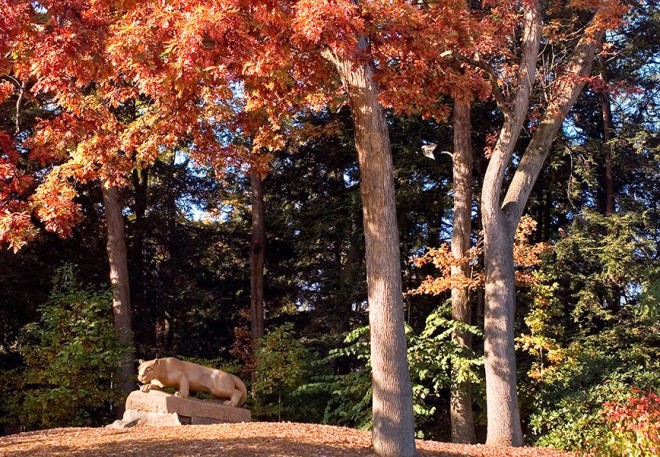
    The Nittany Lion Shrine was reopened this week after a summer of renovation. Kevin Horne, Managing Editor of Onward State, shares his perspective on the iconic symbol of the campus:

    I grew up only an hour away in Williamsport, so this campus was no stranger to me when I enrolled at Penn State three years ago. Consequently, neither was the Lion Shrine. (Proof: Flat Stanley and myself, circa 1999. I was a lot cooler back then, as you can see.) I didn’t realize it then of course, but there was something magical about the simplicity of the whole thing. When Heinz Warneke sculpted the Shrine 73 years ago, I don’t think he could have imagined the landmark — some might even call it sacred ground — that it would become. Indeed, you would hard pressed to find ANY Penn Stater who hasn’t snapped a photo with their arm around the thing.

    It was, in a phrase, a true “symbol of our best.” It wasn’t much, of course — just a statue on top of an eroding mountain of mulch — but isn’t there an endearing quality about something like that? Isn’t that sort of modesty something Penn Staters have always held close to the heart, much like the basic blue uniforms our football team will run out of the tunnel wearing on Saturday?

    I still get chills when I walk by the Lion Shrine. I would map out my nightly runs accordingly so I’d be able to pass the shrine with no one else around, looking stately as ever under the single spotlight. It was an emotion I couldn’t control, not because of how it looked or the landscape surrounding it, but because of what it symbolizes to generations of Penn Staters. A student today could talk to a student who graduated 50 years ago and the Lion Shrine is one symbol they share in common. In today’s thirst for modernity, that timelessness is difficult to find.

    I walked over the new Lion Shrine yesterday morning and I just couldn’t shake the pit in my stomach no matter how hard I tried. Don’t get me wrong — the place looks fine. Aside from the base of the statue, which clashes with the actual Shrine and sticks out like a sore thumb, it’s an aesthetic improvement for certain. It’s also important to have a ramp for handicap access. But I don’t think it will ever be the same for me. The area just feels so scripted and manmade — almost like there should be a gift shop peddling Lion Shrine postcards and coffee mugs off to the side somewhere (don’t get any ideas, Old Main). It has lost the magic of simplicity. In this era of change, that magic is hard to come by.

    I’m sure I’ll get over it. It is, after all, an impressive display. But I know that I’ll always miss that modest mountain of mulch. And I know that when my kids come to Penn State and I take their first Lion Shrine picture, something will be missing. At least to me, anyway.

    Photo credit: Penn State University

  • Introducing ‘Conserving Mount Nittany: A Dynamic Environmentalism’

    Introducing ‘Conserving Mount Nittany: A Dynamic Environmentalism’

    What are the things we care to conserve?

    I’ve been fascinated by the idea that there are certain things we can preserve through time, keeping safe from change, passing along from generation to generation—and yet keep them as living parts of our lives, rather than mere artifacts. In families, heirlooms serve this role. They’re not untouchable things kept behind museum glass. They’re objects that acquire new significance with each passing year. A grandfather’s gun or war uniform, fine china, or a simple photo album.

    Entire communities have their own heirlooms, so to speak. They conserve certain things as a benefit for all, and for the future. Nationally we do this with places like Yosemite or Yellowstone. In Central Pennsylvania, the people of the Nittany Valley have done it for nearly a century now with Mount Nittany. The Mountain, owned and maintained by the people through voluntary association, is a “public good, privately owned,” as the Mount Nittany Conservancy thinks of it.

    It’s Central Pennsylvania’s most famous mountain, and a symbol of Penn State University and the Nittany Valley. Yet the story of Mount Nittany’s conservation hasn’t really been told except in bits and pieces. I wanted to tell that story, which is why I wrote “Conserving Mount Nittany: A Dynamic Environmentalism.”

    “Conserving Mount Nittany,” published by Nittany Valley Press and available in paperback as well as on Kindle, iBooks, and Nook, tells the story of the conservation of the mountain through original research and conversation with Dr. Ben Novak, the founder of the Mount Nittany Conservancy. It’s an easy, invigorating read at 180 pages—perfect for a slow summer afternoon. While the book is available now, I’m treating summer as a sort of “soft launch” period, meaning I won’t be promoting the book heavily or doing any speaking engagements until autumn—but it’s yours to enjoy now if you’re ready.

    In writing and assembling the book, I purposely sought to craft a comfortable, conversational narrative tone. It’s my hope that after reading it, you’ll be able to put it down feeling like we’ve just sat together reminiscing and reflecting over a lager at The Tavern, or maybe a coffee at The Cheese Shop. I didn’t want this to be a boring, distant history, but instead a lively and human one.

    Roger L. Williams, Executive Director of the Penn State Alumni Association, praises “Conserving Mount Nittany” as a “meta-story of pride, determination, and action born of love … to preserve the largest natural physical symbol of our alma mater.”

    The story of Mount Nittany, as I seek to convey in the book, is that of a remarkable and dynamic sort of environmentalism—because its story is just as much a story of the people of the Nittany Valley as it is any dry effort to preserve some land tract. Mount Nittany provides a chance for anyone who hikes her or simply admires her to learn a bit about themselves. As Terry Dunkle has put it so well, it’s chance to stop and listen to the “whisperings of the heart” that can get drowned out in the noise of everyday life. It’s a chance to recover oneself amidst an evergreen nature.

    We are part of Mount Nittany’s continuing story, in other words, which is why I’d like to hear a story of your own about the Mountain. The first ten people to offer a reflection or share an experience of Mount Nittany in the comments will get a complimentary copy of “Conserving Mount Nittany” in their format of choice. Share a great short story, and let me know what sort of copy you’d like.

    It was a really very fun book to assemble. It’s gratifying to see it in print, and I hope it can be a worthwhile and exciting guidebook for Penn Staters everywhere and especially the special people of the Nittany Valley, who every morning get to wake, live, and love in Mount Nittany’s gentle shadow.

  • The Student Contributions to Penn State

    The Mount Nittany Conservancy’s “Ben Novak Fellowship” provides Penn Staters and Nittany Valley residents an opportunity to encounter the Nittany Valley’s legendary spirit through cultural and environmental experiences meant to enhance appreciation for our distinctive community and encourage friendships for the future. The Mount Nittany Conservancy’s Ben Novak Archives are intended to help new generations encounter the Ben Novak Fellowship’s namesake.

    Ben Novak, founder of the Mount Nittany Conservancy, delivered the following speech in his capacity as a Penn State Trustee to the Board of Trustees at its November 1989 meeting:

    Chairman Huck, President Jordan, President Althaus, President Martin, Representative Donaldson, Chairwoman Atwood, Members of the Board:

    The subject I am addressing today is students. Everybody likes stories. So sit back and relax, and let me tell one of the greatest stories of the spirit of Penn State and what it has meant to the greatness of this University. It is a story rarely told, and so for most of you will be new. It is a wonderful story of how much the students of this University have contributed to most of the things we feel are really great about Penn State over the past 130 years. For the student body, acting on its own, independently, usually without administrative or Trustee support, has played a vital role in Penn State’s growth which is without parallel by almost any other portion of the university community.

    Our story begins with a dream, the dream of our Founder and first President, Evan Pugh. When Evan Pugh arrived at the Farmer’s High School to take up his duties as President in 1859, he found little to excite the imagination. He found a building under construction, and a few students who came to learn the practical aspects of agriculture and the mechanic arts. It was a high school, and barely that; little more than a vocational trade school for farmers. But Evan Pugh had a dream that Penn State was to be more, much more than that. In his mind’s eye he saw the great University that was to be. “I would create a noble institution,” he said, “such as Yale or Harvard or Princeton.”

    But how was such a dream to be even begun, let alone realized? Evan Pugh turned to the students. Penn State would have to be more than a vocational trades school. Evan Pugh had told the students that “the only regret of his entire childhood” he later wrote, had been “those two years wasted in learning a trade.” So he inspired them to make the Farmer’s High School more than a trade school and to make themselves more than just tradesmen, but to become men of character. And in the fall of 1859, the students raised $250 and began to make the school a real College. They formed the Washington and the Cresson Literary Societies. Without faculty, budget, position or status, the students began to mold Penn State into the University it was to become. These societies created their own reading room, and built up libraries that Wayland Dunaway recounts, rivaled the College Library. In 1896 funds were made available to create chairs of language, literature, history and philosophy, and the College began to provide the Liberal Arts education our land grant charter had called for. But for 37 years, the students had done it largely on their own, creating the spirit of a real University before we were even a college.

    These student societies created the first printed publications ever published at Penn State. In 1873 and 1874 they brought out the Cresson Annual and the Photosphere. These were completely created and funded by the students themselves. Indeed, in the earliest issue the editors reported that their journal was not only “the latest thing out,” but that the editors were also “out, out of pocket.”

    The journals continued until 1887 when these two Societies formed a Joint Committee to bring out a regular college newspaper called the Free Lance. The Free Lance, as you know, was the forerunner of the Daily Collegian. Just two years ago, the Collegian celebrated its 100th Anniversary, remembering the founding by students, on their own, of what became Penn State’s award winning daily newspaper.

    But creating the forerunners of the College of Liberal Arts, and the Daily Collegian were not the only things that students created on their own.

    The 1890s are recorded in the official history books as the years of great growth for Penn State. In the late 1880s under the dynamic leadership of President George W. Atherton, funds became available for new buildings and an expansion of the campus which would enable the college to increase in size by almost one thousand per cent in the next few decades.

    But that period of growth was also a time of crisis for Penn State. The plans for the college called for growth, but there were no funds for dormitories. The town had not grown enough to provide for an influx of that many students. If the college were to grow, where were the students to be housed?

    The College once more looked to student initiative. In 1887 the ban on Fraternities and secret societies was lifted. Students were allowed to organize themselves independently. The results were spectacular. In the next 20 years, the students built 38 dormitories on the campus and downtown, in the form of Fraternities. The student body grew from 287 in 1887 to about 2,500 in that period, with about three quarters of these new students living in entirely student created housing.

    In effect, once freed of administrative oversight and intervention, students built an average of almost two dormitories a year from 1888 to 1918. They did this without administration support, without a Dean of Students to do it for them, and without government funding. They did it on their own. And they made those Fraternity houses the most beautiful buildings and architecture in the entire Borough.

    Without students providing this housing on their own, our campus could not have grown. There was no General State Authority then. There were only the local banks and local mortgage financing. But Penn State students were able to bond themselves together, in such strong bonds of loyalty, that the Penn State Alumni News reported in the 1920s that banks considered these student fraternities to be the safest investment in the United States.

    Football today we like to think of as one of the most important parts of Penn State life. It, too, was begun entirely by students, without help from faculty, administration or the Board of Trustees. Intercollegiate football games were originally organized entirely by students, beginning in about 1882, with the first “regular season” in 1887. This was set up without any administrative support, without coaches, and little but student initiative. Indeed, it is recorded in the history books that,

    “…prior to 1894 the student body frequently raised and discussed the question; why do not the Faculty and Alumni take more interest in athletics?”

    Indeed, the early athletic programs at Penn State were entirely funded by the students themselves. Dean Erwin Runkle reported:

    “Games are financed by subscription; by contributions from the players themselves; by a series of lectures and entertainments…”

    From the earliest, intercollegiate games, until 1891, there was no paid coach, until in that year the student body petitioned for one, and voted to add one dollar to their student activities fee on their tuition bill to fund a “Chair of Physical Culture,” so that they could have a coach.

    It was student initiative, student self-sacrifice, and student creativity which created both our football team and our College of Physical Education. They raised their own tuition, taxed themselves, and initiated the whole sports program at Penn State, by themselves.

    Student initiative also created our college spirit and traditions. In 1907 a few students anonymously brought out a monthly publication, called The Lemon. In it, the students ribbed the Professors and other students, and argued strenuously for a school flag, school mascot, school colors. They raised school spirit and the student body adopted the Nittany Lion as our mascot, blue and white as our school colors, the official class ring, and the school songs we still sing at Football games.

    The editors of The Lemon also had a magnificent sense of humor. Shortly after starting The Lemon, another anonymous publication appeared, called The Squeeze, which lampooned and ridiculed everything which The Lemon advocated. The campus came alive through the dueling of The Lemon and The Squeeze for almost two years. It was only after the students who brought out The Lemon graduated that the campus learned that both journals had been brought out by the same group of students!

    You can easily guess that these two journals were also the genesis for The Froth, Penn State’s longtime student humor journal.

    In the 1940s came new challenges to students. After World War II Penn State grew like “Topsy” in order to meet the needs of thousands of returning veterans on the GI Bill. The Administration grew, and soon took over almost all of Old Main. The student offices and club rooms and meeting rooms were removed. The students were given a small temporary building, called the TUB, to serve the needs of 5,000 students. That same building we know today as the Robeson Cultural Center.

    This time the students needed help. They petitioned the Board of Trustees for a student bookstore and commissary and a student union building. All were denied. The Board had funds for everything except students. But, rather than demonstrating or protesting, the students once again showed that magnificent Penn State spirit which had served the College so long and so well. It was the Penn State student “can do” spirit which said, “Okay, we’ll do it on our own.”

    And they did. They created their own student bookstore and book exchange, the forerunner of the huge Penn State Bookstore today. That bookstore was entirely run and managed by students from 1949 until the late 1960s. I particularly remember this because from 1962 to 1964 I spent many long hours and late nights serving on its student board of control.

    The students not only created a store, they also built the HUB, their own student union building, by themselves. They devised a two part plan. First, a student insurance program with funds from premiums going into a student union fund. And, second, in a wonderful show of student spirit and self-sacrifice, the student leaders of the All-College Cabinet met in 121 Sparks in May of 1950, and once again voted to raise their own tuition.

    At that time, and since the 1890s, when the $1 was added to the start the football team, the tuition bill had two parts; regular tuition, and a student activities fee set by, and distributed by, students themselves.

    It was this student activities fee portion of the bill that they increased. Now that increase in 1950 was much larger, percentagewise, than the 10 per cent increase in tuition which this Board voted just two years ago. But the students, at that time, gladly voted to increase their tuition because they knew the College needed a student union.

    What was most impressive was a rather startling fact. The students who voted to increase their tuition in 1950 knew that they themselves would never get to use the facility that they were paying for. The HUB did not open until 1955, five years after all the students who voted for it had graduated. But they had a belief in Penn State, and a willingness to sacrifice for Penn State, and they gladly voted to increase their own tuition for the Penn State that was to be.

    It is an interesting footnote that after the HUB was built, the fee was never rescinded. In a deft move, the administration incorporated the enlarged student activities fee into the general budget and announced they would appropriate money for student activities from the general fund. Thus, at a single stroke, the student vehicle to creativity, which had created the football team, the forerunner of the College of Physical Education, and had built the HUB, was removed. And, it seems, the students are still paying for the HUB 39 years later.

    But through it all, Penn State grew in depth and stature, in tradition and in size, largely made possible, when the going got tough, by looking to student initiative to create for Penn State what was needed.

    Many of you enjoy the Central Pennsylvania Festival of the Arts every year. Today the festival attracts about 300,000 visitors to State College each year, and is one of the top summer attractions of both Penn State and the town.

    But the Arts Festival, too, was initiated by students in the early 1960s. It was begun by students of the HUB Committee and run for several years as the “Spring Arts Festival,” a very successful student celebration of the Arts.

    I fondly remember the student arts festivals very well, because in 1964 I was “pinned” to the beautiful chairwoman of the Festival (who, back in those days was still called a “Chairman”) and presented her with a lovely bouquet of red roses at the Festival Finale.

    In 1966 the Spring Arts Festival was taken over by State College and the University and made the Central Pennsylvania Festival of the Arts. It is no win its 23rd successful year and many of us have annually attended it. But its beginning arose from the genius, initiative, creativity and hard work of students.

    There are many more stories about the contributions which students, when they have been given the chance, have been able to make toward the greatness and growth of Penn State. Both in times of crisis and in times of great growth, they have provided the spirit and concrete contributions which have impelled Penn State along its present path of greatness.

    When we look around the campus, from Rec Hall to Old Main, from the Nittany Lion to the Hetzel Union Building, from the College of Physical Education to the College of Liberal Arts, from the campus to the more than 50 beautiful buildings of the Fraternity District. We see the contributions of student creativity, innovation, self-sacrifice and constructiveness.

    What is the moral of the story I have told? It is this;

    Penn State is a living body, and the student body is an important organ of that body. And just like your own body, when one organ is not functioning well—whether it be the heart, lungs or liver or brain—the entire body ceases to function well. I believe that the student body is an organ of Penn State which is as important to the health of the whole, and has as much to contribute, as the faculty, the administration, the Board of Trustees, the staff, and the alumni.

    Students are not customers, nor commodities, nor resources to be managed. The student body is a vital organ of the University which has contributed much to Penn State’s growth and greatness in the past, and has an even greater contribution to make in the future. All they need is your respect and a chance to show what they can do in the future, on their own.

    I have a dream. I see a day when the TK sports part of the student body at Penn State, in independent, constructive endeavors, in adventures of the mind and spirit, in publications and organizations, can engage and enlist the enthusiasm and involvement of our alumni just as much as the football team. And I see the student body, working with townspeople and alumni, making Penn State and the Nittany Valley—and all our Commonwealth campuses—the most intellectually exciting, morally stimulating and mentally alive campuses of all the colleges and Universities in America. I would like this to be our dream.

    The key to unlocking that creativity is what it has always been: independence—the same key that unlocked the greatness of America in 1776. When students are free of red-tape and bureaucracy, whenever they are let go to organize themselves and encouraged to work creatively with townspeople and alumni; they have done nothing but bring glory, pride and honor to Penn State, and contribute to the greatness of our University.

    And so I ask you, remember the students. They are our reason for being. They are our pride. They are the source of our spirit. They are our past and they are our future. They earn the honors. They win the football games. They are what we exist for. Without the students, no matter what else we do, we would not be able to call ourselves a University.

  • The Initiation: A Parable of the Mifflin Streak

    The following poetry was provided to the Mount Nittany Conservancy in the 1990s by a Penn State who wished to remain anonymous. It is presented here as an ode to a Penn State tradition of many years.


    I have often climbed Mount Nittany and spent afternoons and sometimes all night gazing at the valley and the campus. In my mind I would wander, trying to find a deeper meaning in the commonplace things which are often dismissed as unimportant. One day I was sitting on Mount Nittany thinking of what had happened last spring at the “Mifflin Streak.” That was when the idea of this poem came to me.

    The poem is not set on campus, but begins at the foot of a mountain as an initiation ceremony. The poem would seem to have no connection to the Mifflin Streak, except in the wandering mind of a poet.

    The initiation described has no counterpart in fact except that I freely admit to borrowing from newspaper accounts of initiations at other colleges at other times.

    These verses were not written to be skimmed with the eyes, but to be read aloud, several times, moving the lips, giving a chance for the rhythm to be physically felt and for the images to take sensual form. The goal is not to convey information, nor to make a point, but to break through the crust of everyday experience. For poetry is, in its best sense, our deepest longings taking form in our imagination, bringing our senses into congruence with the deepest felt experiences of our civilization.

    The Initiation

    I. 

    Assembled under ancient trees
    On paths once strode by Indian Braves
    Initiates of a noble order
    Waking spirits from their graves.

    Eyes enfolded in a kerchief
    Cannot see to walk or stand
    Up the Mountain blindly climbing
    Hand on shoulder, hand in hand.

    Footsteps groping through the forest
    Feeling for each stone and leaf
    Crossing logs and brooks and gullies
    Hearing whispered ancient beliefs.

    Trusting blindly to tradition
    To those who walked where they now tread
    Beating hearts must trust in friendship
    To someday lead where they’re now led.

    Past the ledge where ancient fires
    Warmed the hunters, cooked their kill
    Spirits of brave men long ago
    Still take away the dark night’s chill.

    II.

    At a pool of deep still water
    Guides remove the kerchief blind
    The young boys stare at stars reflected
    In the pool and in their minds.

    At the spring they taste the water
    Which anoints them deep inside
    Makes them part of past primeval
    Awakening what they thought had died.

    Now it lives! And they’re the vessels
    Bodies with new lives to wear
    Dreams unfolding, visions rising
    From depths they did not know were there.

    They sense within them spirits moving
    They hear old cries of victory
    They feel the deaths — and births — of heroes
    And lose their fear of agony.

    III.

    Then on they walk in wonder waiting
    Each mind reeling, then at peace
    Blindly following ever upward
    Led to unknown mysteries.

    Walking through the forest primeval
    Under vaults of ancient trees
    ‘Til they feel they’re in an opening
    Their blinds removed so they can see.

    In the clearing men stand naked
    Sons of fathers, sons of sons
    Leaping flames and blazing fires
    Beckon to the chosen ones.

    Light illumines awe-struck faces
    Unexpected shock appears
    Dismay, concern at what will happen
    ‘Til the voices calm their fears:

    “You do not live in just this moment
    Others before you faced it, too
    You will stand here naked next year
    Feeling the fear we felt from you.

    “The nakedness you see before you
    Is not for you to touch or feel
    Pleasure is not what man was made for
    Higher goals will be your seal.

    “For the beauty of the gods in heaven
    Is not their flesh, it’s not their youth
    That’s only the visage of their spirit
    To be a man is to seek the truth.

    “But truth’s alarming, truth’s unsettling
    Truth does frighten, truth is spurned
    That’s the reason for this baring
    This the lesson to be learned:

    “Never fear the naked body
    Never fear the naked soul
    Never avoid the naked truth
    And never reject the naked role.

    “Never fear humiliation
    Don’t fear suffering, pain or tears
    The mark of a man is never flinching
    The only thing to fear — is fear.

    “If you have courage and heart and honor
    You’ll stand naked before all men
    You’ll follow your heart where ere it leads you
    Into the flames or the lion’s den.

    “So learn this lesson, learn it well, boys,
    On this our brotherhood depends:
    Having guts is all that matters
    When that is lost, our brotherhood ends.”

    This is how the bond is fashioned
    Naked truth becomes a trust
    Fear transformed by faithful listening
    Words can now break through the crust.

    IV.

    The men now dress in sacred clothing
    Cloaks of honor, caps of care
    Naked truth, a source of loathing
    Now is something they can bear.

    Now they circle round the camp fire
    Each one sits to form a ring
    Then the elders rise to face them
    Each in turn to speak and sing.

    Now are told the ancient stories
    Here the secrets are revealed
    Now the spirit’s incarnated
    Here the fellowship is sealed.

    Then silence. The fire dies to embers
    And in the dark, stars reappear
    The men in cloaks resume their journey
    Young men follow without fear.

    V.

    As they walk they see the stars are
    Growing closer, step by step,
    The earth recedes, the ground grows farther
    They’d enter heaven if they leapt.

    They walk until they reach the summit
    Of the sacred Mount they climb
    Here occurs the last experience
    Which must break the bonds of time.

    For time corrupts and time effaces
    Time’s the enemy of man
    Unless it’s formed in timeless places
    A bond can shift like shifting sand.

    When they reach the highest point
    Where the Mountain touches sky
    Here each man beholds his brother
    Stares him sternly in the eye.

    Hands reach out to pluck the stars
    And place them where his brother sees
    From this night on his brother’s eyes
    Will be his mark of loyalty.

    When stars replace the eyes they glisten
    Streams of diamonds flood the face
    Stars are the eyes of gods and angels
    The beauty seen by the oldest race.

    Nothing can efface this moment
    Can’t erase this time or place
    Each man sees within his brother
    The starry eyes of all the race.

    At that moment every man
    Who has ever lived or ever died
    Is still alive and sees them seeing
    And gazes right back through their eyes.

    Then the gaze is quickly broken
    Resurgent time has healed the breach
    Timelessness has no duration
    The stars are once more out of reach.

    VI.

    In silence they begin descending
    And wonder if they’ve dreamed it all
    ‘Til tears they see on their brothers’ cheeks
    In the light of stars like diamonds fall.

    Now they know the sacred meaning
    Understand why time was breached
    Their eyes now see down through the ages
    Farther than they’ve ever reached.

    The ancient wisdom’s been transmitted
    As it’s always been from age to age
    The light of the world is in their eyes
    As was foretold by the ancient sage.

    VII.

    They’ll never talk of what has happened
    Never say what they have seen
    But they’re now men of deeper courage
    Deeper strength and deeper dreams.

    And each evening they remember
    The time they climbed that Mountain top,
    Recall the naked truth they learned there
    And the time when time was made to stop.

    Something happens on that Mountain
    Something to do with faith and stars
    It’s easy to know just who’s been up there
    Look for the men whose eyes see far:

    Naked truth becomes their passion
    And they seek stars most men don’t seek
    And timeless eyes watch o’er their sons
    And diamonds glisten on their cheeks.

    Epilogue
    An Imaginary Student’s Response

    “And if this hasn’t happened to us
    Why has it not? I’d like to know
    The stars in the sky seem far away
    Where di the men of courage go?

    “Let’s climb that Mountain, pluck the stars
    Two for your eyes, two for mine
    Brothers and guts we know we need
    We’ve got to stretch the bonds of time.

    “We’ll learn the secrets on our own
    Like all such things, they’re plain to see
    We’ll search the wisdom in old books
    Until we’ve found the ancient key.

    “Such a quest is worth all efforts
    Nothing else will suit my eyes
    Until I find the men of courage
    And see the watchers in the skies.

    “And if you won’t go, I’ll go alone
    I’ve got to overcome my fear
    Damn it! There is more to life
    Than textbooks, classes, parties, beer.”