Mount Nittany Newsletter
Subscribe for free to the Mount Nittany Newsletter, or become one of our “Mount Nittany Guardians” at $10/month or $100/year to receive subscriber-only posts.
Subscribe
A newsletter for all those who love Mount Nittany and dwell at heart in her gentle shade.
-
Penn State and State College in their early years

Eric Porterfield, a friend of the Mount Nittany Conservancy, recently shared these historical State College photos. These photos show in a dramatic way the development of State College from something less than a speck on the map into the place we know it as today. They’re a witness to our community’s past, to Pennsylvania’s past, and to the “splendid isolation” and enchanted seclusion that still define places like Mount Nittany:
1876- College Avenue and Beaver Avenue as taken from Old Main tower. The frame house on the left, along East College Avenue, was the John Foster home. This house remains today at 130 East College Avenue:

1890- South of West Beaver Avenue. A child stands in a field on the William Foster farm, the site of present day Memorial Field and Central Parklet:

1924- A view of our growing town from the Old Main tower:

-
In Search of Evan Pugh, or, a Challenge for Penn Staters to Honor Their Founder

Three Penn State presidents have been laid to rest here in Centre County.
President Atherton is famously interred right along Pollock Road adjacent to Schwab Auditorium, while Milton Eisenhower finds his final repose in Centre County Memorial Park along the Benner Pike. Evan Pugh, Penn State’s founding president and one of the most consequential personalities in the Valley’s history, whiles away eternity just a short journey from the flowering campus whose humble seeds he planted. He is memorialized as a scholar, scientist, and leader at his gravesite in Bellefonte’s Union Cemetery.
Soon after his arrival here, Pugh began courting, and eventually married, Rebecca Valentine, daughter of one of Bellefonte’s most important families. He is buried alongside her in the family plot. Once a hub of power and influence throughout the commonwealth, attractor of wealth and exporter of governors, modern Bellefonte retains much of its historic character, but only a fraction of its practical significance. So it is with the gravesite of its once-famous socialites. In their time, Pugh and Valentine were the Nittany Valley’s original power couple; now their place of honor lies in silent neglect. The community that inherited their legacy bustles on ahead, its founder largely forgotten.
The first president of Penn State deserves better.
Over its 160 years, Old State has weathered wild turbulence blowing in from the wider world—civil war and world war, social revolution and heart-breaking scandal—more than once it has teetered on the brink of extinction, yet always it has persevered. Pugh deserves to be remembered as the progenitor of that hardy nature, our penchant for defiant survival.
While barely remembered or recognized today, Pugh is the perfect central character for Penn State’s origin story. Erwin Runkle, the University’s first historian, painted him as possessing “a rugged, energetic physique, a straight-forward common sense manner, combined with the heart of a child, and the integrity and moral robustness of mature manhood.” A bull-necked he-man built to tame the wild, but with a keen, inquisitive mind better suited to conquering a more esoteric landscape.
When he assumed the presidency of a fledgling agricultural college situated in what, to most, seemed like the middle of nowhere, but Pugh called “splendid isolation,” the entire notion of bringing the baser study of agriculture and industry to the hallowed enterprise of higher education was itself a risky proposition. Only through Pugh’s dogged leadership and dedication to a revolutionary vision for American education did the Farmers High School find its footing, and though he tragically died young, so impactful was his short time that its influence echoes through the ages.
The man deserves a statue or memorial on campus. As things stand today, we’ve failed even to honor his memory by caring for his burial place. Seemingly abandoned by the family line, the Valentine plot has fallen into disrepair over the decades. The tombstones have become grimy and covered in lichen; the landscaping, such as it is, overgrown and unkempt, and the once-ornate wrought iron fence enclosing it crumbles. Intermittent efforts have been made throughout the years to rectify this neglect, for which former trustee George Henning deserves a great deal of the credit. However, none of these has been long sustained.
A challenge exists for those Penn Staters willing to take it up: systematically repairing the aesthetics of Evan and Rebecca’s resting site. While the simplest tasks—bagging leaves, cutting grass, washing off the grave stones—are accomplished easily enough, the issues of repairing the fencing and routinizing the maintenance will be heavier lifts. The work will be rewarding, and if the Penn State Alumni Association and others work together, the work could come to serve as one the most powerful public witnesses to the depth of respect and honor that Penn Staters have for their founders.
The journey of exploring Pugh’s back story has revealed much that might not be expected: Finding an original handwritten copy of Rebecca Valentine’s will at Bellefonte’s Pennsylvania Room, encountering the Bog Turtle Brewery in Pugh’s hometown of Oxford, PA and their limited run of Evan Pugh Vanilla Porter, discovering a forgotten memorial marker placed by the University on family lands still inhabited by Pugh’s distant descendants.
We can take pride in restoring some luster to the memory of our Penn State family’s “first couple,” and we enjoy the pleasant surprises along the way.
Why all the fuss? If, today, so few people venture out to honor Evan Pugh’s memory that his grave has fallen into disrepair in the first place, why bother with some long-dead historical figure whom it seems most people can’t be bothered to remember?
Because whether you are an individual or a community, knowing your story—and honoring its heroes—builds confidence and strength. There is an intrinsic quality to humbling ourselves by acknowledging our place within a community and its continuum, a process that is best experienced with sacred retreats where this reverence may be felt most keenly.
Roger Williams, former Penn State Alumni Association executive director and author an upcoming Evan Pugh biography, has called him, “Penn State’s George Washington.” That seems someone worth remembering, even if by only a few.
-
Penn State Football Remixes Its Past
Suffering through a prolonged period of frustration and despair, the Penn State football team faces a do-or-die moment in an early Big Ten contest: Trailing in the fourth quarter and needing an unlikely game-extending play to keep hope alive, the Lions thread the needle, capping off a precarious come-from-behind win with an explosive score from their star playmaker. This escape turns a potentially season-unraveling disaster into the catalyst for the program’s return to glory.
Two weeks later, following a blowout home victory, the Lions score a destiny-altering upset win over a highly-ranked Ohio State team under the lights, sealed with an unforgettable play sure to grace highlight reels for years to come. The team then blossoms into the sort of powerhouse that recalls Penn State’s tradition of gridiron dominance, quickly obscuring memory of a decidedly lackluster recent past. The denizens of Nittany Nation are treated to one of those unforgettable Autumns for the ages—everything from merchandise sales and hotel reservations to alumni donations and season ticket renewals pick back up—as Penn State cruises to an improbable conference crown, one made all the sweeter for just how completely unlooked-for it was before the season began.
While that passage perfectly describes this year’s exhilarating football season, it applies equally to another unexpected comeback campaign from a decade ago, when the 2005 Nittany Lions rescued the program from its early-decade doldrums. Back then, it was Derrick Williams scoring on Northwestern instead of Saquon Barkley against Minnesota. This year, Marcus Allen and Grant Haley combined for the Ohio State game’s signature play rather than Tamba Hali and Scott Paxson.
Just like in 2005, it is probably true that the crowd inside the Lasch Building—Penn State’s players and coaches—had an inkling of the squad’s potential. It is equally fair to say that they were probably the only ones. So the ’05 comparisons may be the most obvious—especially for me, perhaps, as I wrap up work on a book about that season—but in this year’s climb back into college football’s highest echelons, the Nittany Lions offered other echoes of the program’s rich past. Let’s try this one…
After back-to-back uninspiring seasons with identical winning, but underwhelming records, grumbling and skepticism about the head coach is bubbling to the surface with increasing frequency and volume. Into the fold steps a dynamic, but previously unheralded dual-threat quarterback who’d shown the first hints of his potential in the team’s last bowl game. He replaces a multi-year starter, a prototypical pocket passer (wearing number 14) who arrived on campus as an elite recruit, but went on to frustrate and confuse observers with on-field struggles. Despite lacking his predecessor’s recruiting star power, the young man proves to be a heady winner, running and passing his way into the school record books and fans’ hearts as he commands a potent offense that leads Penn State to the Big Ten title, but the bittersweet finish of a Rose Bowl loss to USC.
Did I just describe Daryll Clark succeeding Anthony Morelli for the 2008 Nittany Lions or Trace McSorley’s ascension following the rocky tenure of Christian Hackenberg? Appropriately for this age of the remix, the mashup, and ‘The Force Awakens,’ parallels and callbacks to the past abounded for Penn State this year, as a new generation of Lions inspired nostalgia for the program’s winning ways.
Although 2016 was an up-and-down year for Old State’s defense, in its brightest moments, the unit seemed to channel the very best of their predecessors, such as the stalwart 1986 national champions (right down to linebacker Jason Cabinda’s neck roll). Not since that ’86 season, when the late John Bruno was arguably the Fiesta Bowl MVP, has a punter meant as much to a Penn State team as Blake Gillikin. An invaluable weapon all year in the crucial battle for field position, the true freshman’s heady dash to track down an errant snap and prevent an Ohio State touchdown meant just as much to his team and its season as any time Bruno pinned the Hurricanes deep that night in Tempe.
Penn State’s last outright Big Ten championship came in 1994 (Ohio State earned a share of the 2005 and 2008 titles despite losses to PSU), a year when the Lions unleashed a potent, score-from-anywhere offense. With Trace McSorley playing a more mobile Kerry Collins and Mike Gesicki a rangier Kyle Brady, Joe Moorhead’s group made a fair impersonation of that legendary crew from ’94. But then, as now, the running game powered the juggernaut, and sophomore sensation Saquon Barkley is the team’s most superb tailback since the electrifying Ki-jana Carter. And not since ’94 (and maybe even then), when Carter was joined by Mike Archie and Stephen Pitts, has State enjoyed an assemblage of backfield talent like the current crop of Barkley, Andre Robinson, Miles Sanders, and Mark Allen.
An early season clash with Temple this year marked the 50th anniversary of Penn State’s 1966 opener against Maryland, which commenced Joe Paterno’s head coaching career and brought his first of 409 career wins. But one win this season managed to reach even deeper into the memory bank, back to the days of Rip Engle.
The 2016 campaign went to another level when an unranked Penn State upset the number two team in the nation, duplicating a feat the Lions had accomplished only once before, also against the Buckeyes in 1964, except that time in Columbus. It should be noted that the connection did not go entirely unnoticed in the lead up to the game (and if damage from the post-game celebration this year was disappointing, at least nobody dumped a car into the duck pond at Hintz!). Echoes of the past, but with a twist. Appropriate for a season that opened the door to reclaiming the program’s cherished history while simultaneously launching it into a new epoch.
But for the whims of a fickle playoff selection committee, the Big Ten champs could have joined their counterparts from 1978, 1982, 1985, and 1986: Penn State teams that finished the season with an opportunity to capture the national title by winning it on the field. Instead, group them in with the ’68, ’69, ’73, and ’94 squads that staked a legitimate claim on championship contention, but for various reasons, lacked the chance for a decisive game (the wisdom of 1994 New York Times computer analysis notwithstanding). What’s exciting now is the chance that they’ll be back – and soon.
Unlike the memorable squads of 2005 and 2008, this year’s team does not represent a “last, best shot,” an all-or-nothing opportunity for a senior-laden roster to leave its mark with an unforgettable final act. In one other important way, this season reminds us of those past: In the talent that returns or is soon to arrive via recruiting, the current state of Penn State football recalls the halcyon days when Joe’s teams would reload, not rebuild. Even as it rekindled memories of a rich legacy, 2016 also brought with it promise for the future.
Coach Franklin said it best. “This is just the beginning.”
-
Bog Turtle Brewery’s ‘Evan Pugh Vanilla Porter’

Penn State’s first president Evan Pugh was born in 1828 at Jordan Bank Farm, three miles south of the city center of Oxford, Pennsylvania, an hour west of Philadelphia, in Chester County. One-hundred eighty-nine years later, an Oxford brewery is honoring one of the preeminent champions of public higher education in the form of a delicious porter.

Bog Turtle Brewery, located right off the main street in downtown Oxford, started serving Evan Pugh Vanilla Porter in early November. It’s a true local operation — the brewery, which is just more than a year old, services several local bars and is open itself for a few hours five days a week for growler fills only (Growlers, for the uninitiated, are glass jugs you fill with beer to take home. There is no on-site consumption). The beer itself is a mild, light bodied porter, perfect for the winter months.
Bog Turtle’s decision to name a beer after Pugh happened in a completely random way. According to Chris Davis, the Bog Turtle’s financial guru, the brewery is located in what used to be municipal offices for the Oxford Sewer Authority. In one of the closets, the brewers found the Pennsylvania Historical Marker for Evan Pugh — previously posted near Jordan Bank High School — which had been damaged by a snowplow and removed some years before. It was this chance discovery that inspired the group to name its seventh-ever beer after one of the most important figures in Penn State history.

The vanilla porter isn’t the only reminder of Pugh in his hometown. Drive three miles south of Bog Turtle, deep into Pennsylvania farmland and adjacent to a Mennonite Church, and you’ll run into another subtle reminder of Oxford’s most important former resident. Jordan Bank Farm still exists, and two houses still inhabited by the Pugh family sit on the 56-acre plot on Media Road. A seldom-seen marker placed up against the roadway 50 years ago by Penn State and the local historical society marks the spot where Pugh was born.

Oxford is one of those magical, increasingly rare Pennsylvania towns that allows us to go back in time, even if just for a short visit, unimpeded by the distilled culture creeping into most places today (you won’t find a Target in downtown Oxford, for instance). If you’re ever in the area — it’s just a short detour on the way to State College from Philadelphia — take the opportunity to have a pint of a good beer and experience the world for a few moments like Evan Pugh did before he took on the responsibility as the founding president of the Farmer’s High School.

The Evan Pugh Vanilla Porter is not the first beer paying homage to an important Penn State figure brewed in recent years, but it is definitively the best tasting.
-
Yule Ales Add to Advent Spirit

Today, it is not unusual to enter a bar and find a laundry list of exotic beers on tap or to hear news of a local brew pub or microbrewery opening up. Such was not the case in 1984 (only five years after the legalization of homebrewing) when the editor of the Centre Daily Times approached local lawyer Ben Novak about writing a bi-weekly beer column for the paper. The following excerpt appears in The Birth of the Craft Brew Revolution published by Nittany Valley Press, which collects those columns, the very first of their kind in the United States, and makes them available for the first time since their original publication. They harken back to a time when only a small American subculture had discovered the endless, delicious possibilities of good beer.
***
‘Tis Advent, that holy time of the year when we begin to prepare ourselves for the coming of the Infant. In ancient days this time of year was exciting in a much different way than excitement is generally experienced today.
Nowadays, it seems, excitement is experienced as something that is thrilling because it is new, unknown, risky, sexy and dangerous. Today’s young people seem to look for excitement at the edge of life.
But the ancient excitement of Christmas was something quite different. Christmas wasn’t something which happened at the edge of life, but something that happened at the heart of life. It wasn’t a search for something new and dangerous. On the contrary, Christmas was as predictable as clockwork, and as familiar as one’s most favorite feeling. Each year Christmas came on exactly the same day, and everyone tried very hard to do the same things in the same way they had done them in the past.
To today’s young people that might sound boring. And yet … and yet … in those days it had seemed so very exciting. To me, Christmas had always seemed like a challenge without equal. It was an adventure in time. Every year people tried to see if they could rekindle and pass down the same feeling that had been felt on that first Christmas morn.
They all knew and believed with childlike simplicity that something wonderful had happened on that hallowed night almost 2,000 years ago. They believed that hearts had been opened and changed in a way that had never happened before. They naively believed through all the years since then that the original joy had been rekindled again and again each and every year at Christmas, just as it had been experienced on that first blessed eve.
Oh, the excitement of it all! Each year they wondered: Could it happen again? Would it? Could the magic still work? The anticipation grew to the highest levels of expectation and awe: If they did all the same things, heard the same stories, ate the same foods, drank the same drinks, rejoined in the same ways, would they again feel the excitement of their own first Christmas when they were children? Did they still have it in them to unlock all that joy one more time?
The wonder of it! Could their joy be great enough to renew again for one more year the tremendous joy of that first blessed eve in the year One, when the time of our time began? And so, on the 4th day after the winter solstice, when they were absolutely sure that the sun had begun to rise again in the heavens, they celebrated Christmas.
In ancient days everyone had worked so hard to make it happen again each year. They bought presents which they believed would bring out each person’s most childlike joy. They baked Christmas cakes and cookies, worked for weeks to prepare festive decorations for every room and window, searched out old recipes for Christmas goose or turkey stuffing, hung mistletoe in their hallways, hauled in the Yule logs, and brushed up on the ancient Christmas stories and carols to tell over again to their children and themselves. Old fights were ended, debts forgiven and friendships renewed in this season.
One of the smallest and least significant contributions to the annual challenge to rekindle the ancient joy was made by the brewers of Europe and early America. In those days everyone felt the obligation to contribute whatever they could to the annual renewal of the community’s joy. Each year the brewers made their small contribution by brewing special Christmas ales and holiday beers for the season.
The ancient tradition is undergoing a rebirth in America. Since the early 1970s, when there were only one or two remaining Christmas ales available in America, both small and large brewers are taking up the challenge to deepen the joy of the Christmas season by bringing out special seasonal brews.
Christmas ales and holiday beers are normally brewed deeper and darker than beers for other seasons. At Christmas time, one was expected to sip slowly to enjoy the deep contentment of the season and the memories of childlike joy.
As I write this column in advance of the season, most Christmas ales and holiday beers have not yet come on the market. But here are some names you might look for to taste the challenge of Christmas past:
– Aass Jule 01 (pronounced “Arse Yule Ale”) from Norway. This is a special, rich, malty, dark lager developed specially for the winter holiday season.
– Noche Buena Cervesa Especial from the Montezuma Brewery in Mexico. This is a Marzen-style brew in the old tradition of the Austro-Hungarian Empire. This is a dark brown, medium-bodied beer with a delicate malt taste.
– Anchor Christmas Ale. This is a special ale brewed to a different recipe each year. It is always a real ale, brewed especially dark, heavy and hoppy for the season.
– Newman’s Winter Ale. This is brewed in Ithaca, New York, as a “winter warmer,” and is a real ale, truly dark and different.
– Sierra Nevada Celebration Ale. This is brewed in Chico, California, by two of the most traditional-minded, dedicated micro-brewers in America.
– Boulder Christmas Ale, made by the “second largest brewery in the Rockies,” but nonetheless a very small micro-brewer. It is modeled after 17th and 18th century English mulled ales.
– F.X. Matt’s Traditional Season’s Best from Utica, New York. This is an amber, Vienna-style holiday special made by true craftsmen. It is trucked right through Pennsylvania to Washington, D.C., Virginia and Colorado, but is not marketed here in the Keystone State. Perhaps we must be more sincere this year in extending holiday greetings to our neighbors in the empire state.
Some other Christmas ales and holiday beers one might encounter in one’s travels are: Hudepohol’s Christmas Beer from Cincinnati; August Schell’s Xmas Beer from New Ulm, Minn.; Fred Koch Holiday Beer from Dunkirk, N.Y. (The Koch Brewery was recently purchased by Genessee); and Grant’s Christmas Ale from Yakima, Wash.
It is hoped that the Spirit of Christmases past will inspire many more brewers to introduce new Christmas ales and holiday beers in 1985 to reawaken the ancient joy of the season. And it is hoped that we all should imbibe them in the spirit in which they are brewed.
Ein Prosit der Gemutlichkeit!
-
A Salute to Veterans and the Veterans’ Education and Advancement Fund
The great stories of any age are often best understood by tracing the tiny threads of personal experience. In following these winding strands, seeing where and how they intersect, we come to understand how the collective weight of countless individual acts underpins the forces that shape our world.
On the afternoon of April 11, 1945, General George S. Patton’s 6th Armored Division, including a young soldier from western Pennsylvania named Albert Edward Matyasovsky, rolled in to liberate Buchenwald, one of the largest of the Nazi concentration camps. Among the 21,000 prisoners set free that day was a teenage boy named Elie Wiesel.
In a bustle of thousands of anonymous faces that day, the two never met. For a brief and meaningful moment though, the threads of their life stories intersected.
Wiesel, who passed away earlier this year, counted among the lucky few to survive the horrors of the Holocaust; he grew up to author over 50 books and win the Nobel Prize. Elie Wiesel was able to share his gifts with the world because of the sacrifice and bravery of American and other Allied soldiers. One of them, Matyasovsky, returned from war with a lifetime’s worth of experiences spanning Normandy to the Ardennes and beyond, fortunate enough to have come back home at all. He did not gain great wealth or notoriety in his post-war life, but as a father, he created a legacy and influence that will positively impact the lives of future Penn State students.
Al Matyasovsky, Jr., who recently retired from Penn State after decades overseeing the University’s waste management and recycling programs, has established the Veterans’ Education and Advancement Fund (VEAF), a scholarship endowment with the Penn State World Campus. He and his wife, Sharon, cite their parents, particularly Al’s father and mother, as their inspiration in launching this effort, which will provide financial assistance to veterans, active duty military, and their family members who are enrolled in the University’s online programs.
“We lived in a coal mining town for six years, very meager surroundings. My father used to have to carry water from a community pump up to our house that we drank, bathed in, and cooked with, and I never heard him complain,” the son recalls. Al absorbed the lessons of his father’s work ethic, but also the man’s oft-repeated core values: “Treat people with respect. Be fair. Be honest. Don’t lie. Don’t cheat.”
The “American Century” that blossomed in the wake of Allied victory in WWII brought widespread educational and economic opportunity to a generation of Americans. Despite an impoverished upbringing, Al’s commitment to following his father’s example brought on the academic achievement necessary to open those doors. As a senior, a meeting with his high school guidance counselor put Matyasovsky on the path to a college education.
“She said, ‘We send guys like you to college,’ and she got me all the money that I would go to college on… that changed my life. It demonstrated to me how people outside the family who have faith in you can affect your life in a tremendous way.”
Matyasovsky graduated from Lock Haven University, and after a few job and location changes, he obtained a position with Penn State that turned into a long career. Over more than 30 years of service, Al was in charge of many of the University’s solid waste management and recycling efforts. He managed gameday operations at Beaver Stadium for a quarter century, including post-9/11 security measures, and he also implemented some of the school’s most innovative and recognizable sustainability efforts.
These include the now-ubiquitous blue recycling bags that dot the tailgating fields during football season and, probably most notably, the annual Trash to Treasure sale at Beaver Stadium, where departing students donate items they would otherwise discard that are then sold to benefit the county United Way. Matyasovsky proudly notes that, since its inception, the event has raised over $750,000 for the charity while repurposing “stuff that was going to the landfill.”
After retiring, Al sought to finally make good on a long-held ambition to philanthropically support veterans, thinking of the inspiring role his father had played throughout his life. While considering the creation of a new foundation, he also spoke with staff at the University about his idea. Those discussions led to the creation of the Veterans’ Education and Advancement Fund scholarship within the Penn State World Campus. “The logic is that a veteran and their family don’t have to uproot themselves to come to University Park. They can receive a Penn State degree from anywhere in the world.”
An especially unique facet that distinguishes the VEAF, according to Matyasovsky, is the flexibility to also support family members of service members and vets.
“The love and admiration that we have for our parents is still very strong today. We feel that the family also deserves credit for supporting the veterans who defend our freedoms and support our way of life. Our fathers were in the military, and our mothers taught us the way of keeping family together and being part of the neighborhood and so on.”
The VEAF will hold its first fundraising event, a dinner at the Penn Stater Hotel and Conference Center, in April 2017. The fund is now a permanent part of the veterans’ support programming offered by the World Campus, which has been consistently ranked as the top online education program for veterans and active-duty military in the nation. As the lead donors, Al and Sharon are dedicated to growing the fund continually to amplify its impact.
“I’m not a hero for it. My father was the hero. I just did what my father and mother advised me to do. My mother used to say, ‘Being poor has nothing to do with who you are as a person.’ Both my parents told me, ‘Study hard. Get good grades, and good things will happen to you.’”
Follow the thread.
Through courage and fortitude, a generation of Americans like Al Matyasovsky, Sr. won battlefield victories that changed lives for millions, including a young Elie Wiesel. He returned home to support and inspire a son who went on to make a lasting impact on life here in the Nittany Valley, first as a long-time Penn State employee and now again with the VEAF.
Motivated by the memory of veterans who so strongly influenced their lives, Al and Sharon Matyasovsky’s efforts will enable the dreams of education and opportunity for future generations of America’s service men and women and their families. Until all is said and done, who can know how many more lives they will touch, how many more threads will cross their own and end up better for it?
-
The Penn State-Wisconsin Rivalry That Never Was
Recently, I found myself caught in Park Ave traffic behind a car adorned with an obnoxiously large Ohio State Buckeyes magnet. With merely a glimpse of it, my pulse quickened and my palms tightly gripped the steering wheel. As an ardent Nittany Lions fan, I recoiled at the unwelcome reminder of our rival.
And there it was, that loaded term.
A lot of ink, real and virtual, has been spilled debating what defines a genuine “rivalry” in college football. Because we have imbued the term with a certain sacred quality, participation in a recognized rivalry is its own form of cultural currency. Fans even seek to insult one another by denying that they consider an opposing school their “rival.” So what makes a rivalry?
When your new coach gives his introductory press conference, a rival is the team against whom he goes out of his way to promise wins (the lack of such most likely contributed to the recent job opening). When Jim Tressel arrived at Ohio State, he guaranteed wins against Michigan. Urban Meyer did the same. A couple years later, Jim Harbaugh returned the favor. In the ESPN documentary Trojan War, about the powerhouse USC teams of the early 2000’s, a newly-arrived Pete Carroll is shown listing his top priority for rebuilding the program: Beat UCLA.
Rivals face off on a regular basis; they play meaningful games at key points in the year. Rivals ruin each other’s seasons. Rivalries develop over time, organically; they thrive on geographic proximity (familiarity breeds contempt). They get nicknames, like the Civil War, the Apple Cup, the Red River Shootout, and the Iron Bowl. Speaking of which, sometimes great rivalries get a little out of hand.
And so I got to thinking, “Would a Penn State magnet in Buckeye country elicit a comparably visceral reaction?” When we classify Ohio State as a rival, do their fans reciprocate? Probably not. They’re still settling scores from the War for Toledo.
Ditto, Michigan. The M Club measures success in victories against the hated Buckeyes. What about traditional end-of-season foe Michigan State? Nope. Despite the best efforts of George Perles, Spartans fans will always care more about defeating the in-state Wolverines. Minnesota and Iowa have certainly played the role of antagonist at certain points in program history, but few, if any, of Penn State’s many wins over the Gophers and Hawkeyes carried similar significance. So do the Nittany Lions actually own a piece of that national conversation? Does Penn State have an undisputed, reciprocal “rival?”
Once upon a time, such a question would never be asked. Between 1896 and 1993, Penn State played 96 times, their Thanksgiving weekend clash resonating with media and fans nationwide. We got a glimpse of that again when the two teams staged their epic prize fight last month, the first of four meetings scheduled out until 2019. Pitt-Penn State was once a rivalry, and perhaps it can be again (here’s hoping). But at best, this latest renewal looks like no more than a fleeting echo of the past. The series is set to expire with no sign of further renewal on the horizon. The changing landscape of the sport conspires against it. True gridiron animus needs to flow through regularly-scheduled antagonism. The Lions still lack that one special somebody to clash with year-in and year-out in games of consequence. In the modern era, such consistency can only be found within your school’s athletic conference.
So what about Wisconsin? The Badgers, really? Stay with me here. It could have happened, and here’s how it almost did.
In 1993, Penn State completed its historic transition from football independence and began competing in the Big Ten. The Nittany Lions arrived bearing one of the sport’s great brand names, an asset that carried surprisingly little cache in a discriminating club with a century’s worth of tradition whose members had embraced the change with obvious reluctance. Most Big Ten teams had been facing off since the Depression, and Penn State was the new kid in the old neighborhood. The fit was (some would say “is”) awkward at times.
Three years earlier, in 1990, Wisconsin had hired head coach Barry Alvarez, a man destined to quickly lift the program out of three decades of malaise that its Wikipedia entry charitably terms “Limited successes.” While JoePa and the Lions were earning laurels and playing for titles as independents, the Badgers had been languishing as an afterthought in the conference often known as “The Big Two and Little Eight.” In the 22 years following Alvarez’s arrival, the Badgers would claim the Big Ten crown six times. Almost immediately, these two “square pegs” found, in each other, a reliable measuring stick in their mutual efforts to overthrow the regime of Ohio State and Michigan:
1995 – In their first conference meeting, Alvarez and the Badgers humbled the sixth-ranked defending conference champions with a 17-9 win at Beaver Stadium.
1996-97 – Two of the nation’s best runners, Curtis Enis of Penn State and Wisconsin’s Ron Dayne, faced off in two slugfests won by the Nittany Lions.
1998 – With Enis gone to the NFL, Dayne got his revenge, leading the Badgers to a 24-3 win.
2001 – A somber pall hung over the proceedings in the first week of games after 9/11, and an 18-6 victory for the Badgers denied Joe Paterno a chance to tie Bear Bryant’s all-time wins record in front of the home crowd.
2002 – Penn State scored a hard-fought 34-31 victory at Camp Randall Stadium, highlighted by four field goals from Robbie Gould.
2004 – Quarterbacks Zack Mills and Michael Robinson were knocked out of the game with injuries while Wisconsin fullback Matt Bernstein, fasting for Yom Kippur and running only on IV liquids, gutted the Lions’ defense for 123 rushing yards in a 16-3 win.
2005 – The last meeting between Barry Alvarez and Joe Paterno, a contest for sole possession of first place in the Big Ten, became a Senior Day to remember for the likes of Michael Robinson and Tamba Hali, who helped advance Penn State’s incredible comeback season with a 35-14 victory.
2006 – Wisconsin won 13-3, and new coach Bret Bielema earned the enmity of Penn State coaches, players, and fans by abusing a short-lived kick off rule to run out the first-half clock. Both events were obscured by a sideline collision that sent Joe Paterno to the hospital with a broken leg.
2007 – Unranked Penn State again reclaimed bragging rights in the series by pasting the #19 Badgers 38-7 in Happy Valley.
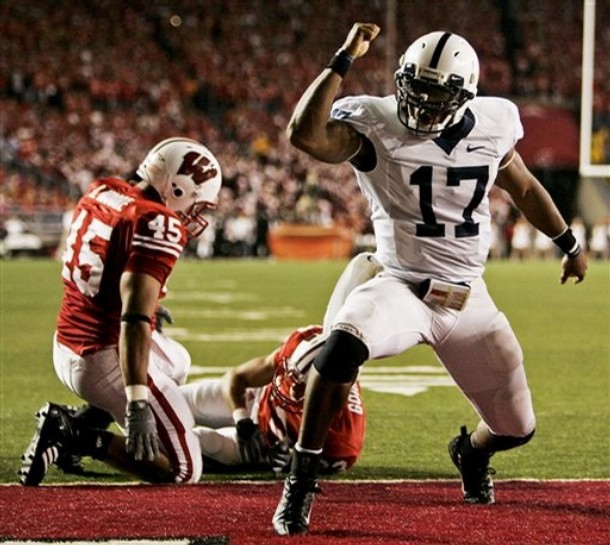
2008 – Derrick Williams took a punt to the house; Aaron Maybin burst onto the scene, and Daryll Clark created an iconic image. Badgers fans probably just wanted it to end, as Penn State grabbed the national spotlight with a 48-7 road win in prime time.
In 2010, the Big Ten welcomed Nebraska in a move that shook college football to its foundations and once again disrupted the equilibrium of the staid conference. For the first time, “the B1G” would divide its teams into divisions whose winners would play in a championship game. With Michigan State sorted into the other division, newly-minted division rival Wisconsin filled the void at the end of Penn State’s conference slate. By that time, these two programs – both outsiders in the kingdom of Woody and Bo, the newcomer and the nouveau riche – had staked their own claims to a share of that vaunted Big Ten tradition. From the very beginning, their new arrangement yielded excitement:
2011 – Battered and reeling from the Sandusky scandal firestorm, Penn State traveled to Madison playing for a berth in the inaugural Big Ten championship game. Russel Wilson and Co. claimed that spot decisively, winning 45-7.
2012 – Badgers tailback Montee Ball set the FBS career touchdown record, but the Nittany Lions won the day. Emotions ran high as one of Old State’s greatest teams honored injured leader Michael Mauti by wearing his number 42 on their helmets and leaving their hearts on the field. When a Wisconsin field goal attempt fell short in overtime, embattled sophomore Sam Ficken’s successful try from the previous series became the winning points in one of the most memorable victories in program history.
2013 – O’Brien’s Lions walked into Madison as 24-point underdogs; they left with a 31-24 win that derailed Wisconsin’s hopes for a BCS bowl. The stunning upset, which brought the all-time series to 8-9 in favor of Wisconsin, also saw Penn State equal the series’ longest winning streak – two games (if you don’t count the Badgers’ three-game “streak” carried over from the early 1950’s to their ’95 win).
The pattern was established. Penn State and Wisconsin, Big Ten party crashers both, would close out against one another, with bowl berths, and potentially division titles, on the line; already in the short series history, each had handed humbling losses to the other.
That scheduling move to end each year’s campaign with the Penn State-Wisconsin game was the key to shifting the matchup from proto-rivalry to genuine article. Virtually all of my key ingredients for a bona fide, both-fanbases-agree, referenced-as-such-on-GameDay college football RIVALRY were there: regular meetings, consequential outcomes that cut both ways, bad blood that develops over time. Yes, proximity worked against it, but in the coming age of the “super conference,” rivals will increasingly be found as close as the nearest airport. The Nittany Lions and Badgers were just on the cusp of playing an often meaningful, usually unpredictable, and gloriously contentious annual capper to their regular seasons. Both were perhaps only a few more meetings away from finally finding a year-in, year-out rival they could both love to hate. It was that close.
For a few fleeting moments, all of this was possible, and then, like so many things in life, it was ruined by Rutgers and Maryland.